Enterprise treasury teams operating on public blockchains face a fundamental challenge: every settlement, payout, and capital movement is visible to competitors, counterparties, and market observers. Zero-knowledge proof technology solves this by enabling confidential settlements that verify transaction validity without exposing sender identity, recipient identity, or transaction amounts.
Treasury teams evaluating ZK privacy tools should prioritize solutions that shield all three critical data points (sender identity, recipient identity, and transaction amount) while maintaining verifiable settlement and regulatory compliance pathways. The privacy computing market is projected to grow from $1.25B in 2023 to $13.75B by 2032 at a 30% CAGR, reflecting institutional demand for confidential onchain operations.
[[KEY_TAKEAWAYS]]
1) Hinkal: Multi-Chain Confidential Settlement with Built-In Compliance
Best For: Enterprise treasury teams requiring confidential settlements across Ethereum, Solana, Tron, and Polygon with integrated compliance controls.
Key Features:
- Shields sender identity, recipient identity, and transaction amount across multiple chains
- Built-in Chainalysis KYT screening blocks sanctioned addresses at the deposit level
- Viewing keys enable selective disclosure to auditors, regulators, or compliance teams
- Zero recipient-side setup where recipients access confidential balances using existing wallets
Hinkal has processed over $400M in volume, positioning it as the leading multi-chain solution for institutional treasury operations. Hinkal operates across existing public chains enterprises already use: Ethereum, Solana, Tron, and Polygon.
The Confidential Payments SDK enables companies to integrate confidential settlement into existing products without changing custody arrangements, wallets, or payment rails. This makes Hinkal particularly suited for PSPs settling merchant funds, OTC desks executing bilateral trades, and companies running payroll or vendor payments.
Hinkal's zero-setup model allows recipients to access confidential balances using their existing wallets with no migration, no new wallet installation, and no recipient-side integration required, according to technical documentation.
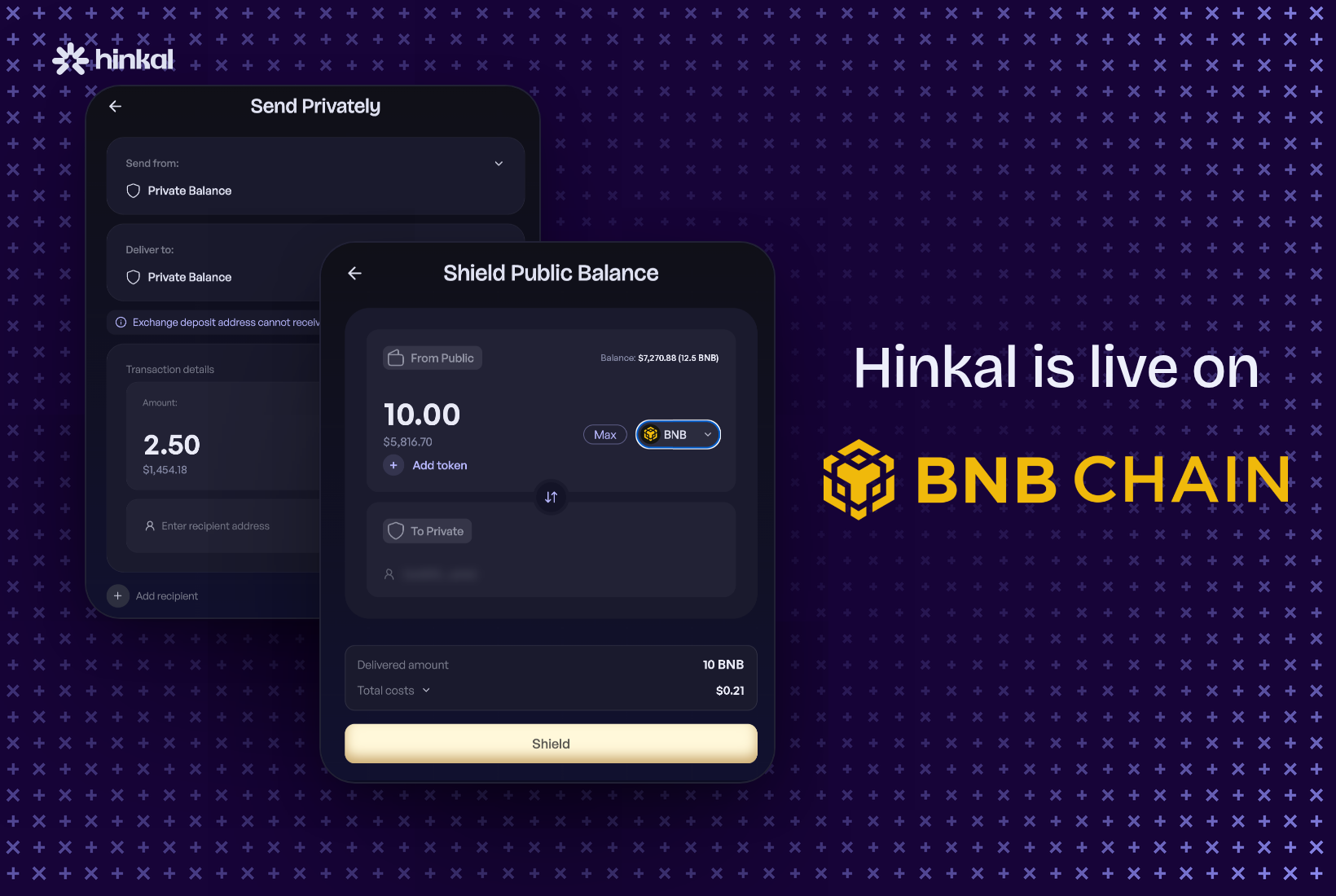
For treasury teams requiring continuous confidential account activity, Hinkal Wallet shields balances and transaction history while enabling swaps and transfers. Hinkal Pay converts any stablecoin transfer into a confidential transaction, obscuring the settlement details onchain while ensuring funds reach the correct destination.
Schedule a demo to explore how Hinkal addresses your treasury confidentiality requirements.
2. Aztec Network
Aztec Network represents the only Ethereum solution specifically designed for private smart contracts. The architecture keeps transaction amounts, counterparties, and timing confidential while maintaining Ethereum security guarantees.
Key Features:
- Hybrid ZK rollup with dual technology ZKPs, where one encrypts transactions and a second compresses for Ethereum
- Noir programming language makes ZK circuit development accessible for enterprise teams
- Aztec Connect previously enabled private DeFi interactions, but it has been sunset. Aztec’s current focus is its newer private smart contract architecture and Noir developer tooling.
- $100M+ funding led by a16z crypto validates institutional interest
A financial institution testing Aztec for corporate treasury management reported the ability to execute on-chain payments and settlements while keeping transaction amounts, counterparties, and timing completely private.
Treasury teams evaluating Aztec should treat it as a developing private smart contract ecosystem rather than an immediately available Aztec Connect-based DeFi privacy layer. Aztec Connect stopped accepting deposits in 2023, and Aztec stopped running its sequencer on March 31, 2024.
The Stellar Development Foundation collaboration introduced NoirLang, lowering barriers for ZKP development within enterprise engineering teams.
3. zkSync Era
ZKsync Era is a general-purpose ZK rollup focused on Ethereum scaling, lower fees, and EVM-compatible application deployment. It should not be treated as a default transaction-confidentiality layer for treasury activity. ZKsync’s enterprise privacy positioning is tied to Prividium, its private, permissioned ZK-rollup offering. Major protocols like SyncSwap and Mute.io process millions in daily volume on zkSync.
Key Features:
- General-purpose ZK rollup with current network metrics that should be checked against live sources such as L2BEAT or DefiLlama before publication
- EVM compatibility via custom zkEVM where you can deploy existing Solidity contracts with minimal modifications
- Native account abstraction enables sophisticated treasury permission systems
- 90% transaction cost reduction vs Ethereum mainnet
After migrating to zkSync Era, DeFi protocols reported transaction costs dropping by over 90% compared to Ethereum mainnet, while maintaining the same security guarantees, according to industry analysis.
The native account abstraction feature allows treasury teams to implement complex permission structures where wallets can sponsor gas fees, batch transactions, and create multi-signature approval workflows at the protocol level.
4. Privacy Pools
Privacy Pools represents a theoretical breakthrough in compliant confidentiality, addressing the regulatory challenge that has impacted enterprise adoption of other privacy solutions. The academic paper introduces a framework where users prove transaction legitimacy without revealing transaction details.
Key Features:
- Co-authored by Vitalik Buterin with academic research validation
- Association Set Provider (ASP) model enables users to prove funds come from clean sources
- Creates "separating equilibrium" where honest users demonstrate compliance while maintaining confidentiality
- Ragequit mechanism allows withdrawal to original address if ASP decisions block normal withdrawal
The ASP model creates what the paper calls a "separating equilibrium": honest users choose association sets excluding illicit deposits, while bad actors cannot plausibly demonstrate clean provenance. This design satisfies regulatory requirements while preserving financial confidentiality.
The conceptually elegant compliance model has attracted attention from regulatory researchers, positioning Privacy Pools as an important reference for how enterprise confidentiality solutions may evolve.
5. Railgun
Railgun provides the third-largest TVL among privacy protocols, specifically designed for confidential DeFi participation. Treasury teams can rebalance portfolios, swap assets, and manage positions without broadcasting strategy to market observers.
Key Features:
- $100.8M TVL across Arbitrum, Binance, Ethereum, and Polygon
- zk-SNARK technology shields wallet balances and transactions within DeFi platforms
- Direct integration with Uniswap and SushiSwap for confidential asset swaps
- Railgun wallet enables confidential transactions without exposing transaction history
Railgun has seen rapid adoption, especially among users concerned with privacy in decentralized exchanges, according to DeFi analysis. The solution processes millions in daily transaction volume through major DEX integrations.
For treasury operations requiring frequent rebalancing or yield optimization, Railgun's Uniswap and SushiSwap integration enables confidential swaps without revealing treasury composition or trading patterns.
6. Zcash (ZEC)
Zcash pioneered zk-SNARK implementation in production cryptocurrency, providing the longest track record for enterprise treasury evaluation. The nearly decade of production use demonstrates cryptographic robustness.
Key Features:
- 9+ years of cryptographic battle-testing since 2016 launch
- Optional "shielded" transactions keep sender, receiver, and amount confidential
- Halo upgrade removed trusted setup requirement, increasing security and scalability
- $346 million market cap reflects sustained institutional interest
A multinational corporation piloted Zcash for confidential payments to suppliers, keeping transaction details private from competitors monitoring public blockchains.
Treasury teams benefit from Zcash's optional confidentiality model where you can choose between transparent and shielded transactions based on operational requirements. The Bitcoin-based architecture provides familiar functionality for teams with existing cryptocurrency treasury experience.
7. Polygon zkEVM
Polygon zkEVM should be discussed with its sunset status in mind. Polygon announced a sunset plan for Polygon zkEVM Mainnet Beta, with the sequencer scheduled to sunset on July 1, 2026. Treasury teams evaluating Polygon should focus on the current Polygon PoS, AggLayer, and Polygon CDK roadmap rather than treating Polygon zkEVM as a long-term active treasury network.
Key Features:
- $1 billion+ commitment to ZKP technology development
- Zero code modifications required where you can deploy existing Solidity contracts directly
- Polygon CDK enables custom ZK-powered chain deployment for enterprise requirements
- AggLayer stitches liquidity and finality across Polygon network
Transaction costs dropped from $2-3 on Ethereum mainnet to under $0.05 on Polygon zkEVM, making high-frequency treasury operations economically viable.
The Polygon CDK and AggLayer roadmap may still be relevant for enterprises exploring custom chains and cross-chain liquidity, but Polygon zkEVM itself should not be framed as the long-term treasury foundation without noting the announced zkEVM Mainnet Beta sunset.
8. Secret Network (SCRT)
Secret Network provides an alternative technical approach to confidentiality, using TEEs rather than zero-knowledge proofs. This architecture enables private smart contracts where nodes verify transactions without accessing underlying user data.
Key Features:
- Native private smart contracts ("secret contracts") shield inputs, outputs, and contract state
- Trusted Execution Environments (TEEs) verify transactions without reading user data
- DeFi partnerships including Sienna for confidential lending and trading
- Cornell University validation of TEE approach for smart contract confidentiality
Secret Network's focus on encrypted data has gotten more attention from institutions. This is especially true for hedge funds and private investors who want to keep their transaction histories secret from the public.
The Sienna partnership enables confidential lending and borrowing, which is critical for treasury yield operations where position sizes and strategies require protection from market observers.
9. Aleo
Aleo represents the "build new infrastructure" approach to enterprise confidentiality, offering a blockchain designed from inception for programmable privacy. The off-chain execution model keeps computations confidential while maintaining verifiable settlement.
Key Features:
- $200M+ funding from a16z, Polychain, and institutional investors
- Leo programming language purpose-built for zero-knowledge circuit development
- Off-chain execution model where computations run privately, only proofs submitted onchain
- Circle and Paxos exploring compliant stablecoin issuance on the platform
The Circle and Paxos exploration of compliant stablecoin issuance signals potential regulatory-compliant treasury use cases. If successful, enterprises could access confidential USDC or USDP settlement directly on Aleo.
Developers have deployed over 10,000 programs during testnet phases, building ecosystem momentum. The programmable confidentiality extends beyond payments to gaming, machine learning, and identity applications.
10. StarkNet
StarkNet provides the highest-throughput ZK solution, processing thousands of trades per second with minimal latency. The STARK proof system's transparency makes it particularly attractive for enterprise applications where trust assumptions must be minimized.
Key Features:
- $150M+ TVL with 10M+ transactions monthly
- STARK proofs require no trusted setup, minimizing trust assumptions
- Cairo programming language optimized for provable computation
- dYdX validation proves capability for institutional trading
StarkWare’s StarkEx has been used for high-throughput application-specific trading systems, including dYdX’s prior L2 architecture. Starknet is a separate general-purpose network in the StarkWare ecosystem, so StarkEx case studies should be described as StarkWare validation rather than direct Starknet adoption.
Treasury teams evaluating Starknet should distinguish between Starknet’s general-purpose validity rollup and StarkEx’s application-specific scaling deployments. Starknet may be relevant for programmable account logic and ZK-based application development, while privacy and institutional trading workflows may require additional application-layer tooling.
Selecting the Right ZK Privacy Solution for Treasury Operations
Enterprise treasury teams evaluating ZK privacy tools should assess four primary criteria:
Multi-Chain Compatibility
Treasury operations rarely operate on a single blockchain. Solutions like Hinkal work across Ethereum, Solana, Tron, and Polygon without requiring network migration. Single-chain solutions require additional infrastructure for multi-chain treasury needs.
Compliance Architecture
Regulated entities require solutions with built-in compliance controls. Viewing keys enable selective disclosure to auditors and regulators. KYT enforcement blocks sanctioned addresses at the protocol level. Privacy Pools' ASP model represents an academic framework for compliant confidentiality.
Recipient Experience
Enterprise settlements involve external counterparties who may not be ZK-native. Solutions requiring recipient-side setup create adoption friction. Hinkal's zero-setup model allows recipients to access confidential balances using existing wallets without migration or integration.
Proven Scale
Treasury operations require battle-tested infrastructure. Hinkal's $400M+ processed volume, zkSync's $748M TVL, and Zcash's 9-year track record demonstrate production readiness.
Why Hinkal is The Best Alternative for ZK Treasury Management
While each solution offers valuable capabilities, Hinkal delivers the most comprehensive package for enterprise treasury teams requiring immediate deployment across multiple blockchains.
Multi-Chain Operation Without Migration: Hinkal operates natively across Ethereum, Solana, Tron, and Polygon, where treasury teams can execute confidential settlements on the chains they already use. Single-chain solutions require network migration or multiple vendor relationships.
Compliance-Ready Infrastructure: Built-in Chainalysis KYT screening blocks sanctioned addresses automatically, while viewing keys enable selective disclosure to auditors and regulators. This compliance architecture operates at the protocol level, not as an afterthought.
Zero Recipient Friction: Recipients access confidential balances using their existing wallets with no setup required. This eliminates the adoption barrier that prevents enterprise settlement when counterparties must install new infrastructure.
Production-Proven Scale: Over $400M in processed volume demonstrates Hinkal operates at enterprise scale with security validated across thousands of confidential transactions. Treasury teams can deploy confidently without pilot program risk.
SDK Integration: The Confidential Payments SDK enables companies to add confidential settlement to existing products without changing custody arrangements, wallets, or payment rails.
For treasury teams requiring confidential settlement today across multiple chains with regulatory compliance built in, Hinkal provides the only solution combining all critical requirements in a single platform.























































.png)
.png)








.webp)