Enterprise settlement on public blockchains creates an uncomfortable reality: every transaction broadcasts sensitive financial data to competitors, counterparties, and market observers. While three distinct approaches have emerged to address this challenge (Hinkal's multi-chain confidential settlement, Zama's fully homomorphic encryption toolkit, and Canton's permissioned institutional network), they serve fundamentally different enterprise needs. For companies requiring immediate confidential settlement without infrastructure changes, Hinkal delivers production-ready privacy across Ethereum, Solana, Tron, and Polygon while maintaining existing wallet custody and compliance requirements.
[[KEY_TAKEAWAYS]]
Public Blockchain Transparency: The Enterprise Privacy Challenge
Every stablecoin settlement, treasury transfer, and vendor payout on public blockchains creates a permanent, searchable record. This transparency (originally designed to ensure trustless verification) creates significant operational risks for enterprises:
Competitive intelligence exposure:
- Counterparties can map settlement volumes and routing patterns
- Competitors track treasury movements and payment infrastructure
- Market observers reconstruct commercial relationships from on-chain data
Operational vulnerabilities:
- Salary and contractor payment flows reveal headcount and compensation structures
- Partner payout graphs expose affiliate economics and business relationships
- Treasury rebalancing signals strategic intentions to the market
Compliance complexity:
- Regulators may demand disclosure enterprises cannot selectively control
- Audit trails require revealing more information than necessary for verification
- On-chain data can be used against companies in negotiations
For payment service providers settling merchant funds, OTC desks executing bilateral trades, and enterprises running crypto payroll, this exposure creates unacceptable business risk. The question becomes: how do you maintain blockchain settlement benefits while protecting commercially sensitive information?
Three distinct architectural approaches have emerged to solve this problem, each with different tradeoffs for enterprise adoption.
Hinkal's Protocol-Level Confidentiality: Multi-Chain, Non-Custodial, and Compliance-Ready
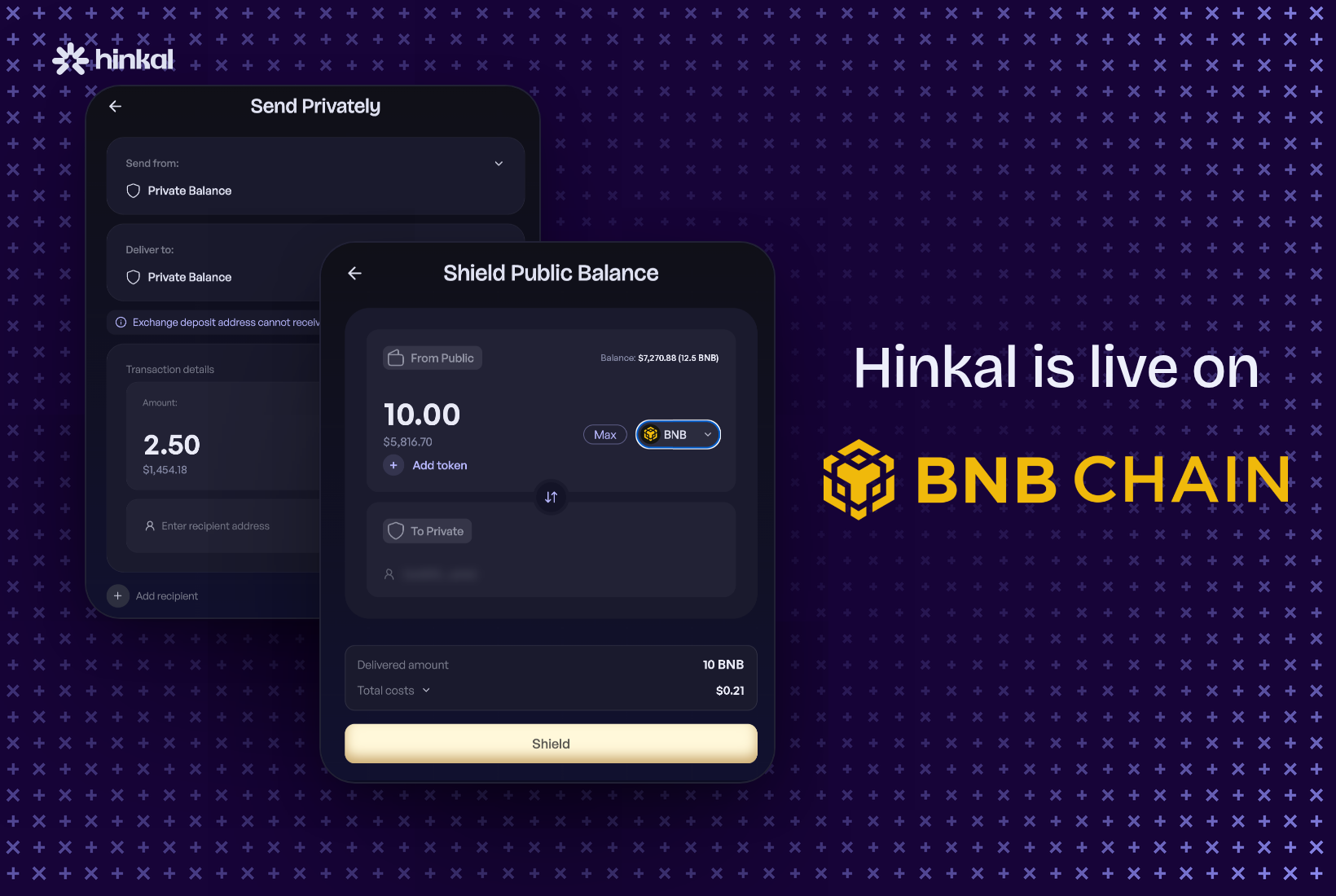
Hinkal operates as an institutional-grade, self-custodial privacy solution that shields sender identity, recipient identity, and transaction amount while maintaining verifiable settlement on public blockchains. Unlike approaches requiring network migration or custom development, Hinkal works across chains enterprises already use (Ethereum, Solana, Tron, and Polygon among them).
What Makes Hinkal Architecturally Private?
Hinkal's design makes collecting, logging, or sharing private wallet addresses, asset balances, or transaction histories technically impossible. The architecture provides:
- Three-dimensional confidentiality: Every settlement shields the sender wallet, recipient wallet, and amount (most alternatives protect only one dimension)
- Non-custodial operation: Users retain control via their private keys; Hinkal never holds or controls assets
- Verifiable settlement: Transactions settle publicly on the blockchain, but the privacy solution obscures commercial relationships and financial details
The Confidential Payments SDK enables enterprises to integrate privacy into existing products without changing custody arrangements, wallets, or payment rails. This means PSPs, OTC desks, and payroll platforms can deploy confidential settlement while maintaining current operational infrastructure.
Multi-Chain Reach: Where Hinkal Operates
Hinkal provides unified confidentiality across multiple chains including Ethereum, Solana, Tron, Polygon, Base, Arbitrum, Optimism, Arc, and Tempo. This multi-chain architecture delivers critical advantages:
- Operate where counterparties already exist: No network migration required
- Single SDK for all chains: Unified API reduces integration complexity
- Chain-native throughput: Settlement inherits the performance characteristics of underlying blockchains
Zero Knowledge Proofs in Action: How Hinkal Ensures Verifiable Privacy
Hinkal employs zero-knowledge proofs to enable verification without revealing underlying data (a fundamental requirement for compliance-ready confidential settlement).
Integrity Check: Balancing Privacy and Regulation
For settlements over $1,000, Hinkal requires an Integrity Check to comply with US/EU AML/CFT regulations and block sanctioned entities. The verification process offers two methods:
ZK-TLS Method (Recommended):
- Uses Reclaim Protocol to generate a zero-knowledge proof on the user's device
- Confirms prior verification on major exchanges like Coinbase or Binance
- Hinkal receives only the final ZK-proof confirming verification status
- No names, IDs, exchange accounts, or personal data ever reach Hinkal
Traditional Verification Method:
- Partners AiPrise or zkMe handle identity documents
- Hinkal receives only a pass/fail status for whitelisting
- Suitable for enterprises preferring standard KYC processes
This two-tier approach allows privacy-conscious users to prove verification without identity disclosure while accommodating traditional compliance workflows.
The Role of ZKP in Confidential Transactions
Zero-knowledge proofs enable Hinkal to verify transaction validity (confirming sufficient balances and proper authorization) without exposing the actual values or participants. This cryptographic approach maintains blockchain integrity while creating confidential settlement capabilities.
Zama's Homomorphic Encryption
Zama takes a fundamentally different approach to blockchain privacy through fully homomorphic encryption (FHE). With over $150M raised and a $1B+ valuation, Zama represents significant investment in FHE technology for blockchain applications.
The Promises and Challenges of Fully Homomorphic Encryption
FHE enables computation on encrypted data without decryption (a powerful capability with specific tradeoffs):
Technical capabilities:
- Smart contracts can process encrypted inputs and produce encrypted outputs
- Data remains protected even during computation
- Lattice-based cryptography provides quantum resistance
Implementation considerations:
- Current throughput of 20 TPS, with roadmap targeting hundreds to thousands TPS
- Zama Protocol went live on mainnet on December 31, 2025, with its first mainnet application, Zama Auction, launching on January 21, 2026, giving it an early production track record compared with more established settlement-focused systems.
- Developers build FHE-aware contracts, requiring specialized cryptographic expertise
- Implementation timeline measured in months
Application Areas for Encrypted Computation
Zama's FHE approach serves use cases requiring computation on encrypted data:
- Blind auctions where bids remain confidential until settlement
- Private lending protocols with encrypted collateral verification
- Privacy-preserving machine learning applications
Canton Network
Canton Network represents a purpose-built distributed ledger technology designed specifically for major financial institutions. Operating as a privacy-enabled public permissioned network, Canton has achieved significant institutional adoption, with over 600 institutions participating across the ecosystem, including major financial institutions and infrastructure providers.
Canton's Focus on Interoperability and Atomic Settlement
Canton's architecture provides:
- Sub-transaction privacy controls: Different parties see different parts of the same transaction (a bank sees cash flows while a registrar sees securities transfers)
- Institutional scale: $9T monthly volume and $6T+ tokenized assets on network
- Regulatory framework: Purpose-built compliance for traditional finance requirements
Canton has achieved 57.5% market share of global digital bond issuance, demonstrating its dominance in institutional tokenized securities.
The Rationale Behind New DLTs for Institutions
Canton's approach requires participants to join its permissioned network. This design choice creates specific characteristics:
Network features:
- Institutional-grade compliance framework from the ground up
- Network effects among participating major financial institutions
- Sub-transaction privacy unavailable on public chains
Operational model:
- Participants join the Canton Network
- Single-network architecture
- Enterprise onboarding process
Seamless Integration: Why No Recipient Setup is Critical for Enterprise Adoption
Hinkal's zero recipient setup represents a fundamental differentiator for enterprise adoption. When PSPs, OTC desks, or payroll platforms initiate confidential settlement, the recipient simply connects their existing wallet and sees the confidential balance. No migration, no new wallet, no integration required on the recipient side.
Bridging Privacy with Existing Workflows
This "one button, frictionless flow" architecture enables:
Payment Service Providers:
- Settle merchant funds confidentially without exposing merchant economics
- Merchants connect existing wallets to access confidential balances
- No merchant-side integration or onboarding required
OTC Desks:
- Execute bilateral trades without exposing volumes or counterparty relationships
- Counterparties receive via their current wallet infrastructure
- Preserve operational security without adding friction
Payroll and HR Platforms:
- Shield salary amounts, pay cycles, and contractor relationships
- Employees receive on their existing wallets
- No recipient-side setup eliminates adoption barriers
Hinkal Pay transforms any transfer into a confidential transaction, allowing enterprises to send stablecoins without exposing balances, counterparties, or wallet history.
Empowering Existing Wallets with Confidentiality
The contrast with alternatives is significant:
- Zama: Recipients interact with FHE-aware architecture
- Canton: Counterparties join the permissioned network
Hinkal's approach means enterprises can offer confidential settlement to their entire counterparty network immediately, regardless of what wallets those counterparties use.
Beyond Anonymity: Compliance-Ready Privacy for Regulated Industries
Hinkal explicitly differentiates from purely anonymous systems through its comprehensive compliance framework. Transactions are confidential, not anonymous (a critical distinction for regulated enterprises).
The Nuance of Confidentiality vs. Anonymity
Confidential settlement protects commercially sensitive information while maintaining the ability to demonstrate compliance when required. This approach provides:
Selective Disclosure via Viewing Keys:
- Reveal full or partial transaction history to auditors, regulators, exchanges, or internal compliance teams on demand
- Maintain confidentiality from competitors while satisfying regulatory requirements
- Enable institutional oversight without compromising day-to-day operational privacy
KYT Enforcement via Chainalysis:
- Block flagged wallets at the deposit stage
- Prevent tainted funds from entering privacy pools
- Proactive compliance approach
Custom Pool Deployments:
- Configurable compliance logic for heavily regulated entities
- Optional master-key visibility for institutional oversight
- Tailored solutions for specific regulatory environments
Building Trust Through Auditable Privacy
This compliance architecture positions Hinkal for institutional adoption where regulatory requirements mandate both privacy and auditability. Canton offers institutional compliance frameworks for its permissioned network, while Zama provides FHE toolkits for developers to implement compliance controls.
The Impact of Private Stablecoin Payments on Enterprise Operations
Stablecoin settlement has become critical infrastructure for enterprise payments, but public blockchain transparency undermines the confidentiality that traditional financial rails provide. Hinkal addresses this gap for specific enterprise verticals.
Protecting Payment Service Providers' Merchant Economics
PSPs settling merchant funds on public chains expose:
- Settlement volumes and routing patterns
- Merchant relationships and counterparty identities
- Operational playbooks and payment infrastructure
The Confidential Payments SDK enables PSPs to route settlements through confidential balances while merchants continue using their existing wallets. Integration partners including MPCVault, Utila, Psalion, Request, omypayments, and Aquanow demonstrate enterprise adoption of this approach.
Confidential Payroll: Safeguarding Employee Data
Companies running crypto payroll expose headcount, pay cycles, salary costs, and contractor relationships on-chain. Hinkal routes salary through confidential settlement so sender and amounts stay private, while employees receive funds on their existing wallet with no recipient-side setup required.
Hinkal Wallet provides continuous confidentiality for treasury operations, shielding balances and transaction history while enabling swaps and transfers across multiple chains.
Evaluating Enterprise Needs: Hinkal, Zama, and Canton in Summary
Each solution serves distinct enterprise requirements based on deployment model, timeline, and use case fit.
Choosing the Right Privacy Solution for Your Business
Choose Hinkal when you need:
- Immediate confidential settlement on public blockchains (deploy in days to weeks)
- Multi-chain operations with unified privacy across Ethereum, Solana, Tron, and Polygon
- Zero recipient friction (counterparties use existing wallets without migration)
- Built-in compliance with Chainalysis KYT and selective disclosure via viewing keys
- Non-custodial settlement maintaining existing custody arrangements
Key Considerations for Enterprise DLT Adoption
For enterprises evaluating confidential settlement options, several factors determine the right choice:
Deployment Timeline:
- Hinkal: Days to weeks
- Zama: Months
- Canton: Varies (enterprise onboarding)
Chain Support:
- Hinkal: Multiple public chains
- Zama: Multi-chain capable
- Canton: Canton Network only
Recipient Onboarding:
- Hinkal: None required
- Zama: Architecture interaction needed
- Canton: Network membership required
Compliance Tools:
- Hinkal: Built-in (Chainalysis, Viewing Keys)
- Zama: Developer-implemented
- Canton: Institutional framework
Production Track Record:
For enterprise decision-makers evaluating stablecoin settlement and payout workflows, Hinkal delivers the fastest path to confidential settlement without requiring infrastructure changes, network migrations, or extended development timelines.
Why Hinkal is The Best Alternative for Zama and Canton
For enterprises evaluating Zama or Canton, Hinkal provides immediate deployment advantages without sacrificing privacy or compliance capabilities.
Compared to Zama:
Hinkal delivers production-ready confidential settlement today, while Zama's FHE technology requires months of specialized development. Hinkal's Confidential Payments SDK integrates with existing infrastructure in days to weeks, processing over $400M in volume across 6 independent security audits. For enterprises needing confidential stablecoin settlement now (rather than building novel encrypted computation applications), Hinkal provides proven infrastructure with built-in compliance via Chainalysis KYT and selective disclosure through Viewing Keys.
Compared to Canton:
Hinkal operates across existing public blockchains (Ethereum, Solana, Tron, Polygon) where enterprises and their counterparties already transact, eliminating network migration requirements. While Canton serves major financial institutions within its permissioned network, Hinkal enables confidential settlement with any counterparty using any wallet on supported chains. Zero recipient setup means merchants, employees, and trading partners access confidential balances by simply connecting their existing wallet. For enterprises requiring multi-chain flexibility and frictionless counterparty onboarding, Hinkal delivers immediate deployment without permissioned network membership.



























































.png)
.png)











.webp)