Enterprise finance teams running settlements on public blockchains face a critical challenge: every transaction exposes sender identity, recipient identity, and settlement amounts to competitors, counterparties, and market observers. Three distinct solutions, Hinkal, Privacy Pools, and Aleo, approach this problem differently. While Privacy Pools focuses on compliance-first withdrawal privacy on Ethereum and Aleo builds a standalone blockchain for programmable privacy, Hinkal delivers institutional-grade confidential settlement across multiple chains without requiring wallet migrations or recipient-side setup. Understanding these fundamental differences helps enterprise decision-makers select the approach that matches their operational requirements.
[[KEY_TAKEAWAYS]]
Understanding the Need for Confidentiality in Enterprise Blockchain
Public blockchains create a paradox for enterprise users. The transparency that makes blockchain valuable for settlement verification simultaneously exposes sensitive business information to anyone with a block explorer.
What gets exposed on public chains:
- Settlement volumes and routing patterns visible to competitors
- Counterparty relationships mapped through wallet analysis
- Treasury positions and rebalancing strategies broadcast publicly
- Payroll cycles, headcounts, and contractor relationships inferrable from transaction timing
- Commercial economics exposed through payment frequency and amounts
For payment service providers settling merchant funds, OTC desks executing bilateral trades, or treasury teams moving capital between entities, this transparency creates competitive disadvantages. A competitor can map your operational playbook simply by watching your on-chain activity.
The challenge intensifies for regulated entities. Compliance officers need the ability to demonstrate transaction legitimacy to auditors and regulators while simultaneously protecting commercial confidentiality from market observers. Most privacy approaches force a choice between these requirements; Hinkal addresses both simultaneously.
Hinkal's Approach: Institutional-Grade Confidential Payments
Hinkal operates as a self-custodial privacy solution that enables confidential transactions across Ethereum, Solana, Tron, Polygon, and other major public blockchains. The technology shields sender identity, recipient identity, and transaction amount while settlement remains publicly verifiable on the underlying blockchain.
Core architecture principles:
- Multi-chain compatibility: Works across chains enterprises already use without requiring network migration
- Non-custodial design: Users retain control via their private keys; Hinkal never holds or controls assets
- Zero recipient-side setup: Senders route funds through Hinkal's smart contract into a confidential balance linked to the recipient's existing wallet
- Solution-level confidentiality: Technology design makes collecting, logging, or sharing private wallet addresses technically impossible
The Confidential Payments SDK enables companies to integrate privacy into existing products without changing custody arrangements or payment rails. Available via npm, the SDK allows developers to build confidential payment flows directly into applications for use cases including:
- Settling funds with counterparties without exposing volumes or relationships
- Moving capital and rebalancing liquidity without broadcasting strategy
- Paying employees and vendors without revealing treasury wallet details
- Executing partner payouts at scale without revealing payout graphs
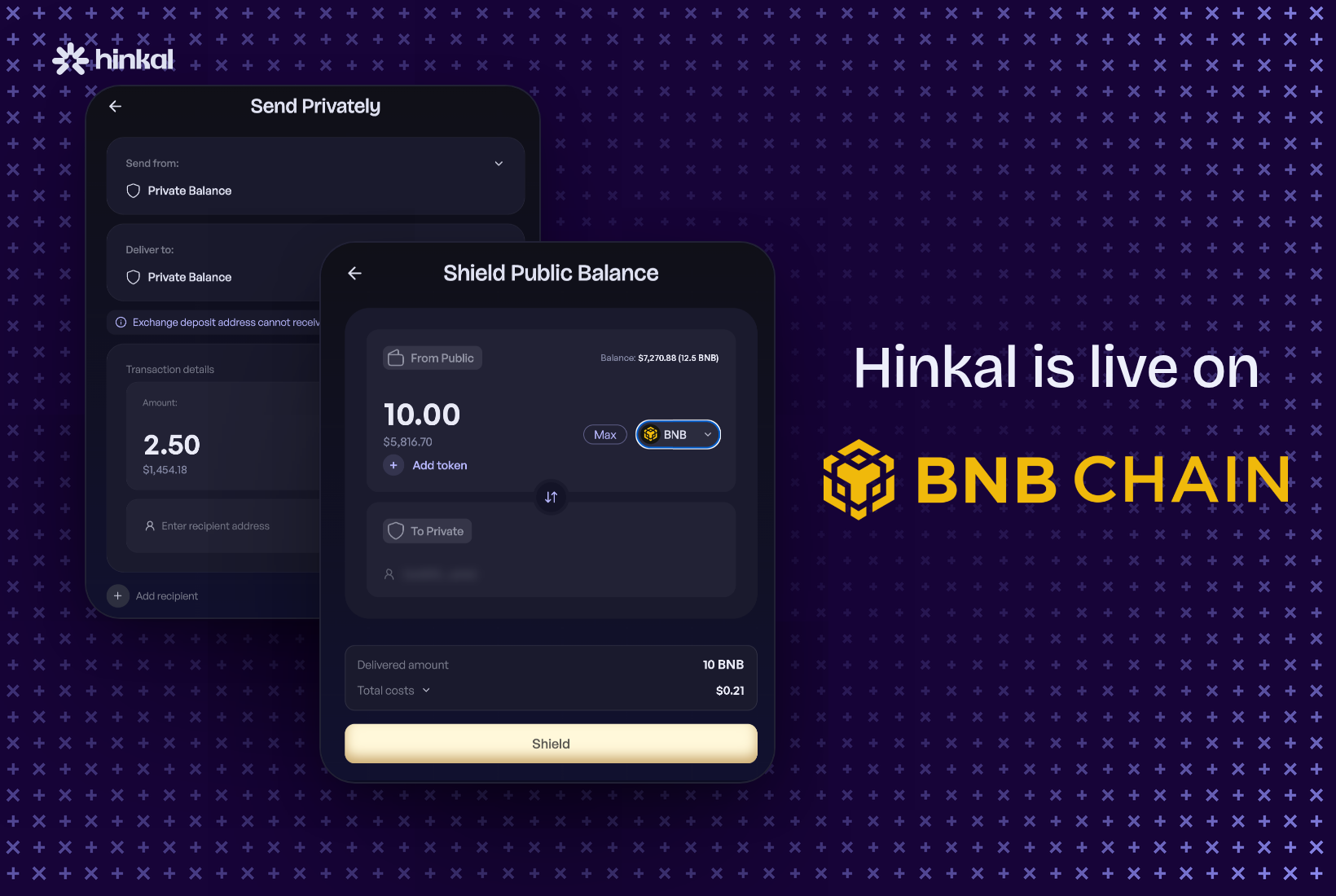
Hinkal Pay transforms any transfer into a confidential transaction, allowing users to send stablecoins without exposing balances, counterparties, or wallet history. The recipient simply connects their existing wallet and sees the confidential balance with no special wallet installation or custody changes required.
The Hinkal Wallet provides continuous privacy for all account activity, shielding balances and transaction history while enabling swaps and transfers through a private account across multiple chains.
Compliance Controls: Selective Disclosure and KYT for Public Blockchains
Hinkal's compliance framework differentiates it from purely confidential systems by combining privacy with auditability.
Three compliance controls built into Hinkal:
- Selective Disclosure via Viewing Keys: Reveal full or partial transaction history to auditors, regulators, exchanges, or internal compliance teams on demand
- KYT Enforcement via Chainalysis: Blocks flagged wallets at the deposit level, preventing tainted funds from entering privacy pools
- Custom Pool Deployments: Heavily regulated entities can deploy dedicated pools with configurable compliance logic and optional master-key visibility
For transactions over $1,000, Hinkal's Integrity Check uses zero-knowledge proofs via Reclaim Protocol. Users prove verification status through zkTLS verification; Hinkal receives only a cryptographic proof confirming verification, never seeing names, IDs, or personal documents. This approach satisfies US/EU AML/CFT requirements while preserving privacy.
The compliance architecture positions Hinkal for institutional adoption where regulatory requirements mandate both privacy and auditability, a combination that purely confidential systems cannot provide.
Privacy Pools
Privacy Pools, backed by a paper co-authored by Vitalik Buterin, takes an Association Set Provider (ASP) approach to privacy. Users deposit funds into pools and later withdraw with zero-knowledge proofs demonstrating their funds come from approved sources.
How Privacy Pools operates:
- Users deposit ETH or ERC-20 tokens into shared pools on Ethereum
- Association Set Providers maintain inclusion/exclusion lists based on compliance criteria
- Withdrawals include ZK proofs showing membership in "clean" association sets
- A "ragequit" mechanism allows users to withdraw to their original address publicly if ASP decisions block normal withdrawal
The ASP model creates what the academic paper calls a "separating equilibrium": honest users choose sets excluding illicit deposits, while bad actors cannot plausibly demonstrate clean provenance.
Privacy Pools launched with approximately 21 ETH across 69 deposits. The conceptually elegant compliance model has attracted attention from regulatory researchers.
The solution operates exclusively on Ethereum.
Aleo
Aleo represents a fundamentally different approach: building an entirely new blockchain where privacy is the default state rather than an added feature. The platform uses zero-knowledge cryptography to enable private computation and has raised over $200M from investors including a16z and Polychain.
Aleo's technical foundation:
- Leo programming language: Purpose-built language for writing zero-knowledge circuits, making privacy development accessible to developers
- Off-chain execution: Users or provers run computations privately, with only proofs submitted on-chain
- AleoBFT consensus: Provides instant finality rather than Ethereum's ~12 minute confirmation time
- Records model: Assets exist as private "records" that can be converted between private and public states
The platform enables programmable privacy beyond simple transfers; developers can build private gaming applications, machine learning models, and identity systems. Over 10,000 Leo programs were deployed during testnet phases.
Aleo offers view keys for selective disclosure, allowing users to reveal transaction details to authorized parties. Circle and Paxos have announced plans to explore compliant stablecoin issuance on the platform.
Comparing Core Privacy Mechanisms: Solution vs. Standalone Blockchain vs. Pool-Based
The three solutions represent distinct architectural philosophies that determine their practical applicability for enterprise use cases.
Hinkal's approach:
- Operates as a solution across existing public chains enterprises already use
- Integrates with existing DeFi protocols; users can privately swap on Uniswap, stake on Lido, or interact with Curve
- No migration required; works with current wallets and custody arrangements
- Shared privacy pools via "EigenLayer for Privacy" model bootstrap liquidity across chains
Privacy Pools' approach:
- Provides withdrawal privacy through shared deposit pools
- Focuses specifically on compliance-forward fund provenance
- Operates on Ethereum mainnet only
- Privacy applies to deposits and withdrawals
Aleo's approach:
- Offers foundational privacy at the consensus level
- Developers build new applications in Leo language
- Private applications on Aleo have composability considerations; private records from one program have specific interaction patterns with others
- Operates as a standalone blockchain ecosystem
For enterprises needing privacy for existing stablecoin settlement workflows, treasury operations, or payment processing, Hinkal's approach provides immediate utility. Privacy Pools offers a research-backed compliance model within Ethereum's environment. Aleo provides a dedicated privacy blockchain with programmable capabilities.
Institutional Adoption: Compliance, Integration, and Existing Wallet Compatibility
Series A+ enterprises evaluating privacy solutions prioritize different factors than individual users. Integration complexity, compliance posture, and operational continuity matter more than theoretical privacy guarantees.
Hinkal's institutional advantages:
- Zero setup for recipients: The counterparty connects their existing wallet and accesses the confidential balance
- No custody changes: Enterprises maintain existing wallet and custody arrangements
- Built-in compliance: Chainalysis KYT integration screens deposits automatically; viewing keys enable selective disclosure
- Proven at scale: $400M+ private volume processed with 6 independent security audits
- Cross-chain via Axelar: Cross-chain access tokens enable privacy across supported chains without re-verification
Privacy Pools' characteristics:
- ASP-based compliance model interacts with external providers
- Ragequit mechanism ensures funds access regardless of ASP decisions
- Operates on Ethereum mainnet
- Early-stage adoption
Aleo's characteristics:
- New blockchain with privacy-first architecture
- View key system enables compliance capabilities
- Ecosystem continues development
- Validator staking requires 1M ALEO minimum for institutional participation
The "one button, frictionless flow" that Hinkal enables across verticals (PSPs settling with merchants, companies paying employees, OTC desks settling with counterparties) addresses the adoption friction that constrains purely technical solutions.
Why Hinkal is The Best Alternative for Privacy Pools and Aleo
For enterprises seeking on-chain privacy, Hinkal delivers distinct advantages over both Privacy Pools and Aleo through its combination of multi-chain support, compliance-ready architecture, and zero-friction recipient experience.
Multi-chain operational flexibility: While Privacy Pools operates exclusively on Ethereum and Aleo requires building on an entirely new blockchain, Hinkal works across Ethereum, Solana, Tron, Polygon, and other major chains. Enterprises maintain existing infrastructure and custody arrangements without migration overhead or network-specific rebuild requirements.
Immediate deployment capability: Hinkal integrates into existing workflows through the Confidential Payments SDK and Hinkal Pay, enabling privacy for current operations within days rather than months. This contrasts with rebuilding applications in Leo for Aleo or implementing ASP relationships for Privacy Pools.
Recipient-side zero setup: Hinkal's architecture allows senders to route funds to any wallet address confidentially; recipients access balances using their existing wallets with no special software, registration, or coordination. This eliminates the bilateral adoption barrier that exists with other privacy approaches.
Proven compliance integration: With $400M+ in processed volume, built-in Chainalysis KYT screening, and selective disclosure via viewing keys, Hinkal demonstrates regulatory readiness at scale. Enterprises gain both commercial confidentiality and audit capability without choosing between them.
DeFi composability: Hinkal enables confidential interactions with existing protocols like Uniswap, Curve, and Lido across multiple chains. Users access the full DeFi ecosystem privately rather than operating within a single-chain environment or building new applications from scratch.
For treasury operations, merchant settlements, contractor payments, and bilateral OTC trades, Hinkal provides institutional-grade privacy that integrates with existing workflows rather than requiring operational reconstruction.
Request a demo to see how Hinkal enables confidential settlement for your enterprise workflows.
























































.png)
.png)










.webp)