Every OTC settlement you execute on public blockchains broadcasts your volumes, counterparties, and strategy to anyone watching. With $52.9 trillion in stablecoin settlements last year, this transparency has become a competitive intelligence crisis for desks that need discretion. Crypto OTC desks now have equivalent solutions through confidential settlement technology.
[[KEY_TAKEAWAYS]]
The protocols below were evaluated based on OTC-specific features, multi-chain support, compliance integration, institutional adoption metrics, and recipient friction. Private transaction routing now accounts for approximately 35% to 45% of daily Ethereum transactions, demonstrating mainstream demand for confidential on-chain activity.
Why Crypto OTC Desks Need Confidentiality in DeFi
Public blockchain transparency creates four distinct risks for OTC trading operations:
- Trade volume exposure: Counterparties and competitors can monitor your settlement patterns, inferring deal sizes and frequency
- Wallet pattern analysis: Persistent addresses reveal treasury structure, capital deployment, and operational rhythms
- Counterparty relationship mapping: On-chain observers can identify your trading partners and reconstruct your network
- Strategy signaling: Large movements broadcast intent before execution completes, enabling front-running and copycat trading
The problem compounds when OTC desks settle with institutional counterparties who also require discretion. Both sides of the settlement become visible, creating mutual exposure that neither party wants.
OTC desks operating across multiple chains need confidential settlement solutions that work wherever their counterparties hold assets.
Core Privacy Requirements for OTC Desks
Effective confidential settlement must shield three specific data points, and every protocol should be evaluated against all three:
- Sender identity: The originating wallet address and its transaction history
- Recipient identity: The destination address and its connection to known entities
- Transaction amount: The precise value being settled
Solutions that shield only one dimension provide incomplete protection. Hiding the sender but not the amount still exposes enough data for observers to map volumes and infer relationships. OTC desks require protocols that address all three simultaneously while maintaining verifiable settlement on the underlying blockchain.
The distinction matters for compliance as well. Confidential settlement means the transaction details remain private while settlement remains publicly verifiable. This differs fundamentally from approaches that attempt to make funds untraceable or obscure the fact that settlement occurred.
1) Hinkal – Multi-Chain Confidential Settlement with Zero Recipient Friction
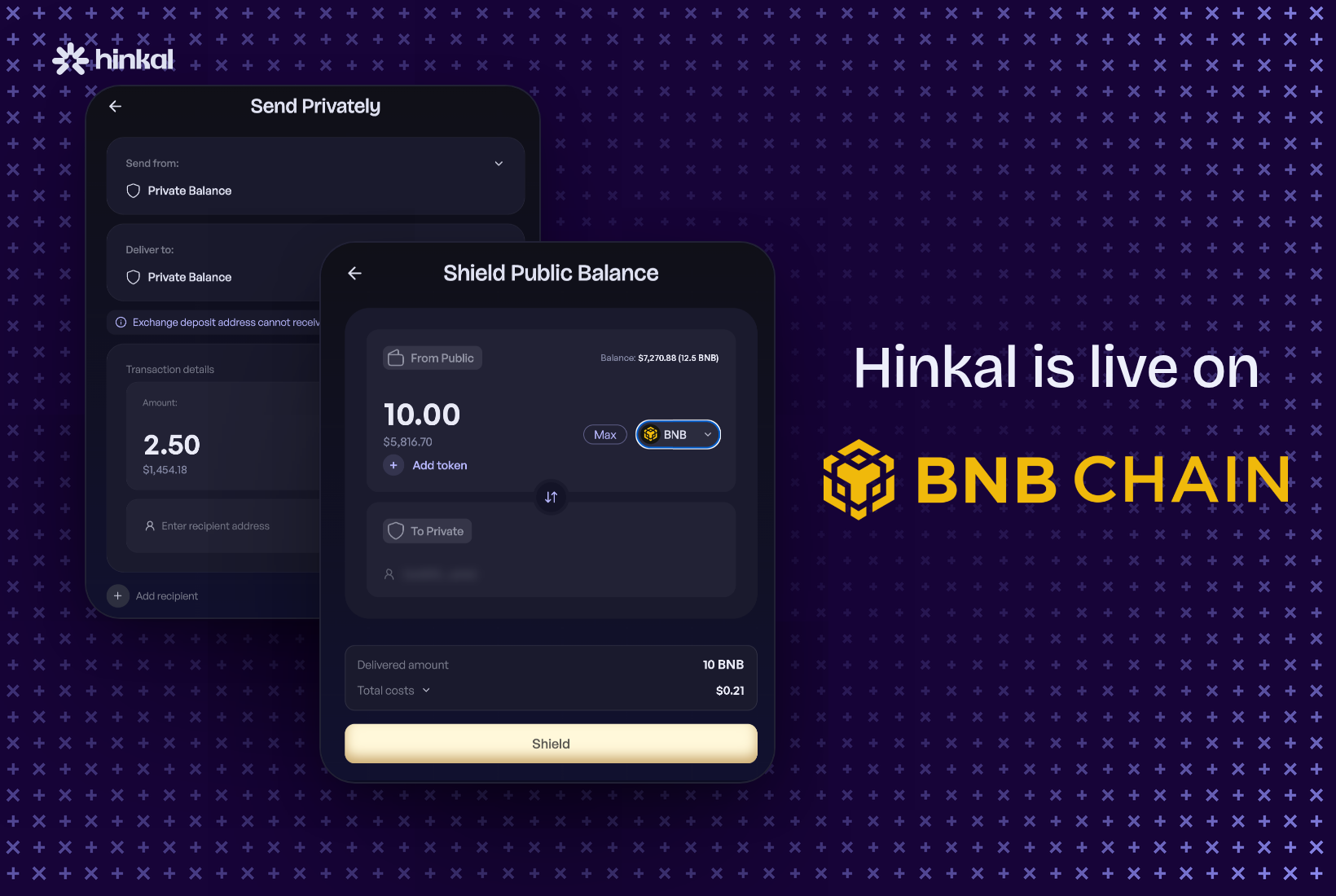
Hinkal provides institutional-grade, self-custodial confidential settlement across Ethereum, Solana, Tron, Polygon, Base, Arbitrum, Optimism, and other major chains. Hinkal has processed over $400 million in confidential on-chain volume with six independent security audits.
Best For: OTC desks needing immediate confidential settlement capability without counterparty integration requirements
Status: Production-ready across multiple chains
Key OTC Feature: Zero-setup recipient experience. Counterparties connect their existing wallet and access their confidential balance without migration or new wallet creation
Hinkal's primary differentiator for OTC operations is eliminating recipient-side friction. When you settle funds through Hinkal, they route to a confidential balance linked to the recipient's existing wallet address. The counterparty simply connects their wallet to see and manage the balance. No Hinkal account, no specialized address format, no integration required on their end.
Compliance Features:
- Chainalysis KYT integration blocks flagged wallets at the deposit stage
- Selective disclosure via viewing keys enables revealing full or partial transaction history to auditors, regulators, or compliance teams
- Integrity Check for settlements over $1,000 uses zero-knowledge proofs via Reclaim Protocol
- Custom pool deployments available for heavily regulated entities with configurable compliance logic
OTC Desk Applications:
- Settle bilateral trades without exposing volume or counterparty relationships
- Execute treasury movements across entities without broadcasting capital allocation strategy
- Pay partners and vendors at scale without revealing payout structures
The Confidential Payments SDK enables direct integration into existing systems without changing custody arrangements or payment rails. For one-off confidential settlements, Hinkal Pay converts any transfer into a confidential transaction accessible through a standard interface.
Why It Made the List: Hinkal addresses the specific requirements OTC desks face: multi-chain support for diverse counterparty preferences, compliance controls that satisfy institutional requirements, and the critical zero-recipient-setup feature that removes adoption barriers when settling with new trading partners.
2. Aztec Network
Aztec Network launched its Ignition Chain in November 2025 as a privacy-focused Ethereum L2 with programmable confidentiality. Aztec’s OTC reference design uses Partial Notes to support private bilateral trades, but the network is still in Alpha and should be evaluated carefully before live OTC settlement use, especially given Aztec’s disclosed March 2026 critical vulnerability and user-funds warning.
Key Features:
- Programmable privacy: Noir programming language for confidential smart contract execution
- Protocol-level privacy: Neither party in an OTC trade knows the counterparty's identity
- Open-source OTC implementation: Reference code available for custom trading venues
- Non-custodial atomic swaps: Complete counterparty confidentiality with verifiable settlement
- Ethereum L2 architecture: Requires bridging assets from other networks
OTC Desk Applications:
- Build custom private trading venues with programmable settlement logic
- Execute complex multi-leg trades where intermediate steps remain confidential
- Develop confidential RFQ systems where quotes and executions stay private
Aztec's approach enables private smart contract execution where inputs, outputs, and contract state remain encrypted. The network uses zero-knowledge proofs to verify computation without revealing transaction details.
Why It Made the List: Aztec provides programmable privacy for OTC desks building specialized confidential trading systems. The open-source reference code offers a starting point for custom implementation.
3. Railgun
Railgun brings privacy to DeFi trading operations through shielded pools on Ethereum, Arbitrum, Polygon, and BSC. Operating since 2021, Railgun enables private interactions with major decentralized exchanges and lending protocols.
Key Features:
- Groth16 zk-SNARKs: Shielded pool operations for confidential balances
- DEX integration: Private swaps through Uniswap, Aave, and Curve protocols
- Railway DEX aggregator: Shielded balances within trading interface
- Private Proofs of Innocence: Compliance demonstration without KYC requirements
- MEV protection: Strategy protection from front-running and copycat trading
OTC Desk Applications:
- Execute hedging strategies without broadcasting positions to competitors
- Access DeFi liquidity privately for inventory management
- Protect algorithmic trading approaches from reverse-engineering
Railgun uses specialized 0zk addresses for receiving private transfers. This address format enables shielded operations while maintaining compatibility with major DeFi protocols.
Why It Made the List: Railgun serves OTC desks needing privacy extending beyond bilateral settlement into active DeFi trading, addressing strategy protection from MEV extraction.
4. Secret Network
Secret Network represents one of the longest-operating confidential blockchain environments, with its mainnet live since 2020. The platform uses Trusted Execution Environments (TEE) with Intel SGX to enable confidential computation.
Key Features:
- 5+ years mainnet operation: Security track record since 2020
- TEE-based architecture: Intel SGX for confidential smart contract execution
- Cosmos IBC integration: Native interoperability within the Cosmos ecosystem
- SecretSwap DEX: Privacy-first automated market maker for confidential trading
- Secret NFTs: Private ownership and metadata for asset representation
OTC Desk Applications:
- Manage treasury positions without exposing holdings to market observers
- Provide liquidity on SecretSwap without revealing LP positions
- Execute recurring treasury operations with persistent privacy
Secret Network operates as a dedicated blockchain where all smart contract data, inputs, outputs, and state, remains encrypted by default. The platform launched in 2020 and maintains an established DeFi ecosystem.
Why It Made the List: Secret Network provides a complete privacy-first environment for OTC desks operating within a dedicated ecosystem with encrypted smart contract capabilities.
5. Oasis Network
Oasis Network focuses on enterprise-grade confidential computing, enabling privacy-preserving smart contracts designed for business data protection. The network targets institutional users with regulatory requirements around data handling.
Key Features:
- Hardware-based secure enclaves: Encrypted data processing beyond transit or storage
- Confidential smart contracts: Hardware-backed security guarantees for execution
- Tokenized data economy: Data monetization without exposure
- Scalable architecture: Separated consensus and execution design
- Enterprise focus: Institutional data privacy standards and compliance
OTC Desk Applications:
- Process client portfolio data without exposing holdings
- Run proprietary trading algorithms with computational privacy
- Handle sensitive business data for institutional counterparties
Oasis uses Trusted Execution Environments at the hardware level to enable computation on encrypted data. This approach addresses use cases where the processing logic itself must remain confidential.
Why It Made the List: Oasis serves OTC desks whose institutional clients mandate specific data protection standards beyond transaction-level privacy.
6. Privacy Pools
Privacy Pools began as an academic framework for compliant privacy and now has a live Ethereum mainnet implementation through 0xbow. The system uses zero-knowledge proofs and Association Set Providers to let users transact privately while demonstrating that their funds are not linked to illicit sources. The concept was co-authored by Vitalik Buterin and continues to influence how production privacy systems approach compliance.
Key Features:
- Association sets: Define "clean" fund groups for proof of innocence
- Zero-knowledge proofs: Demonstrate fund origins without revealing transaction details
- Dynamic risk management: Real-time association set updates
- Flexible compliance standards: Jurisdiction-specific requirement adaptation
- Status: Live on Ethereum mainnet through 0xbow’s Privacy Pools implementation, with early usage limits and compliance-oriented Association Set screening
OTC Desk Applications:
- Understand emerging compliance standards for confidential settlement
- Evaluate production solutions based on alignment with Privacy Pools principles
- Plan for regulatory environments that may mandate compliant privacy approaches
Privacy Pools addresses institutional concerns about how on-chain privacy can exist without enabling illicit flows. Production solutions like Hinkal implement similar approaches through viewing keys and KYT enforcement.
Why It Made the List: Privacy Pools represents the direction institutional confidential settlement is taking, with production implementations already demonstrating operational capability.
7. Inco Network
Inco Network develops confidential computing using Fully Homomorphic Encryption (FHE), enabling computation on encrypted data without decryption. Inco announced a $5 million strategic round led by a16z CSX, with participation from Coinbase Ventures and follow-on support from 1kx Capital, OrangeDAO, South Park Commons, and Script Capital. The round brought Inco’s total funding to $10 million.
Key Features:
- FHE technology: True encrypted computation without intermediate decryption
- fhEVM capabilities: Building confidential applications on encrypted virtual machine
- Circle partnership: Confidential ERC-20 framework development
- Novel applications: Games with hidden randomness, prediction markets with confidential positions
- Testnet stage: Not production-ready for live settlement operations
OTC Desk Applications (Future):
- Encrypted order books where bid/ask sizes remain confidential
- Confidential execution algorithms that operate on encrypted inputs
- Private settlement with computational privacy guarantees
Inco's FHE approach enables operations on encrypted data without intermediate decryption. This creates use cases impossible with other privacy technologies, including confidential order books and encrypted execution algorithms.
Why It Made the List: Inco represents where confidential settlement technology is heading, with institutional interest in FHE approaches signaled by Circle's stablecoin partnership.
How to Evaluate Privacy Protocols for Your OTC Operations
Selecting the right confidential settlement approach requires matching protocol capabilities to your specific operational requirements. Consider these factors:
Chain Coverage
Where do your counterparties hold assets? Multi-chain support eliminates bridging friction and enables settlement on networks where liquidity already exists. Solutions operating across Ethereum, Solana, Tron, and Polygon address the broadest range of institutional counterparty preferences.
Recipient Experience
Will your counterparties adopt new wallet software or address formats? Zero-setup recipient experiences reduce onboarding friction and enable confidential settlement with new trading partners immediately. Protocols requiring specialized addresses or dedicated wallets create adoption considerations.
Compliance Integration
Does your operation require audit trails, selective disclosure, or KYT enforcement? Compliance-ready architecture with viewing keys and Chainalysis integration enables confidential settlement within regulatory frameworks. Purely anonymous systems may create compliance considerations.
Production Readiness
Is the protocol live with demonstrated volume and security audits? Testnet solutions may offer innovative technology but cannot serve current settlement needs. Evaluate track record, audit history, and institutional adoption metrics.
Integration Requirements
How much development effort is required? SDK-based integration enables adding confidential settlement to existing systems. Dedicated network solutions require more significant architectural changes.
Why Hinkal is The Best Solution for OTC Desks
OTC desks face a unique challenge: achieving confidential settlement without creating friction for counterparties. While several privacy protocols exist, most require both parties to adopt new infrastructure, specialized wallets, or dedicated networks.
Hinkal solves this through zero-recipient-setup architecture. When you settle through Hinkal, funds route to a confidential balance linked to the recipient's existing wallet address. They simply connect their standard wallet to access the balance. No new account, no specialized address format, no integration required.
This removes the primary barrier preventing institutional privacy adoption. You can settle confidentially with any counterparty, whether they've used privacy protocols before or not. The recipient experience matches standard wallet interactions, making confidential settlement as frictionless as transparent transactions.
Beyond recipient experience, Hinkal operates across Ethereum, Solana, Tron, Polygon, and other major chains where counterparties already hold assets. This eliminates bridging requirements and enables settlement on whatever network your trading partner prefers.
Compliance architecture matters for institutional operations. Hinkal's integration with Chainalysis KYT blocks flagged wallets at deposit, while viewing keys enable selective disclosure to auditors and regulators. This compliance-ready design allows confidential settlement within regulatory frameworks rather than attempting to circumvent oversight.
With over $400 million in confidential volume processed and six independent security audits, Hinkal provides production-ready infrastructure for OTC desks requiring immediate confidential settlement capability without counterparty adoption barriers.

























































.png)
.png)










.webp)