What a Hinkal Deposit Address Is, and Why You'd Use One
When someone pays you in crypto, they pay a wallet address. That address is public, and so is everything attached to it: every payment that ever came in, every payment that went out, and the balance sitting in it right now. Anyone who has the address can look all of that up on a block explorer, a free website that reads the blockchain.
Often that's harmless. Sometimes it isn't. A client doesn't need to see your savings, and a supplier doesn't need to see what your other customers pay you.
A Hinkal deposit address is a way to be paid without handing that over. It looks like an ordinary wallet address to whoever is paying you, and the money that arrives ends up in your private balance.
Public balance, Private balance
Inside Hinkal Pay you have two balances.
Your public balance is your normal wallet. It works the way wallets always have, and anybody can look it up.
Your private balance sits inside Hinkal's smart contract. The blockchain shows that the contract holds money, but not how much of it is yours or who you are. Moving funds from the public side into the private one is called shielding. Moving them back out is unshielding.
Why receiving was the hard part
To put money into a private balance, something has to talk to Hinkal's smart contract. When the money is already yours, that something is you, inside the app, in a couple of taps.
When the money comes from someone else, that breaks down. A client paying an invoice isn't going to connect their wallet to a privacy protocol as a favour to you. An exchange can't do it at all, because its withdrawal form has one box and it takes a wallet address, not an instruction to a contract.
So the usual routine was to receive into a normal wallet and shield the funds afterwards. Two transactions, two fees, and a public wallet left holding the record of both.
What a deposit address is
It's a wallet address that Hinkal generates for you and links to your private balance. On the blockchain it looks like any other address, which is exactly the point. Anything that can send to an address can send to this one: a friend's wallet, an exchange withdrawal, a payment provider's payout system, a company treasury.
The difference is what happens after the money lands. Hinkal checks the incoming payment, and if it passes, moves it into your private balance for you. You don't sign anything extra, and the sender never has to know any of it happened.
What the person paying you sees
An address, and nothing else. No Hinkal account to create, no wallet to connect, nothing to install, and no sight of the wallet you use to sign into Hinkal.
The payment into your deposit address is a normal blockchain transaction, so it can be seen like any other, and so can the move from that address into Hinkal's contract. What can't be seen is where the money ends up: whose private balance it became, how much of that balance belongs to you, or what you do with it next. The deposit address is the line between the public part and the private part.
Where people use it
Getting Paid for Work
You can put the address on the invoice and the client pays it like any other address. Nothing about their process changes, which is usually where privacy tools fall over: the moment you have to talk a counterparty into using one. Freelancers, contractors, agencies, and anyone invoicing in stablecoins all land in the same place.
Taking Money Off an Exchange
Say you hold funds on Coinbase, Kraken, or Binance and want them in your private balance. The old way was to withdraw to your own public wallet and shield from there, which is two transactions, two fees, and a wallet that now holds both halves of the story. Now you paste your deposit address into the withdrawal form and withdraw once. To the exchange it's a normal withdrawal, because it is one.
Payouts from Platforms and Providers
Any payout box that takes a wallet address takes this one: a payment processor settling a merchant, a marketplace paying out earnings, a platform running contractor payments in batches. Whoever is paying you doesn't add anything to their systems.
Business and Treasury Payments
A finance team can give the address to a counterparty, or use it to bring funds in from another part of the group, without handing out the wallet it settles from. The counterparty gets somewhere to pay. They don't get a view of the treasury behind it.
Every payment gets checked before it reaches you
Before anything enters your private balance, Hinkal screens the incoming deposit with Chainalysis KYT. That's the same risk check exchanges and payment companies run on money arriving: it looks at where the funds came from, against sanctions lists and addresses tied to theft or fraud.
If the payment passes, it's shielded automatically and shows up in your private balance.
If it comes back high risk, it stops at the deposit address and stays there as public balance. It never enters your private balance, and you can return it to the sender or move it to another wallet.
The order helps you in a practical way. When a tainted payment lands in a wallet you use, it sits next to your own money, and that's when the trouble starts: an exchange may refuse the deposit, a counterparty may ask where it came from, and clean funds in the same wallet become harder to spend because of what arrived beside them. Checking at the door keeps unknown money out of your balance until it has cleared.
You can swap your address out
You can generate a new deposit address whenever you want, and the one you already handed out keeps working. Nothing expires and nothing gets cut off, so an invoice you sent last week still gets paid while new payers use the new address. Some people take a fresh address for every payer, so each counterparty has its own. Every address you've generated stays usable, and they all lead to the same private balance.
A new address per payer is mostly about keeping things apart. Each client, exchange, or platform pays into its own address, so no single one ends up collecting everything you get paid. It's the same instinct as not using one email address for every sign-up.
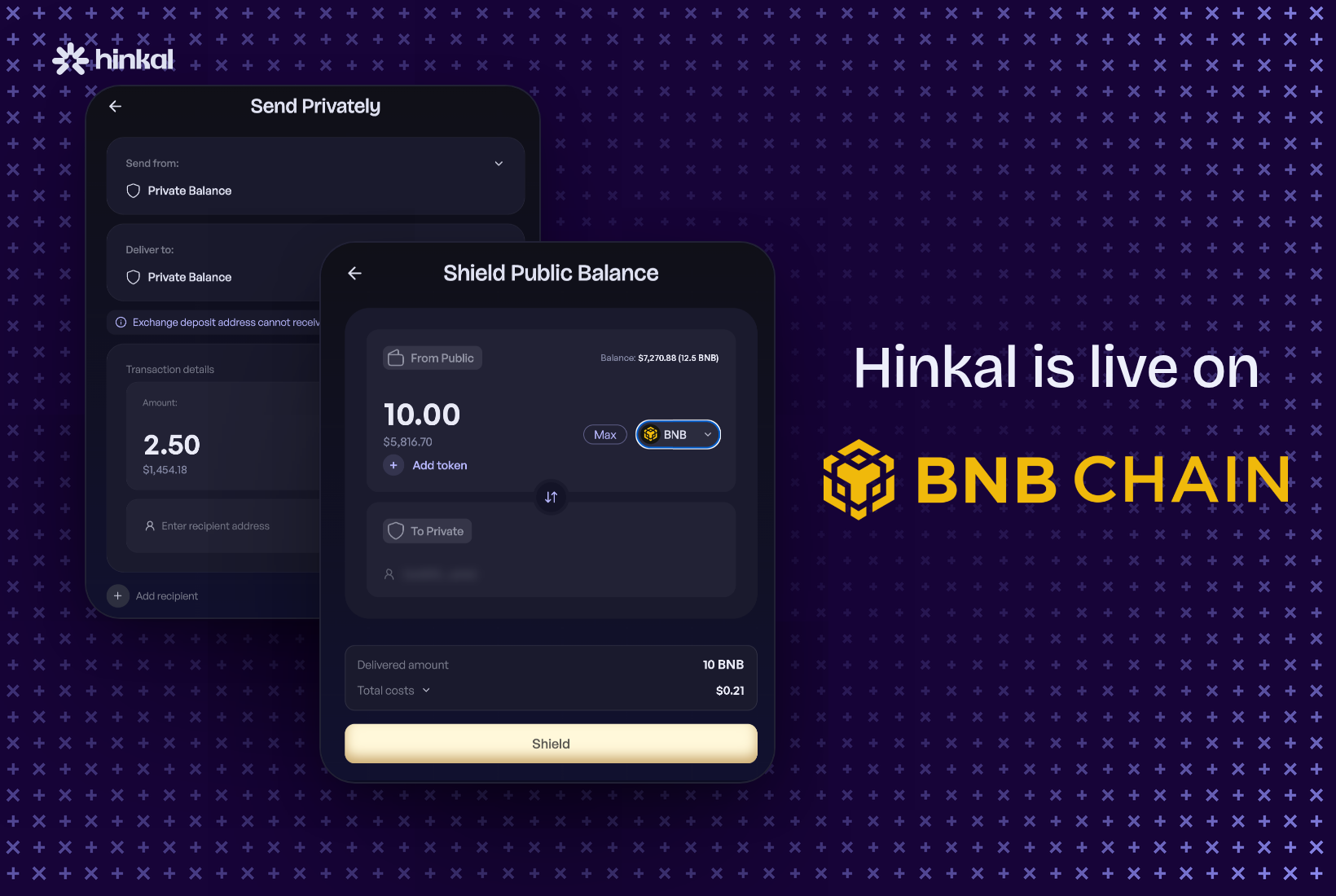
Hinkal Deposit Addresses are now available on Ethereum, Solana, TRON, Arbitrum, BNB Chain, Tempo, Polygon, Arc, and Base.
A regular transfer for the sender, a private balance for you.
Read the docs to learn more on how Hinkal Deposit Addresses work.
Frequently Asked Questions
What is a Hinkal deposit address?
It's a wallet address that Hinkal creates for you and links to your private balance. Anyone can pay it like a normal address, and payments that pass Hinkal's check are moved into your private balance automatically.
Does the sender need Hinkal?
No. They make a normal transfer from the wallet, exchange, or payment provider they already use. There's no account to create, no wallet to connect, and nothing for them to install.
Can I withdraw from an exchange straight into my private balance?
Yes, as long as the asset and network are supported. Use the deposit address as the withdrawal destination and withdraw as usual. The funds are checked when they arrive and shielded from there, so you skip the public wallet in the middle and the second transaction that came with it.
What happens if a payment doesn't pass the check?
It stays at the deposit address as public balance and never enters your private balance. The money is still yours, and you can send it back to whoever sent it or move it to another wallet.
Is this a mixer?
No. A mixer takes in whatever it's given and pools it together. Hinkal screens every incoming payment with Chainalysis KYT before it can enter a private balance, and funds that come back high risk are kept out.

























































.png)
.png)






.webp)