Treasury & Payments Are Moving On-Chain. Visa is settling stablecoin volume at a $7B annualized run rate across nine chains. Meta is paying creators in USDC on Polygon and Solana through Stripe. Japan shipped JPYC, the first FSA-licensed yen-backed stablecoin. The Government of Georgia signed with Tether for a lari-pegged national stablecoin this week.
Stablecoins are settlement infrastructure for institutional finance, and the institutions that move the largest flows are already arriving.
Privacy is the gap
Bessemer's April 2026 stablecoin roadmap names privacy among five gaps between this market shift and the next wave of institutional adoption. Two companies are named as what closes it. Hinkal is one of them.
The gap is the one institutions already operate around on every traditional rail. Companies do not publish vendor lists or what they pay. Banks do not expose client flow. Treasuries do not telegraph positions. Privacy is a gating condition for institutional adoption, and the baseline expectation for every individual on-chain.
The question is no longer whether on-chain payments need privacy. The question is which privacy you trust enough to put your money, your treasury, or your users through.
The Teams Operating At Institutional Scale Already Picked
Polygon uses Hinkal to power privacy inside the official Polygon Wallet for confidential USDC and USDT transfers. MPCVault, the institutional MPC wallet platform processing roughly $10B in weekly volume, uses Hinkal to power privacy for its institutional users. Borderless is integrating Hinkal as the confidential settlement infrastructure across its 94+ country stablecoin orchestration network. TokenFlight by Khalani is integrating Hinkal as the privacy infrastructure on its embedded execution widget for wallets, exchanges, payment apps, and treasury tools.
See How Hinkal Fits Your Use Case
The same Hinkal is now open on Ethereum Sepolia Testnet. Same cryptography, same compliance behavior, same user experience as mainnet. The assets are test assets. Nothing in the loop costs a real dollar.
Try Hinkal before you use it personally, adopt it for treasury and operational flow, or integrate it as the privacy infrastructure inside your own product.
Step 1. Claim test USDC, EURC, and cirBTC
- Open faucet.circle.com
- Select Sepolia in the network dropdown.
- Paste your wallet address.
You can claim 20 test USDC, 20 test EURC, and 0.0001 test cirBTC in one session. One claim per wallet every two hours.
Step 2. Claim Sepolia ETH
The wallet needs at least 0.001 ETH on Ethereum mainnet to qualify - an anti-abuse check that any real wallet will clear.
Step 3. Connect at Hinkal Pay
- Open pay.hinkal.io
- Connect the same wallet you entered to receive test assets.
- Switch its active network to Ethereum Sepolia.
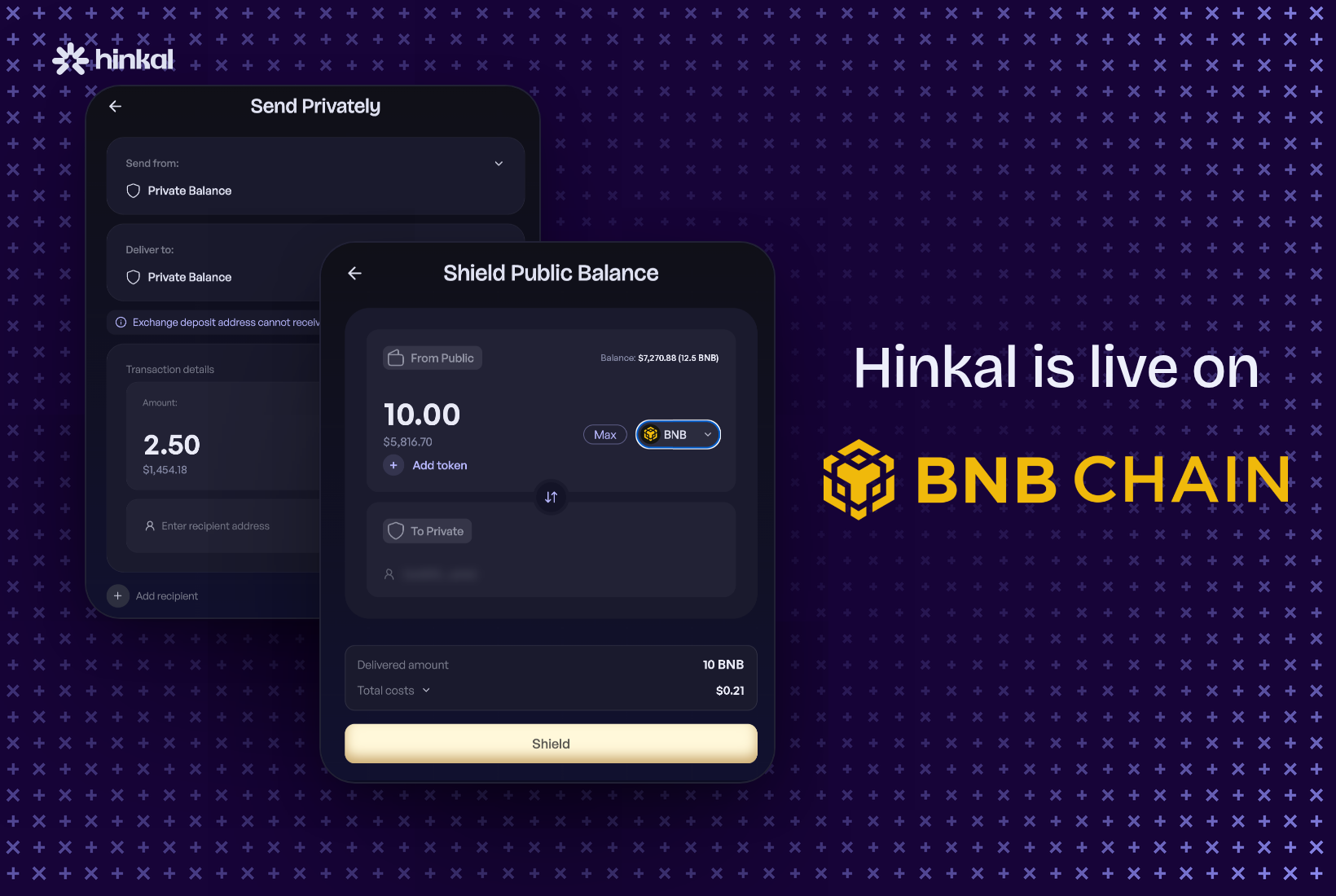
Step 4. Send private stablecoin transfers Send to one recipient, or to multiple recipients in a single transfer.
Pick the settlement type:
- Confidential settlement. The recipient receives the amount on their confidential balance, accessible via the same wallet the sender entered as the recipient. They connect that wallet at Hinkal Pay and the funds are there. No new wallet, no separate setup.
- Direct to wallet. The amount lands directly in the recipient's wallet, no confidential balance step.
The next wave of stablecoin payments is private
The teams building it already picked.
Hinkal is now open for anyone to try→ pay.hinkal.io
Trusted by teams building on public chains



























































.png)
.png)










.webp)