Market makers operating on public blockchains face a fundamental problem: every position, counterparty relationship, and settlement pattern sits exposed on-chain where competitors and MEV bots extract value within milliseconds. For institutional trading desks processing significant daily volume, this transparency creates strategic disadvantages that traditional finance never tolerated. The solution lies in confidential settlement technology that shields sender identity, recipient identity, and transaction amount while maintaining verifiable on-chain execution.
[[KEY_TAKEAWAYS]]
Market makers need confidential settlement technology that protects all three dimensions of transaction privacy without sacrificing regulatory compliance or operational efficiency. The Confidential Payments SDK enables enterprises to integrate privacy into existing products without changing custody arrangements, wallets, or payment rails: a critical requirement for institutional trading operations.
Why Market Makers Require Confidential Settlement
Public blockchains expose everything. When a market maker executes a large settlement, competitors immediately see:
- Wallet addresses revealing counterparty relationships
- Transaction amounts exposing position sizes and strategies
- Timing patterns signaling trading algorithms and rebalancing schedules
This transparency creates measurable costs. For market makers, the damage extends beyond direct extraction: counterparties can map treasury operations, competitors can front-run large orders, and auditors can access information without proper authorization.
The shift reflects institutional requirements. A Coinbase and EY-Parthenon survey found that meaningful institutional participation hinges on three pillars: privacy to safeguard information and strategies, embedded compliance to meet regulatory standards, and composability.
11 Privacy Solutions for Crypto Market Makers
1. Hinkal: Compliance-Ready Privacy for Institutional Market Makers
Best For: Regulated market makers requiring audit trails, selective disclosure, and multi-chain confidential settlement
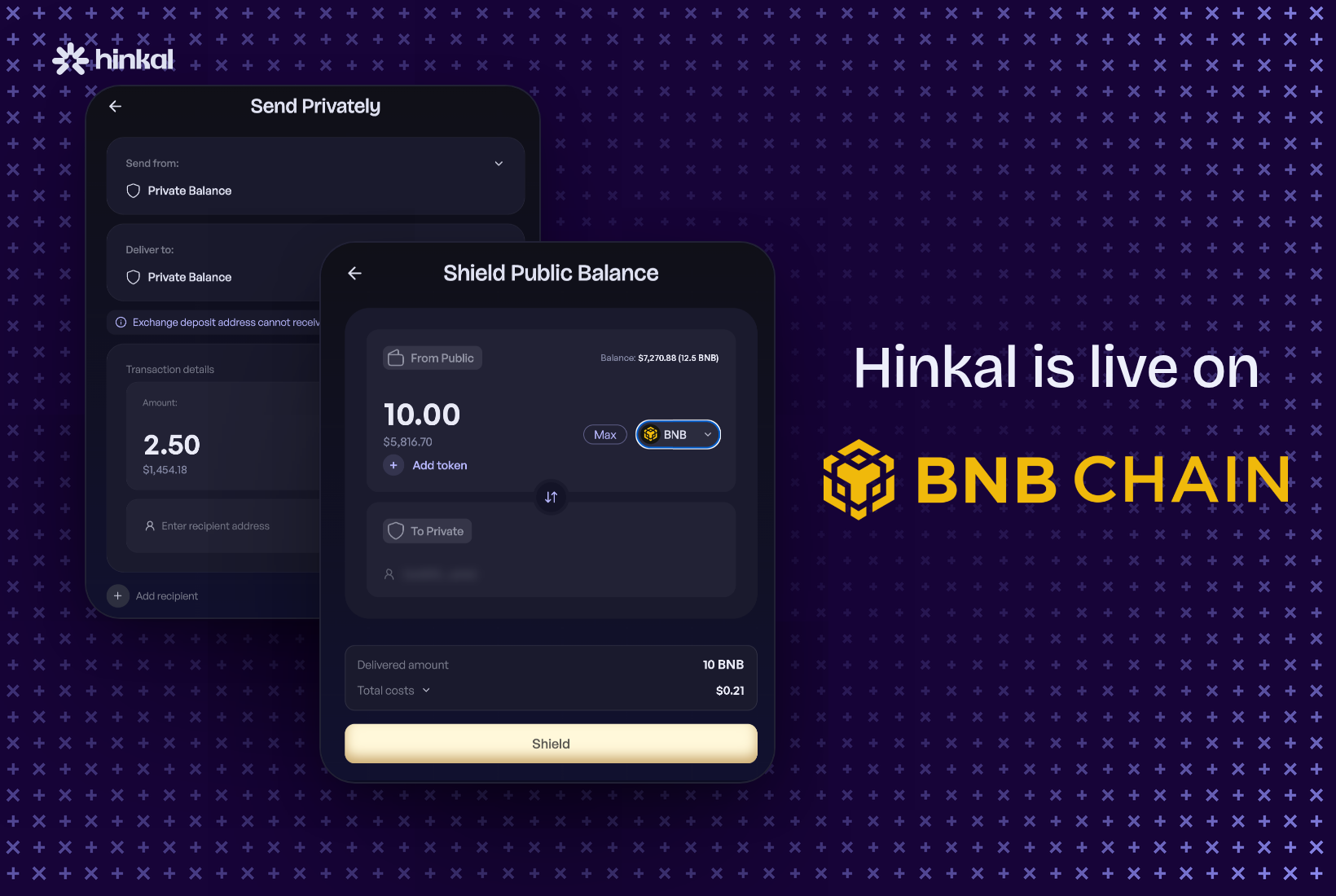
Hinkal provides institutional-grade confidential settlement technology that protects sender identity, recipient identity, and transaction amount across Ethereum, Solana, Tron, and Polygon. The platform has processed over $400M in private on-chain volume with 6 independent security audits, demonstrating production-scale reliability for institutional operations.
Key Features:
- Three-dimensional privacy protection: Complete confidentiality of sender, recipient, and amount without compromising verifiable execution
- Multi-chain operation: Unified privacy across Ethereum, Solana, Tron, and Polygon without wallet migration
- Selective disclosure compliance: Viewing keys enable full or partial transaction history revelation to auditors on demand
- KYT enforcement: Integrated Chainalysis blocking of flagged wallets at deposit level
- Zero recipient setup: Recipients connect existing wallets to access confidential balances without integration requirements
- Hinkal Wallet: Private wallet solution maintaining confidentiality across all on-chain operations
- Hinkal Pay: Confidential payment routing through smart contracts that obscure commercial relationships
The Confidential Payments SDK enables seamless integration into existing enterprise products without changing custody arrangements or payment infrastructure. For institutional use cases, compliance-ready privacy tools represent the critical differentiator between workable solutions and regulatory risk.
2. Fhenix
Fhenix provides a Fully Homomorphic Encryption (FHE) coprocessor that enables encrypted smart contract computation without decryption. The technology allows computation on encrypted data, meaning swap amounts and positions remain confidential even during execution.
Key Features:
- Single-line Solidity integration: Minimal code changes required for implementation
- Non-interactive encryption: No coordination required between parties
- Cryptographic guarantees: No trusted hardware dependencies
- $22 million funding: CoFHE is live on Ethereum mainnet and Arbitrum, with additional testnet deployments such as Arbitrum Sepolia
- Strategic investment from BIPROGY: Targeting Japanese privacy-focused fintech markets
FHE computation can require more processing resources than some zero-knowledge approaches, but Fhenix has moved beyond testnet-only deployment with CoFHE live on Ethereum mainnet and Arbitrum.
3. Aztec Network
Aztec operates as a privacy-native L2 solution where all transactions remain confidential by default. The platform launched Ignition Chain mainnet in November 2025 with 500+ validators.
Key Features:
- $100 million raised: Led by a16z crypto
- Noir programming language: Zero-knowledge circuit development framework
- Confidential state: Both transaction details and contract state remain private
- Previous traction: 17M TVL and 100,000+ wallets in prior iteration
The platform requires Noir language adoption and operates on a separate L2, creating liquidity fragmentation from Ethereum mainnet.
4. Railgun
Railgun addresses compliance requirements through Private Proofs of Innocence and shareable viewing keys. Users can cryptographically prove funds aren't from sanctioned addresses without revealing transaction history.
Key Features:
- Monthly volume exceeding $200M: Sustained 2025 volume
- Multi-chain operation: Ethereum, BSC, Polygon, and Arbitrum support
- Selective disclosure: Auditor-specific transaction history revelation
- Protocol integration: Works with existing DeFi protocols without modifications
5. Secret Network
Secret Network represents one of the longest-operating confidential blockchain environments, with its mainnet live since 2020. The platform uses Trusted Execution Environments (TEE) with Intel SGX to enable confidential computation.
Key Features:
- 5+ years mainnet operation: Security track record since 2020
- TEE-based architecture: Intel SGX for confidential smart contract execution
- Cosmos IBC integration: Native interoperability within the Cosmos ecosystem
- CosmWasm environment: Cosmos-specific smart contract framework
The platform operates on Cosmos rather than Ethereum, requiring CosmWasm development instead of EVM compatibility.
6. Flashbots Protect
Flashbots Protect offers rapid integration through RPC endpoint modification. Transactions route through a private mempool instead of the public one.
Key Features:
- Minutes to deploy: RPC endpoint change only
- Frontrunning protection: Sandwich attack mitigation
- No gas for failures: Failed transactions don't cost gas
- Zero contract modifications: Works with existing smart contracts
Flashbots protects transaction submission only, not persistent state privacy. Balances and positions remain visible on-chain after execution.
7. zkSync Era
zkSync Era processes 27 million transactions monthly with 90% cost reduction compared to Ethereum mainnet. The platform provides scalability today with zero-knowledge foundations enabling future privacy features.
Key Features:
- Native account abstraction: Gas sponsorship and batched transactions
- EVM compatibility: Minimal contract modifications required
- Major DeFi protocols: SyncSwap processing millions in daily volume
- Boojum upgrade: GPU-friendly proof generation
- Fast confirmations with Ethereum finality: ZKsync transactions can appear quickly as unconfirmed, while full finality on Ethereum can take a few hours.
8. StarkNet
StarkWare’s STARK-based stack has demonstrated high-throughput exchange infrastructure through products such as StarkEx, which powered dYdX v3’s Layer 2 perpetuals. StarkNet is StarkWare’s general-purpose permissionless Layer 2, using the Cairo language and STARK proofs for scalable applications.
Key Features:
- $150 million TVL: 10 million+ monthly transactions
- No trusted setup: STARKs vs SNARKs architecture
- 90% gas reduction: High-frequency operation optimization
- Cairo language: Zero-knowledge computation framework
Cairo represents a learning curve compared to Solidity, and privacy features remain on the roadmap rather than current production capabilities.
9. Polygon zkEVM
Polygon has committed $1 billion+ to ZK technology, signaling long-term institutional confidence. The existing Polygon ecosystem provides immediate access to established trading venues.
Key Features:
- Solidity compatibility: Deploy existing contracts with minimal changes
- AggLayer: Interconnected ZK rollup liquidity
- Low transaction costs: Under $0.05 compared to mainnet
- CDK framework: Custom ZK-powered chain deployment
10. Zama
Zama provides open-source FHE libraries for custom privacy implementations rather than turnkey solutions. The modular approach enables existing DeFi protocols to integrate end-to-end privacy features.
Key Features:
- Maximum flexibility: Bespoke confidentiality requirements
- Multi-chain compatibility: Ethereum, Solana, and other major chains
- Diverse applications: Confidential token swaps, lending, and stablecoin payments
- Open-source: Community auditing enabled
Zama requires significant engineering resources and cryptography expertise for implementation.
11. Oasis Network
Oasis uses confidential computing with secure enclaves for privacy-preserving smart contracts. The platform separates consensus (public) from execution (confidential).
Key Features:
- Enterprise focus: Healthcare, finance, and sensitive data applications
- Secure enclaves: Data encryption during processing
- Separated architecture: Public consensus with confidential execution
Why Hinkal is The Best Alternative for Institutional Market Makers
While each privacy solution offers specific technical approaches, institutional market makers face unique requirements that demand comprehensive confidential settlement technology. Hinkal addresses the three critical dimensions that alternative solutions handle incompletely:
Complete Three-Dimensional Privacy
Most alternatives protect only one privacy dimension. Flashbots shields transaction submission but leaves balances exposed. zkSync and StarkNet provide scalability infrastructure with future privacy potential rather than production confidentiality. Secret Network and Aztec require migrating to separate chains, fragmenting liquidity and operational complexity.
Hinkal protects sender identity, recipient identity, and transaction amount simultaneously without requiring wallet migration or custody changes. Market makers maintain existing operational infrastructure while gaining complete confidentiality across Ethereum, Solana, Tron, and Polygon.
Production-Scale Institutional Compliance
Railgun offers compliance features, but Hinkal combines selective disclosure with integrated KYT enforcement and configurable compliance logic for regulated entities. The platform provides:
- Shareable viewing keys for auditor access without compromising ongoing confidentiality
- Chainalysis integration blocking sanctioned addresses at deposit level
- Custom pool deployments with entity-specific compliance requirements
- Zero-knowledge verification proving regulatory status without exposing identity documents
Alternative solutions either prioritize pure anonymity (creating regulatory risk) or require complex custom development for compliance integration.
Zero Recipient Integration Requirements
Fhenix, Aztec, and Secret Network require counterparties to adopt new programming languages, deploy to specific chains, or modify existing contracts. This creates adoption friction for market makers whose counterparties operate on existing infrastructure.
Hinkal requires zero setup for recipients. Market makers route settlements through confidential smart contracts, and recipients connect existing wallets to access funds. No migration, no new custody arrangements, no integration requirements on the recipient side.
Multi-Chain Unified Operations
Operating confidential settlements across Ethereum, Solana, Tron, and Polygon through a single solution eliminates the operational complexity of deploying separate privacy infrastructure for each chain. Alternative solutions typically focus on single-chain ecosystems (Secret on Cosmos, Aztec as standalone L2) or require separate implementations per chain.
For institutional trading desks processing significant daily volume across multiple venues, unified multi-chain privacy with compliance readiness and zero counterparty friction represents the practical path to confidential settlement at scale.
























































.png)
.png)



.webp)