Enterprise teams moving stablecoins on public blockchains face a fundamental tension: every settlement, payout, and treasury operation broadcasts sensitive financial data to competitors, counterparties, and market observers. The challenge is protecting commercial relationships and transaction details while satisfying regulatory requirements for auditability. Solutions like Hinkal address this by shielding sender identity, recipient identity, and transaction amount without sacrificing verifiable settlement or compliance controls.
This guide examines the leading privacy protocols that enable confidential crypto payments for enterprises, focusing on solutions that balance operational discretion with regulatory readiness.
[[KEY_TAKEAWAYS]]
1) Hinkal: Confidential Settlements with Built-In Compliance
Hinkal stands apart as the leading compliance-ready confidential settlement solution for enterprises. Unlike solutions that force trade-offs between privacy and regulatory alignment, Hinkal delivers both through a purpose-built architecture that shields sender identity, recipient identity, and transaction amount while settlement remains publicly verifiable.
Key Differentiators:
- Three-dimensional privacy: Shields sender, recipient, and amount
- Zero recipient-side setup: Recipients connect their existing wallet and see their confidential balance immediately
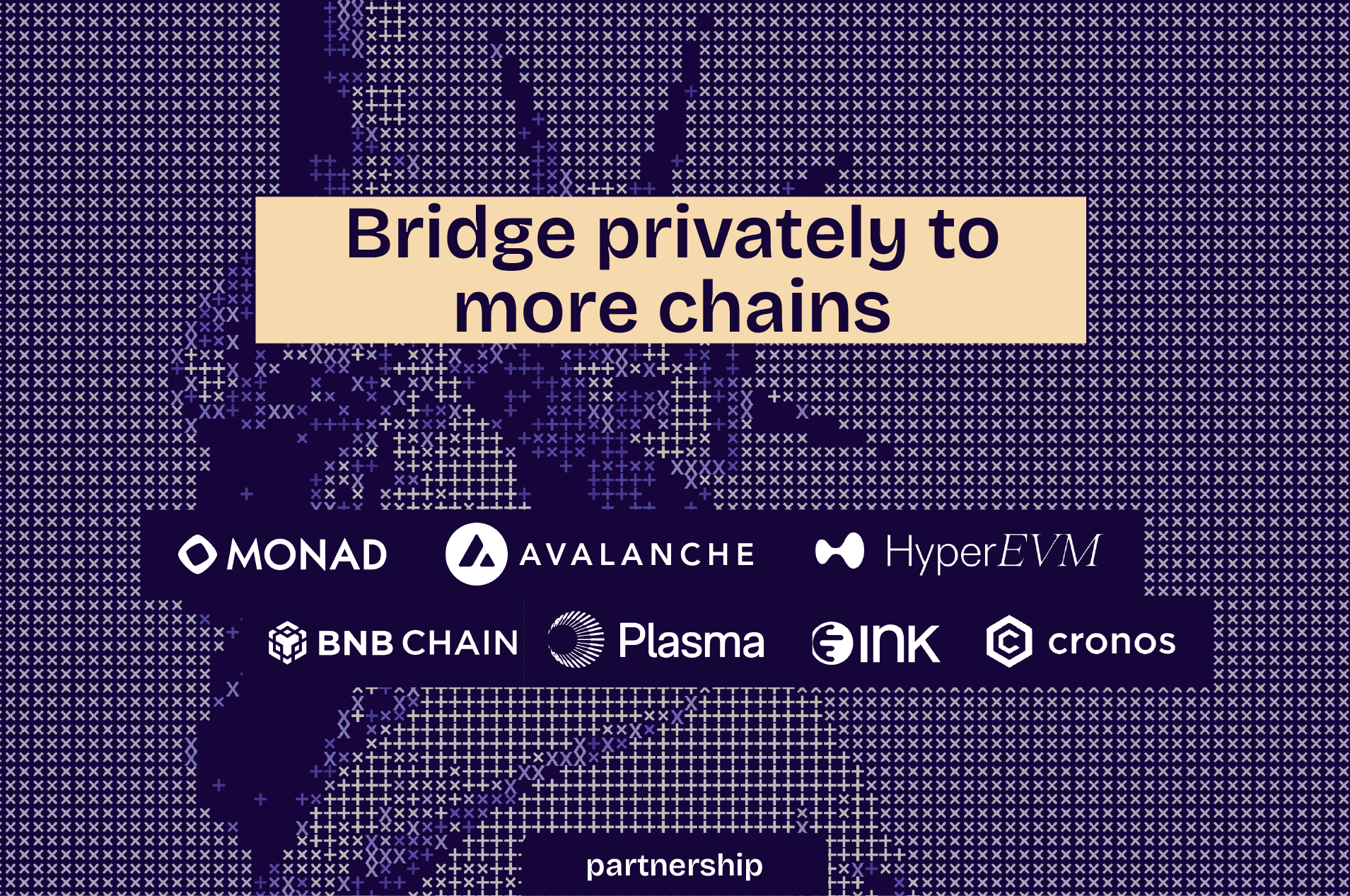
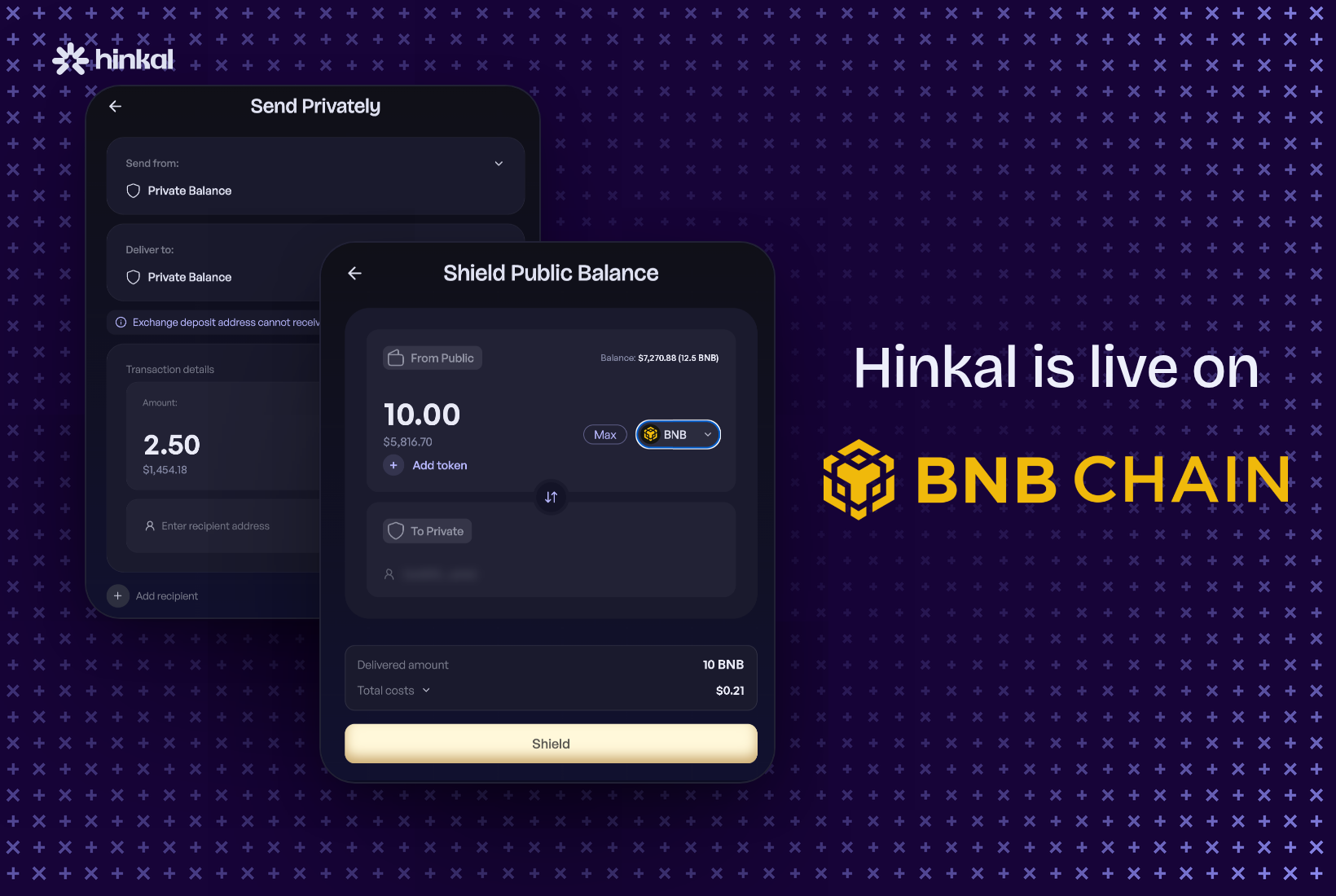
- Multi-chain deployment: Operates across Ethereum, Solana, Tron, Polygon, Base, Arbitrum, Optimism, Arc, and Tempo
- Non-custodial architecture: Enterprises maintain existing custody arrangements
Hinkal has processed over $400M in private volume with six independent security audits. Integration partners include MPCVault, Utila, Psalion, Request, omypayments, and Aquanow.
Compliance Architecture:
Hinkal's compliance framework includes:
- Selective disclosure via Viewing Keys: Reveal full or partial transaction history to auditors, regulators, or internal compliance teams on demand
- KYT enforcement via Chainalysis: Blocks flagged wallets at the deposit technology, preventing tainted funds from entering
- Custom pool deployments: Heavily regulated entities can deploy dedicated pools with configurable compliance logic
- Integrity Check: Transactions over $1,000 use zero-knowledge proofs via Reclaim Protocol, proving verification status without revealing identity data
For enterprise integration, the Confidential Payments SDK enables companies to build confidential settlement flows directly into existing products. Hinkal Pay transforms any stablecoin transfer into a confidential transaction without exposing balances or wallet history.
2. Zero-Knowledge Proofs (zk-SNARKs & zk-STARKs)
Zero-knowledge proofs represent the cryptographic foundation enabling privacy and compliance to coexist. These mathematical constructs allow one party to prove a statement is true without revealing the underlying data, critical for enterprises that need to demonstrate regulatory compliance without exposing commercial details.
Key Features:
- Mathematical privacy guarantees: Users can prove transaction criteria without exposing transaction details
- Two primary implementations: zk-SNARKs generate compact proofs quickly (used by Zcash), while zk-STARKs require no trusted setup
- Enterprise adoption examples: Deutsche Bank partnership with Nethermind demonstrates institutional confidence
- Regulatory alignment: ZK proofs and selective disclosure can help privacy-preserving identity and compliance workflows align with data-minimization and auditability goals, but MiCA and UK eIDAS should not be described as explicitly approving zk-proof identity verification.
- Selective disclosure capability: Enables compliance verification while maintaining privacy
3. Zcash with Selective Disclosure
Zcash demonstrates that strong cryptographic privacy can coexist with institutional compliance requirements. Its optional privacy model and viewing key functionality have made it a regulatory-acceptable asset among privacy-focused cryptocurrencies.
Key Features:
- Optional privacy model: Users choose between transparent (t-addresses) and shielded (z-addresses) transactions
- Viewing key functionality: Enables selective disclosure to auditors and regulators without compromising ongoing privacy
- zk-SNARK technology: Mathematical privacy proofs verified on-chain
- 20-25% supply: The shielded pool contains significant adoption of privacy features
- Exchange compatibility: Flexibility has helped Zcash maintain listings on more exchanges than fully private alternatives
Zcash's optional model allows enterprises to use transparent transactions for routine operations while shielding sensitive settlements.
4. Confidential Transactions Systems
Confidential Transactions (CT) technology shields transaction amounts while maintaining full verifiability on shared ledgers. Originally conceptualized by Adam Back in 2013, production implementations now serve enterprise financial infrastructure including wholesale CBDC pilots.
Key Features:
- Pedersen commitments: Enable zero-knowledge amount proofs
- Oracle implementation: Production-ready on Hyperledger Fabric with role-based access
- GLBA compliance: Meets US financial privacy requirements
- Wholesale CBDC support: Enables interbank settlements with full privacy
- Verifiable amounts: Inputs equal outputs can be verified without revealing actual values
Enterprise applications include interbank settlements, treasury operations, and vendor payments that require amount confidentiality.
5. Blockchain Analytics Solutions (Chainalysis, Elliptic, TRM Labs)
Blockchain analytics platforms enable institutions to work with privacy-preserving technologies while maintaining compliance. Rather than blocking all privacy features, these solutions provide risk-based controls that allow compliant use of confidential transactions.
Key Features:
- Transaction monitoring: Track exposure to privacy-enhanced assets
- Wallet screening: Integrated with AML workflows
- Behavioral risk assessment: Evaluate risk based on transaction patterns rather than identity alone
- Industry standard: Chainalysis serves nine of ten top exchanges
- Court-trusted intelligence: Elliptic provides monitoring for multiple privacy-enhanced solutions
These platforms enable a middle path between blocking all privacy features and ignoring compliance requirements. Enterprises can implement confidential settlements while demonstrating regulatory due diligence through integrated monitoring.
Hinkal's KYT enforcement uses Chainalysis at the contract level, blocking flagged wallets at deposit. This integration exemplifies how privacy solutions and compliance tools work together.
6. Decentralized Identity (DIDs) with Verifiable Credentials
Decentralized Identity solutions address the KYC privacy problem: how can enterprises verify counterparty compliance without creating centralized databases of sensitive identity data? DIDs enable privacy-preserving KYC through user-controlled credentials and selective attribute disclosure.
Key Features:
- Cryptographic control: DIDs can be assigned to entities enabling owners to prove cryptographic control
- Reusable verification: Complete KYC once, prove compliance across platforms
- Data minimization: Share only necessary attributes, not full identity documents
- Reduced honeypot risk: No centralized databases to breach
- GDPR alignment: Designed for compliance with data minimization requirements
DIDs integrate with confidential settlement solutions to verify counterparty compliance without exposing identity data. For example, an OTC desk can confirm a counterparty passed KYC verification without accessing their passport or personal documents.
The EU Digital Identity Wallet initiative leverages DID technology, signaling regulatory acceptance.
7. Privacy Pools
Privacy Pools represent an emerging approach to confidential transactions designed explicitly for regulatory compatibility. The architecture allows users to prove non-association with illicit funds while maintaining transaction privacy, a direct response to regulatory concerns about purely confidential systems.
Key Features:
- Association set proofs: Users can demonstrate fund compliance without revealing source
- Selective disclosure: Satisfy regulatory requirements while protecting commercial details
- Zero-knowledge verification: Compliance proofs verified without revealing transaction details
- Regulatory alignment: Designed to address compliance concerns from the outset
- Research stage: Early deployment with design principles influencing production solutions
Privacy Pools remain in research and early deployment stages. However, their design principles influence production solutions including Hinkal's approach to compliance-compatible confidential settlements.
8. Encrypted Stablecoins for Institutional Payments
Encrypted stablecoins address a specific enterprise problem: how to run on-chain payroll, vendor payments, or affiliate payouts without broadcasting salary costs and commercial relationships. These solutions maintain stablecoin utility while adding confidentiality for amounts and counterparties.
Key Features:
- Amount confidentiality: Shield payment sizes while maintaining stablecoin peg
- Selective disclosure: Provide audit access without public exposure
- Institutional focus: Designed for payroll and treasury operations
- Market direction: Privacy is moving from ideology to infrastructure in the stablecoin space
- Standards development: Encrypted stablecoin standards integrating with existing compliance frameworks
Companies using public stablecoins for payroll expose headcount, pay cycles, salary costs, and contractor relationships. Every payment becomes competitive intelligence for observers who can map organizational structure and compensation.
Hinkal Pay transforms any stablecoin transfer into a confidential transaction today, without waiting for new encrypted stablecoin solutions. Enterprises can use existing USDC, USDT, or DAI holdings while gaining confidentiality for settlements.
9. Lightning Network
The Lightning Network provides transaction privacy through off-chain execution. While the Bitcoin base technology remains fully transparent, Lightning payments use onion routing that shields payment paths from network observers.
Key Features:
- Path privacy: Intermediate nodes see only adjacent hops, not full payment route
- Amount privacy: Payment amounts not visible to network observers
- Base technology compliance: Bitcoin's transparent blockchain satisfies regulatory requirements
- Off-chain execution: Only channel opening and closing appear on Bitcoin blockchain
- Regulatory acceptance: Acceptable approach to payment privacy due to auditable base technology
Lightning represents a solution where privacy comes from operational architecture rather than cryptographic shielding. This creates different trade-offs than zero-knowledge based solutions: channel liquidity requirements, network topology constraints, and limitation to Bitcoin ecosystem.
10. Enterprise Stablecoin Privacy Infrastructure
Major blockchain platforms are building enterprise-focused privacy features that emphasize operational privacy over cryptographic guarantees. These solutions help enterprises manage privacy through address management, custody choices, and provider selection.
Key Features:
- Address rotation: Reduce linkability across transactions
- Custodial netting: Consolidate settlements to limit on-chain observability
- Provider selection: Choose settlement partners that don't expose counterparty relationships
- Fresh addresses: Privacy-preserving features for each settlement
- Batched payouts: Obscure individual amounts
Rather than cryptographic confidentiality, operational privacy infrastructure provides address management and settlement timing improvements. Enterprise stablecoin infrastructure increasingly includes these capabilities as standard features.
Operational privacy provides weaker guarantees than cryptographic solutions. Sophisticated observers can often correlate transactions through timing analysis, amount patterns, or counterparty behavior.
Why Hinkal Stands Out
Hinkal provides the most comprehensive approach to enterprise privacy by addressing all three dimensions: sender identity, recipient identity, and transaction amount. While other solutions focus on single aspects of privacy or require trade-offs between confidentiality and compliance, Hinkal delivers both through purpose-built architecture.
The zero-setup recipient experience sets Hinkal apart operationally. Recipients connect their existing wallet and immediately see confidential balances without migration, new wallet creation, or custody changes. This removes the largest friction point in enterprise privacy adoption.
Multi-chain deployment across Ethereum, Solana, Tron, and Polygon gives enterprises flexibility to operate where their treasury infrastructure already exists. Combined with selective disclosure via Viewing Keys and contract-level KYT enforcement, Hinkal provides the compliance controls institutions require without sacrificing the operational privacy they need.
The $400M in volume processed with six independent security audits demonstrates production readiness. Integration with enterprise custody providers including MPCVault and payment infrastructure like Request shows Hinkal fits into existing financial operations rather than requiring wholesale infrastructure changes.

























































.png)
.png)










.webp)