Stablecoins have proven they can move money faster than legacy payment rails, particularly in cross-border settlement. The problem surfaces a step later when a company realizes that each payment leaves a public record, creating a trail that competitors and data firms can study over time. For enterprises running treasury operations, payroll, or vendor payouts on public blockchains, this transparency becomes a liability.
Hinkal stands out as the leading solution for enterprises requiring confidential stablecoin settlements across Ethereum, Solana, Tron, and Polygon without changing existing wallets or custody arrangements.
[[KEY_TAKEAWAYS]]
Enterprise decision-makers evaluating stablecoin settlement workflows need privacy platforms that protect competitive intelligence while meeting regulatory requirements. The eight platforms below represent the current best options for B2B confidential settlements, ranked by privacy technology strength, compliance capabilities, and proven adoption.
1) Hinkal – Multi-Chain Confidential Settlements with Built-In Compliance
Best For: Enterprises needing confidential settlements across multiple chains without custody changes
Privacy Method: Zero-knowledge proofs with shielded pools
Hinkal provides institutional-grade confidential settlement capabilities across Ethereum, Solana, Tron, and Polygon. Hinkal shields sender identity, recipient identity, and settlement amount while maintaining publicly verifiable settlement on the underlying blockchain.
Key Features:
- Multi-chain support via the Confidential Payments SDK for developers integrating privacy into existing products
- Chainalysis KYT enforcement blocking flagged wallets at the deposit layer
- Selective disclosure through viewing keys for auditors, regulators, and compliance teams
- Zero setup for recipients, counterparties connect existing wallets and see their confidential balance
Hinkal has processed $400M+ in private on-chain volume with six independent audits completed. The platform raised $6M in funding from SALT, Draper Associates, Orange DAO, and SNZ.
The compliance framework differentiates Hinkal from purely anonymous systems. For settlements over $10,000, the Integrity Check uses zero-knowledge proofs via Reclaim Protocol, enabling users to prove verification status without revealing identity data.
Why It Made The List: Hinkal is the only platform offering confidential settlements across Ethereum, Solana, Tron, and Polygon with a single SDK while maintaining compliance-ready architecture. The "one button, frictionless flow" applies across PSP settlement, employee payments, OTC desk settlement, and iGaming payouts.
2) Aleo
Aleo operates as a privacy-by-default blockchain where transaction details can be encrypted by design. The network supports private stablecoin activity through USDCx, a dollar-denominated stablecoin deployed by Aleo and backed by USDC held in Circle xReserve, as well as USAD, a privacy-focused dollar stablecoin launched through a partnership between Paxos Labs and the Aleo Network Foundation.
Key Features:
- Privacy built into the base protocol, not an add-on
- View key architecture for regulatory compliance and audit access
- Active testing for confidential invoice settlement and procurement payments
- All settlements private by default with selective disclosure capabilities
Aleo addresses the core enterprise requirement: "companies need privacy" to keep sensitive information secure while remaining compliant with KYC, AML, and counter-terrorism financing regulations.
The platform targets supply chain financing, payroll, contractor payouts, and embedded finance use cases. Zero-knowledge proof cryptography ensures settlement validity without revealing commercial details.
Why It Made The List: Aleo represents a leading privacy-native blockchain with active B2B stablecoin testing. The view key architecture solves the compliance challenge that prevents enterprise adoption of purely anonymous systems.
3) Aztec Network
Aztec Network delivers privacy-preserving settlement capabilities as an Ethereum rollup. The architecture inherits Ethereum base security while obscuring commercial relationships and settlement amounts.
Key Features:
- Privacy within the Ethereum ecosystem
- Confidential B2B transfers for procurement and vendor settlement
- Auditor access controls for compliance requirements
- Hides invoice amounts to prevent competitors from reverse-engineering supply chain costs
Taurus deployed the first private stablecoin contract on Aztec for corporate treasuries, demonstrating live enterprise adoption. This deployment enables procurement and settlement with completely hidden B2B transfers.
Why It Made The List: Aztec offers the first proven B2B stablecoin deployment via Taurus, and Ethereum compatibility makes adoption easier than migrating to new blockchains.
4) Midnight
Midnight operates as a partner chain within the Cardano ecosystem, focused on programmable privacy, selective disclosure, and enterprise-friendly data control. Its architecture is positioned for use cases where organizations need to keep sensitive data confidential while retaining auditability and regulatory visibility.
Key Features:
- Regulatory selective disclosure built into the base protocol
- Categorizes data views into public, private, and auditor
- Designed for entities settling on public rails but needing strict global data law compliance
- Protocol-level selective disclosure (not application-level)
Midnight targets entities bound by strict regulatory frameworks who need clarity in their compliance posture.
Why It Made The List: Midnight is built explicitly for MiCA, GENIUS Act, and GDPR compliance in B2B stablecoin settlements. Regulatory clarity drives enterprise adoption decisions.
5) Canton Network
Canton Network provides a closed environment where parties only see relevant settlements. Unlike other platforms on this list, Canton bypasses public blockchains entirely.
Key Features:
- Tokenized asset settlement in synchronized private ledgers
- Selective disclosure for regulatory audits (MiCA/Basel III)
- Privacy and compliance both built in
- Target audience: banking consortiums and tokenized asset settlement
Why It Made The List: Canton represents the maximum privacy option for traditional financial institutions requiring fully private settlement networks with no public blockchain footprint.
6) Solana Confidential Balances
Solana's Confidential Balances feature encrypts transfer amounts through ZK cryptography while maintaining Solana's sub-second settlement speed.
Key Features:
- Encrypts transfer amounts via ZK cryptography
- Counterparties remain visible, only amounts hidden, partial privacy model
- Works within Solana without requiring migration from mainnet liquidity
- Vendor pricing hidden while maintaining public settlement speed
The approach: counterparties remain visible, providing amount privacy within the Solana ecosystem.
Why It Made The List: For companies operating on Solana, Confidential Balances provide amount privacy for vendor pricing without ecosystem migration.
7) Inco Network
Inco Network uses Fully Homomorphic Encryption for programmable confidentiality, enabling computation on encrypted data without decryption.
Key Features:
- Compute on encrypted data without decrypting
- Confidential stablecoin systems plus private DeFi and dark pools
- Protects smart contract logic itself, not just settlement data
- Enables private order books, blind auctions, and confidential payroll
Inco is powered by Zama FHE cryptography libraries, representing cutting-edge privacy technology.
Why It Made The List: Inco represents the FHE frontier for enterprises needing to protect not just settlements but internal logic (governance, order books, yield strategies).
8) Circle Payments Network
Circle Payments Network (CPN) connects licensed institutions for USDC/EURC settlement. While not inherently private, CPN represents the infrastructure that privacy platforms build upon.
Key Features:
- Connects licensed institutions for stablecoin settlement
- Compliance data exchange (Travel Rule) built-in
- Reserve transparency for Circle-issued stablecoins such as USDC and EURC, supported by Circle’s published transparency reporting
- Developed with input from major financial institutions, including Deutsche Bank and Standard Chartered, with fintech design partners such as Flutterwave participating in the network buildout
Why It Made The List: Included as the baseline that privacy platforms enhance. Many B2B settlements use USDC, making Circle's role foundational to understanding the privacy gap these platforms address.
Why Confidential Settlement Matters for Enterprise Stablecoin Operations
Public blockchain transparency creates specific risks for enterprise operations that privacy platforms must address.
Competitive Intelligence Exposure
When companies settle on transparent chains, competitors can map:
- Treasury balances and capital movements
- Supplier relationships and pricing through settlement patterns
- Payroll cycles and headcount from recurring payments
- Partner economics from payout graphs
Regulatory Disclosure Control
Enterprises need selective disclosure capabilities, the ability to reveal settlement details to regulators and auditors without broadcasting to the entire market. Viewing keys solve this by enabling full or partial settlement history revelation on demand.
Zero Setup for Recipients
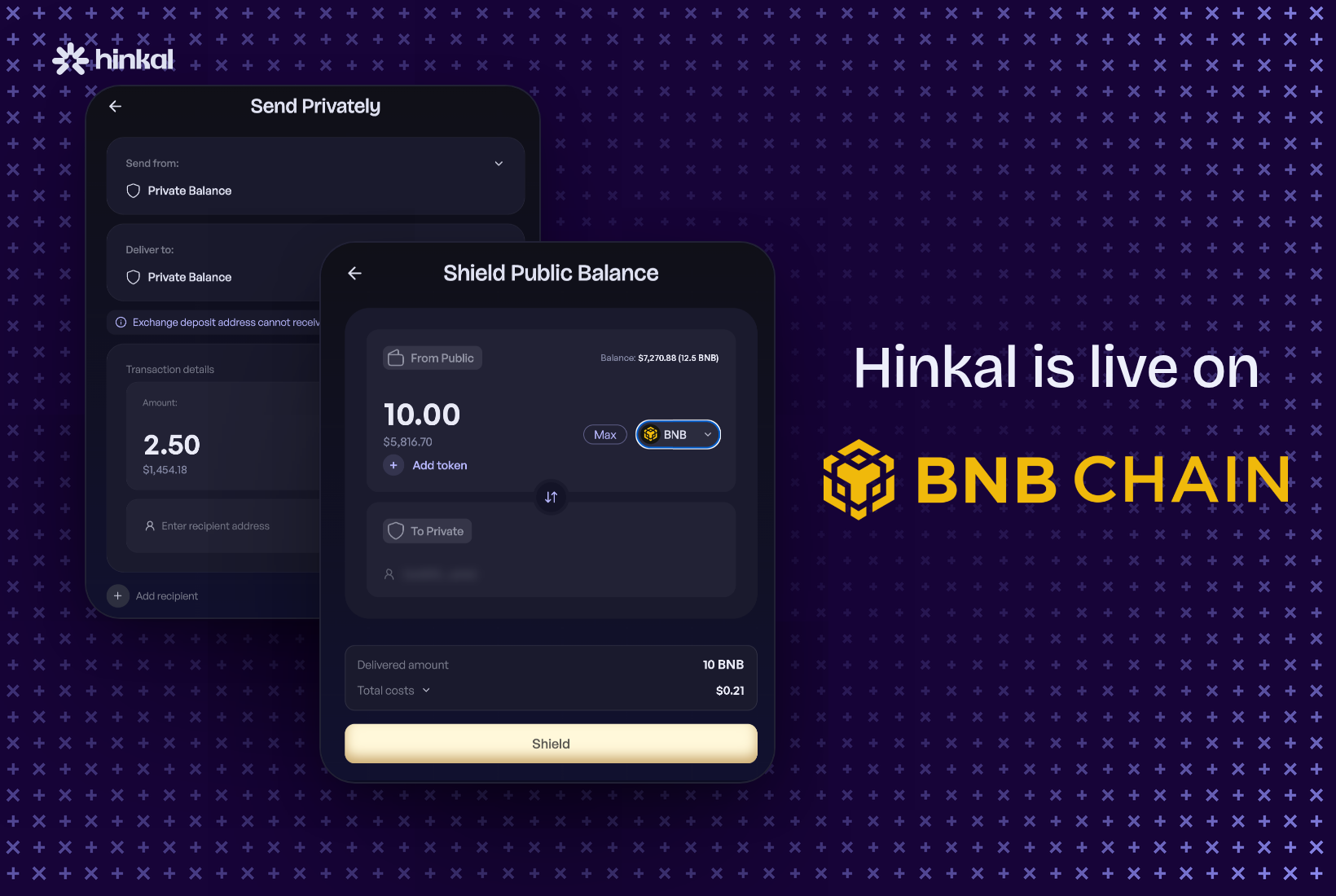
The best privacy platforms require no action from counterparties. With Hinkal Pay, senders route funds through the smart contract into a confidential balance linked to the recipient's existing wallet. The recipient connects their wallet and sees the balance, no migration, no new wallet, no integration required.






















































.png)
.png)
.webp)