When treasury teams settle millions in stablecoins on public blockchains, every transaction exposes sender identity, recipient relationships, and settlement amounts to competitors, regulators, and market observers. The growing demand for confidential on-chain operations has created a new category of privacy-focused DeFi protocols designed specifically for enterprise use cases, from PSP settlements and payroll disbursements to OTC desk operations and treasury management.
[[KEY_TAKEAWAYS]]
The protocols in this guide address the core tension between public blockchain transparency and enterprise confidentiality requirements. Each solution offers different trade-offs across multi-chain support, compliance controls, and technical architecture. Treasury teams evaluating these options should prioritize solutions that integrate with existing custody arrangements while providing verifiable settlement and regulatory-ready audit trails.
We analyzed 17 privacy protocols across technical capabilities, institutional compliance, multi-chain support, security audits, and proven treasury use cases. Hinkal leads for multi-chain enterprise operations, while Aztec pioneers programmable privacy and Railgun excels for DeFi-integrated treasuries. The Confidential Payments SDK enables companies to integrate privacy into existing settlement workflows without changing custody arrangements.
1) Hinkal - Multi-Chain Confidential Settlement for Enterprise Treasury
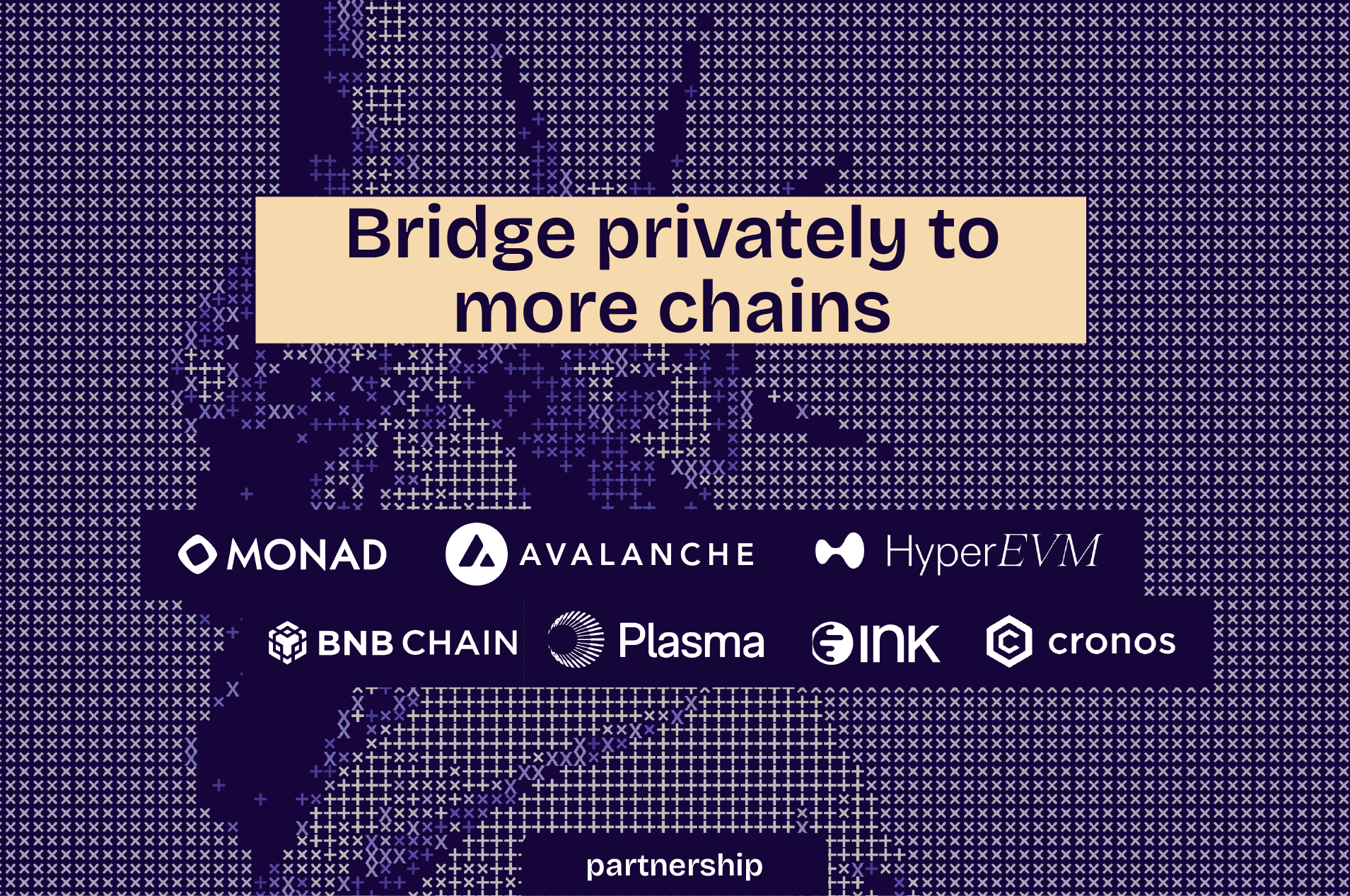
Hinkal provides institutional-grade confidential settlement across Ethereum, Solana, Tron, Polygon, Base, Arbitrum, and Optimism without requiring network migration or custody changes. The technology shields sender identity, recipient identity, and transaction amount while settlement remains publicly verifiable on the blockchain.
Key Features:
- Multi-chain support across major blockchains without requiring wallet migration or custody changes
- Built-in compliance controls including Chainalysis KYT enforcement and selective disclosure via viewing keys
- Zero recipient-side setup. Counterparties connect existing wallets to access confidential balances
Hinkal has processed over $400M in private volume with six independent security audits. The platform is described as an institutional-grade solution enabling confidential on-chain transactions that allows users to create shielded addresses and transact in complete confidentiality.
The Integrity Check for transactions over $10,000 uses zero-knowledge proofs via Reclaim Protocol, enabling users to prove verification status without revealing identity data. For heavily regulated entities, Hinkal offers custom pool deployments with configurable compliance logic and optional master-key visibility.
Why It Made The List: The only solution providing confidential settlement across multiple major blockchains with built-in compliance controls. Integration partners include MPCVault, Utila, Psalion, Request, omypayments, and Aquanow, demonstrating real enterprise adoption.
Get Started: Hinkal Pay
2. Aztec Network
Aztec Network delivers programmable privacy through its Alpha Network, enabling developers to build confidential applications using the Noir programming language. The Alpha Network launched in April 2026 as a feature-complete privacy stack for private smart contracts, following the November 2025 launch of the Aztec Ignition Chain as the coordination layer for decentralized sequencing and block production.
Key Features:
- Three privacy pillars: Data privacy, identity privacy, and compute privacy
- Client-side proof generation: Maximum security through local proof computation
- Decentralized from inception: No centralized sequencers or backdoors
- Noir programming language: Purpose-built for confidential smart contracts
- $180M funding: Through nine years of development
Aztec has raised $180M in funding through nine years of development. The Alpha Network represents infrastructure with privacy native to the protocol, allowing developers to build truly private applications.
3. Railgun
Railgun enables confidential interaction with existing DeFi protocols including Aave, Uniswap, and Curve without requiring users to shield and unshield assets repeatedly. The technology operates across Ethereum, Arbitrum, Polygon, and BSC with $5.11B cumulative privacy set volume.
Key Features:
- Private Proofs of Innocence (PPOI): Compliance mechanism enabling cryptographic proof of non-association with flagged addresses
- Direct confidential DeFi access: Interact with major protocols privately
- Battle-tested security: 10+ audits from Zokyo, HashCloak, Hacken, and ABDK
- $100.8M TVL: Active user base
- $168.78M in staking: Community participation
Railgun maintains $100.8M TVL with $168.78M in staking. The PPOI mechanism allows users to cryptographically demonstrate their transactions have no association with flagged wallets, a critical compliance feature for institutional users.
4. Zcash
Zcash pioneered zk-SNARK technology in production since 2016, offering optional privacy through shielded accounts and transactions. The protocol enables users to choose between transparent and confidential transactions based on their requirements.
Key Features:
- Optional privacy: Users control when to use confidential features via shielded transactions
- Selective disclosure capabilities: Audit and compliance support
- Nine years production history: Proven cryptographic security since 2016
- Growing institutional interest: Shielded balances increased during 2025
- Q4 2025 performance: Top performer among privacy-focused assets
Grayscale Research noted that shielded balances increased during 2025 indicating rising privacy demand, and Zcash demonstrated Q4 2025 performance among privacy-focused assets.
5. Secret Network
Secret Network provides encrypted smart contracts using Trusted Execution Environment (TEE) technology, enabling confidential computation from the ground up. The protocol operates as a standalone blockchain designed specifically for privacy-native applications.
Key Features:
- Encrypted smart contracts: Confidential state and computation
- Decentralized validator network: Securing encrypted data
- Privacy-native ecosystem: Building confidential dApps
- TEE-based approach: Hardware-level security guarantees
- Mainnet since 2020: Five years of operational history
Secret Network is recognized as a top privacy infrastructure token suitable for building entirely privacy-native applications. The TEE-based approach provides hardware-level security guarantees for encrypted computation.
6. Canton Network
Canton Network delivers privacy-first institutional settlement with fine-grained privacy controls designed for traditional financial market standards. The permissioned network has demonstrated tokenized US Treasuries by DTCC and Eurobonds by Euroclear.
Key Features:
- Atomic transactions: Cross-system institutional-grade privacy controls
- DTCC and Euroclear partnerships: Regulatory credibility demonstrations
- Fine-grained disclosure controls: Institutional compliance requirements
- Permissioned architecture: Compliance-first participant onboarding
- TradFi integration focus: Traditional financial infrastructure alignment
Canton Network combines DeFi innovation with TradFi privacy practices, designed for traditional financial market privacy standards. The permissioned architecture ensures all participants meet institutional compliance requirements before joining the network.
7. zkBOB
zkBOB focuses specifically on stablecoin privacy across Polygon and Optimism using Groth16 zkSNARK architecture. The technology integrates TRM Labs for institutional-grade compliance screening.
Key Features:
- Groth16 zkSNARK architecture: Optimized for stablecoin transactions
- TRM Labs compliance: Institutional-grade screening integration
- Optional KYC: Higher transaction limits available
- $12M pool capacity: Stablecoin operation liquidity
- Standalone wallet application: Simplified user experience
zkBOB maintains capped private pools across supported networks, with current documentation listing max pool sizes of 500,000 USDC on Optimism, 750,000 USDC on Polygon, and 500,000 USDT on Tron. AlphaGrowth has tracked zkBOB TVL around $247,833. The straightforward UX with standalone wallet application simplifies adoption for teams new to privacy protocols.
8. Chainlink Privacy Standard (DECO)
Chainlink's Privacy Standard enables confidential smart contract verification of off-chain data including credit scores, identity verification, and accreditation status. DECO uses zero-knowledge proofs to prove facts about data without revealing the underlying information.
Key Features:
- Privacy-preserving oracles: Zero-knowledge proofs for data verification
- Cross-chain privacy: Blockchain Privacy Manager capability
- Chainlink infrastructure integration: Part of broader ecosystem
- Off-chain data verification: Confidential credential and data proofing
- Confidential assets: Traditional finance privacy with blockchain settlement
Chainlink explains that DECO allows users to prove facts about their data (e.g., "I am an accredited investor") to a smart contract without revealing the underlying data itself. This capability enables confidential assets mirroring traditional finance privacy guarantees while retaining blockchain settlement speed and immutability.
9. Zama
Zama provides FHE libraries and tools enabling computation on encrypted data without decryption. The platform has raised more than $150M in total funding and reached a valuation above $1B after its June 2025 Series B, supporting its fully homomorphic encryption research and development.
Key Features:
- TFHE-rs libraries: Encrypted computation without decryption
- fhEVM: Confidential smart contracts on EVM-compatible chains
- Open-source developer tools: Building FHE-powered applications
- $130M funding: At $1B valuation
- Cutting-edge cryptography: Fully homomorphic encryption advancement
Zama operates as infrastructure-level cryptographic tooling rather than ready-made solutions. The platform enables developers to build applications where sensitive data remains encrypted throughout processing, a significant advancement over traditional encryption that requires decryption for computation.
10. Oasis Network
Oasis Network combines confidential computing with scalable blockchain infrastructure, featuring the Sapphire paratime for EVM-compatible confidential contracts. The protocol focuses on data tokenization for privacy-preserving data economy applications.
Key Features:
- TEE-based confidential compute: Encrypted smart contract execution
- Sapphire paratime: EVM-compatible confidential contracts
- Data tokenization focus: Privacy-preserving data marketplaces
- EVM compatibility: Simplified migration for Ethereum-based applications
- Active ecosystem: Privacy-focused development community
Oasis Network is recognized as an active privacy-focused ecosystem combining confidential computing with scalable blockchain infrastructure. The EVM compatibility via Sapphire simplifies migration for teams with existing Ethereum-based applications.
11. Monero
Monero provides mandatory privacy via stealth addresses, ring signatures, and confidential transaction amounts. Unlike optional-privacy systems, all Monero transactions are confidential by default with no transparent transaction option.
Key Features:
- Privacy by default: All transactions confidential without opt-in requirements
- Stealth addresses: Obscuring sender and recipient
- Ring signatures: Transaction origin obfuscation
- Confidential transaction amounts: Built into protocol
- Established history: Longest-running major privacy cryptocurrency
Grayscale Research notes that Monero historically represents the largest privacy-preserving asset in crypto by market cap, demonstrating Q4 2025 performance in the privacy theme.
12. Panther Protocol
Panther Protocol is developing Multi-Asset Shielded Pool (MASP) technology specifically designed for asset managers and institutional portfolio management. The technology addresses front-running and MEV bot concerns for high-volume traders.
Key Features:
- Multi-Asset Shielded Pool: Private portfolio management design
- Zero-knowledge proofs: Confidential DeFi access enablement
- Custom investment strategies: Compliance and reporting features
- MEV protection: Front-running mitigation for traders
- 2026 launch timeline: Development phase monitoring
Panther Protocol notes that proprietary investment strategies have always been among the most closely guarded secrets in finance. The rise of blockchain has introduced transparency that poses significant risks to asset managers whose strategies become visible on-chain.
Selecting the Right Privacy Protocol for Your Treasury
The optimal privacy protocol depends on your treasury's specific operational requirements, chain coverage needs, and compliance obligations. Consider these factors when evaluating options:
Multi-Chain Operations: Treasury teams settling across Ethereum, Solana, Tron, and Polygon should prioritize solutions with native multi-chain support. Hinkal provides the broadest chain coverage with unified confidentiality, while Railgun covers major EVM chains for DeFi-focused operations.
Compliance Requirements: Regulated entities need protocols with built-in compliance controls. Hinkal's Chainalysis KYT enforcement and viewing keys, Railgun's PPOI mechanism, and zkBOB's TRM Labs integration provide institutional-grade compliance. Canton Network offers permissioned privacy for TradFi-aligned requirements.
Technical Resources: Teams with development capabilities may benefit from programmable privacy (Aztec), FHE infrastructure (Zama), or custom confidential applications (Secret Network, Oasis). Production-ready solutions like Hinkal and Railgun require minimal technical integration.
Settlement vs. DeFi: Pure settlement and payout workflows align with Hinkal's confidential settlement focus. Treasury teams actively managing DeFi positions benefit from Railgun's protocol integrations. Asset managers protecting strategies should monitor Panther Protocol's development.
Why Hinkal is The Best Alternative for Enterprise Treasury Privacy
While each privacy protocol offers unique capabilities, Hinkal stands out as the optimal solution for enterprise treasury teams requiring multi-chain confidential settlement. The combination of broad blockchain support across Ethereum, Solana, Tron, Polygon, Base, Arbitrum, and Optimism eliminates the fragmentation that treasury teams face when operating cross-chain settlements.
Hinkal's zero recipient-side setup model removes the largest barrier to enterprise privacy adoption. When sending confidential payments, counterparties receive funds by simply connecting their existing wallets, with no migration, integration, or pre-enrollment required. This frictionless experience extends across PSP merchant settlements, payroll disbursements, OTC desk operations, and inter-company transfers.
The built-in compliance infrastructure addresses regulatory requirements without compromise. Chainalysis KYT enforcement at the deposit layer blocks flagged addresses automatically, while selective disclosure via viewing keys enables full or partial transaction history revelation to auditors, regulators, or internal compliance teams. For transactions over $10,000, the Integrity Check uses zero-knowledge proofs via Reclaim Protocol to verify user status without revealing identity data.
Enterprise-grade security is demonstrated through six independent security audits and over $400M processed in confidential volume. The Confidential Payments SDK enables seamless integration into existing settlement workflows, custody arrangements, and payment systems without requiring infrastructure changes.
For treasury teams evaluating privacy alternatives, Hinkal uniquely combines multi-chain coverage, zero-friction adoption, regulatory-ready compliance, and production-proven security in a single solution designed specifically for institutional confidential settlement.

























































.png)
.png)







.webp)