This makes implementation slow, expensive, or unrealistic.
For privacy to work at scale, it has to integrate into existing systems - not replace them.
This means: No change in custody No disruption to user flows No new operational overhead
That’s exactly what Hinkal enables With Hinkal, neobanks can integrate privacy directly into their existing stack:
A lightweight integration - as little as a 2-line implementation Multi-chain support across EVM, Solana, and TRON Compatibility with existing wallets and transaction flows Fully self-custodial by design
This removes the typical friction associated with adding privacy infrastructure. Once integrated, privacy becomes native to every on-chain action:
Confidential balances Private transfers No exposure of sender, recipient, or amount Users can operate without revealing financial activity on-chain.
Privacy alone is not sufficient for financial institutions - Compliance is equally critical. Hinkal is designed to support both:
KYT monitoring via Chainalysis Selective disclosure through viewing keys
This enables institutions to remain compliant while maintaining confidentiality where it matters.
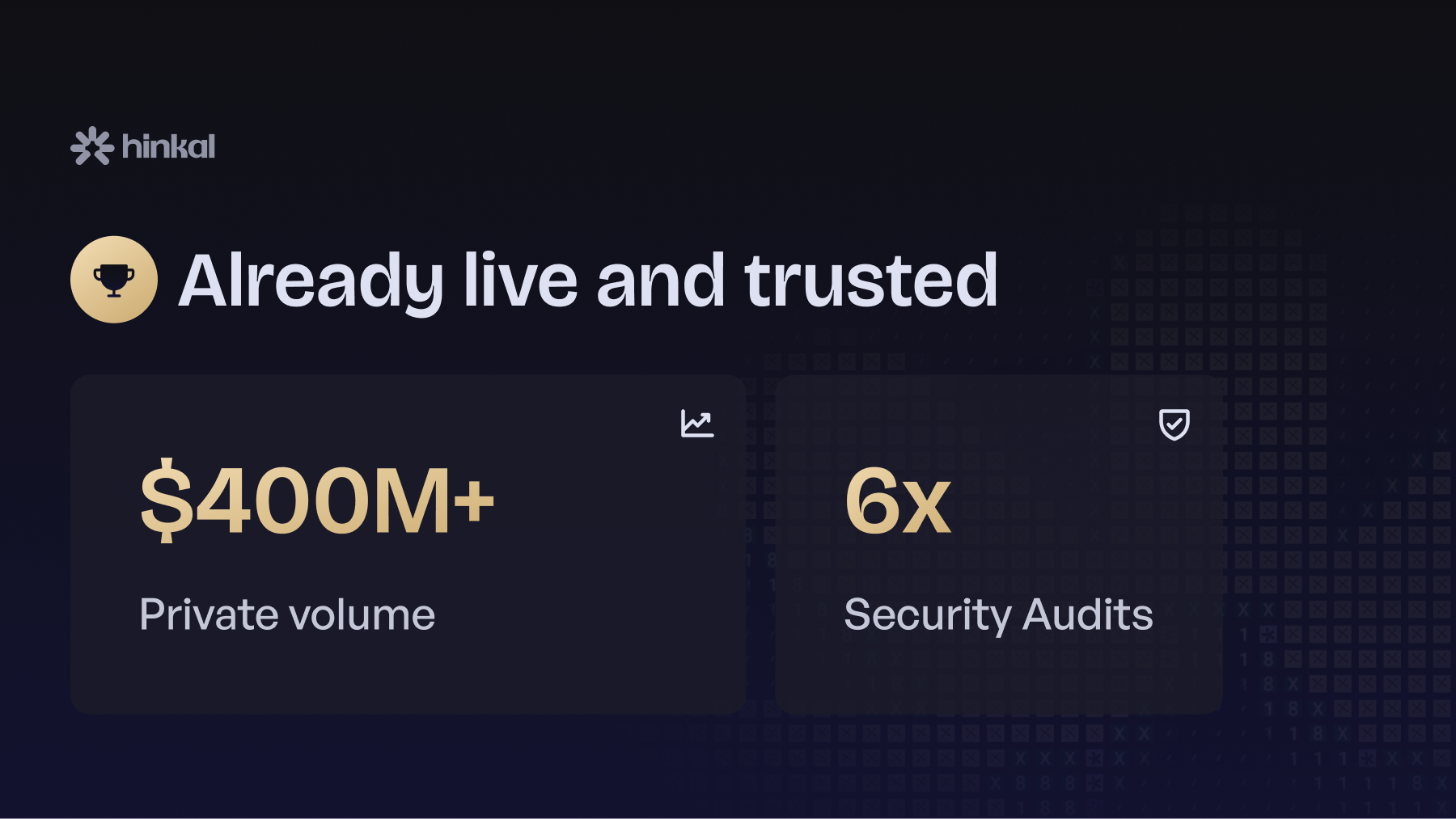
This is not theoretical infrastructure. Hinkal is already in production, supporting real usage:
Over $400M in confidential transaction volume Audited five times Backed by leading investors
This demonstrates both technical maturity and real market demand for private financial execution.
Neobanks that introduce privacy move beyond a structural limitation.
They can: Unlock new revenue streams Attract and retain high-value users Increase transaction volume Differentiate in an increasingly competitive market
FAQ
Common questions
Do I need a new wallet to use Hinkal Wallet?
No. You can import your existing wallet using a seed phrase and access your assets immediately.
Do I need a new wallet to use Hinkal Wallet?
No. You can import your existing wallet using a seed phrase and access your assets immediately.
Do I need a new wallet to use Hinkal Wallet?
No. You can import your existing wallet using a seed phrase and access your assets immediately.
Trusted by teams building on public chains
Key Takeaways
Want
to
stay
ahead
of
the
market?
Get exclusive insights on privacy, stablecoins, and marketdevelopments shaping enterprise on-chain finance.
Thank you! Your submission has been received!
Oops! Something went wrong while submitting the form.
Related Articles
October 9, 2026
Hinkal joins the Mastercard Crypto Partner Program
announcement
September 23, 2026
Hinkal x Tether WDK: Private Payments for Self-Custodial Wallets
Announcement
September 22, 2026
Hinkal Is Now Live on Robinhood Chain
Announcement
September 17, 2026
Private Balances & Payments Now Live in Avvio, powered by Hinkal
Announcement
September 16, 2026
Deposit Address Screening: KYT at the Point of Entry
Analysis
September 14, 2026
What Is a Hinkal Deposit Address? Get Paid Privately
Announcement
September 14, 2026
Private Swaps: The Crypto Privacy Risks They Remove
Announcement
August 10, 2026
Hinkal can now be integrated directly into Go backends
Announcement
August 6, 2026
Episode 04: Stealth Addresses
Opinion
August 4, 2026
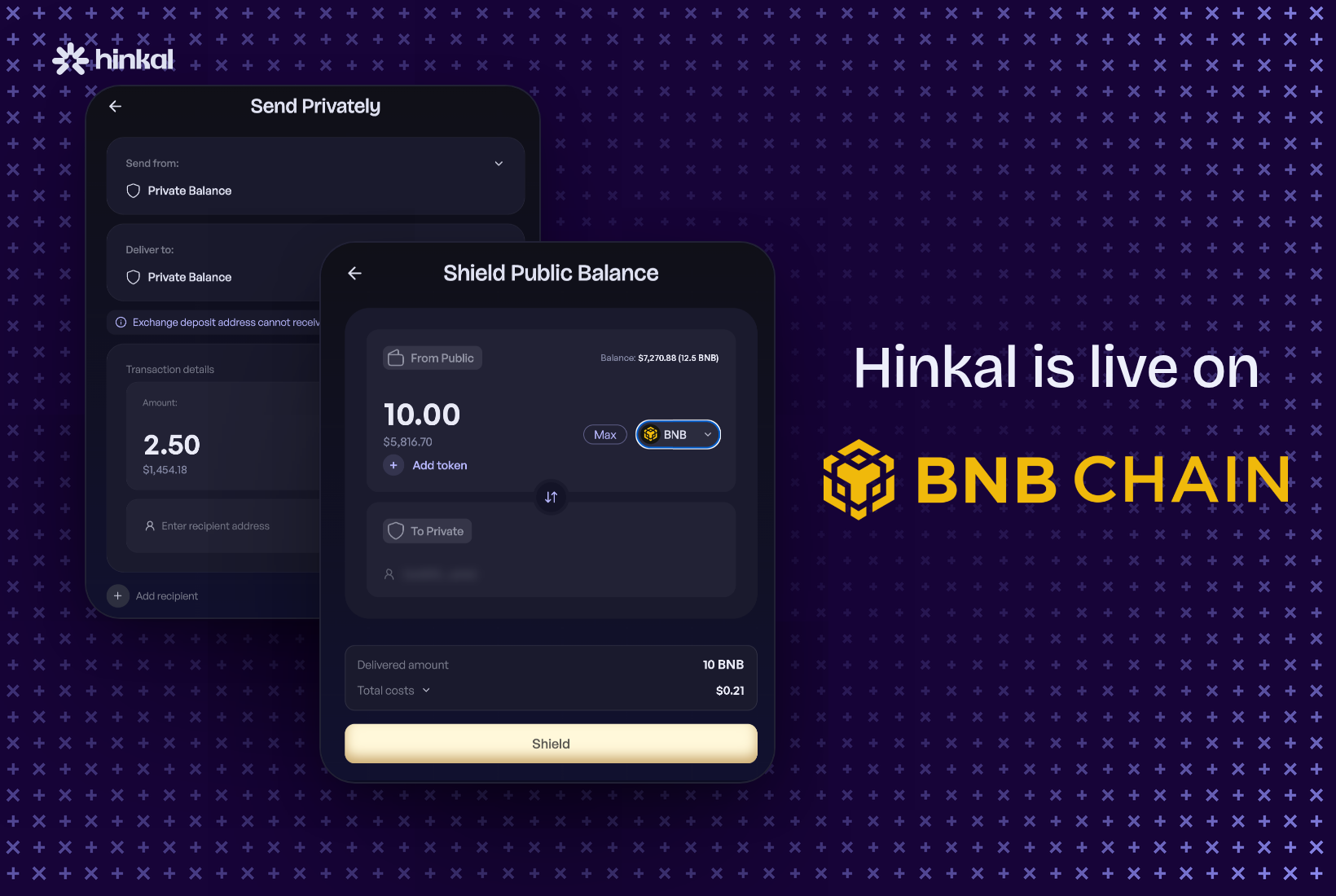
Hinkal Pay is now live on BNB Chain
Announcement
July 31, 2026
Hinkal can now be integrated directly into iOS and Android
Announcement
July 29, 2026
Hinkal MCP: Private Payments from Any AI Client
Announcement
July 27, 2026
Private Balances and Transfers Are Live on Privy Wallets
Announcement
July 24, 2026
The On-Chain Treasury Exposure Report: What Public Corporate Wallets Reveal
Opinion
July 23, 2026
The Hidden Cost of Public Crypto Payroll: A 2026 Exposure Report
Opinion
July 23, 2026
Hinkal is Live on Openfort
Announcement
July 22, 2026
Confidential Stablecoin Settlement Under MiCA, the Travel Rule, and GENIUS: 2026 Readiness Report
Analysis
July 21, 2026
Confidential Settlement for Stablecoin Issuers: How Issuers Keep Vault Positions and Holder Balances Private
Opinion
July 20, 2026
Reading the Tape: How Counterparties Reverse-Engineer an OTC Desk's Book From On-Chain Settlement
Opinion
July 20, 2026
Introducing the New Hinkal Pay: New Look and Features
Announcement
July 17, 2026
Embedded Wallet Integration Guide: Private Balances via the Hinkal SDK (Privy / Turnkey / Crossmint)
Analysis
July 16, 2026
How to Pay Vendors in Stablecoins Without Exposing Your Treasury Balance
Analysis
July 15, 2026
Best Private Settlement Infrastructure for Solana Businesses
Analysis
July 14, 2026
The Migration Tax: What It Costs a Treasury to Move to a Privacy Chain vs Add Privacy on Ethereum
Opinion
July 13, 2026
Confidential Settlement for Regulated Treasuries
Opinion
July 10, 2026
How RWA Protocols Can Protect Investor Activity Onchain
Analysis
July 9, 2026
Association Sets vs Selective Disclosure: Which Privacy Model Passes a Compliance Review?
Analysis
July 8, 2026
Best Privacy Infrastructure for Tokenized Asset Platforms
Analysis
July 7, 2026
How to Shield and Unshield Crypto Assets with Hinkal: A Step-by-Step Guide
Analysis
July 6, 2026
Best Railgun Alternatives for Private Stablecoin Treasury Management (2026)
Analysis
July 6, 2026
Best Crypto Payment API for Fintechs With Private Settlements (2026)
Analysis
July 6, 2026
Privacy vs Compliance: Which Crypto Privacy Solutions Work for Businesses?
Opinion
July 6, 2026
How DAOs Can Pay Contributors Without Revealing Compensation Data
Opinion
July 2, 2026
Privacy is live on Turnkey wallets, powered by Hinkal
Partnership
June 29, 2026
Best Privacy Infrastructure for Institutional DeFi Platforms in 2026
Opinion
June 26, 2026
Private settlements & payouts are coming to AllScale
Partnership
June 18, 2026
Private Stablecoin Custody Is Coming to The Vault
Partnership
June 17, 2026
Episode 03: UTXO Model, Commitments & Nullifiers
Opinion
June 16, 2026
Both-Way Bridging Across EVM, Solana, and TRON Is Live

























































.png)
.png)






.webp)