Enterprises conducting stablecoin settlements on public blockchains face a critical exposure problem: every transaction reveals sender identity, recipient identity, and transaction amount to competitors, counterparties, and market observers. While Railgun and Aleo offer privacy-focused approaches to this challenge, Hinkal stands apart as the only institutional-grade, self-custodial solution that combines confidential settlements with built-in compliance controls across Ethereum, Solana, Tron, and Polygon. Understanding these fundamental differences between compliance-ready confidentiality and general-purpose privacy helps enterprise decision-makers select the approach that matches their regulatory requirements, operational workflows, and growth objectives.
Understanding the Core Challenge: Why Confidentiality Matters on Public Blockchains
Every transaction on public blockchains creates a permanent, visible record. When enterprises settle payments, execute treasury operations, or process payroll on-chain, they broadcast sensitive commercial information to anyone monitoring the network.
The exposure risks are substantial:
- Counterparties seeing settlement volumes - Trading partners can analyze your transaction patterns and use that data in negotiations
- Competitors mapping treasury operations - Your capital movements, liquidity positions, and strategic rebalancing become public knowledge
- On-chain data used against you - Market observers can front-run trades, predict business decisions, or identify customer relationships
- Compliance exposure - Without selective disclosure capabilities, enterprises cannot control what regulators and auditors see
For Payment Service Providers settling merchant funds, the problem compounds. Public settlements expose merchant economics, payout graphs, and commercial relationships. OTC desks face similar challenges: bilateral trade volumes and counterparty relationships become visible to competitors.
The solution requires shielding all three data points: sender identity, recipient identity, and transaction amount. Shielding only one dimension still exposes enough information for sophisticated observers to map financial relationships and volumes.
Hinkal: Institutional-Grade Privacy with Built-in Compliance and Multi-Chain Compatibility
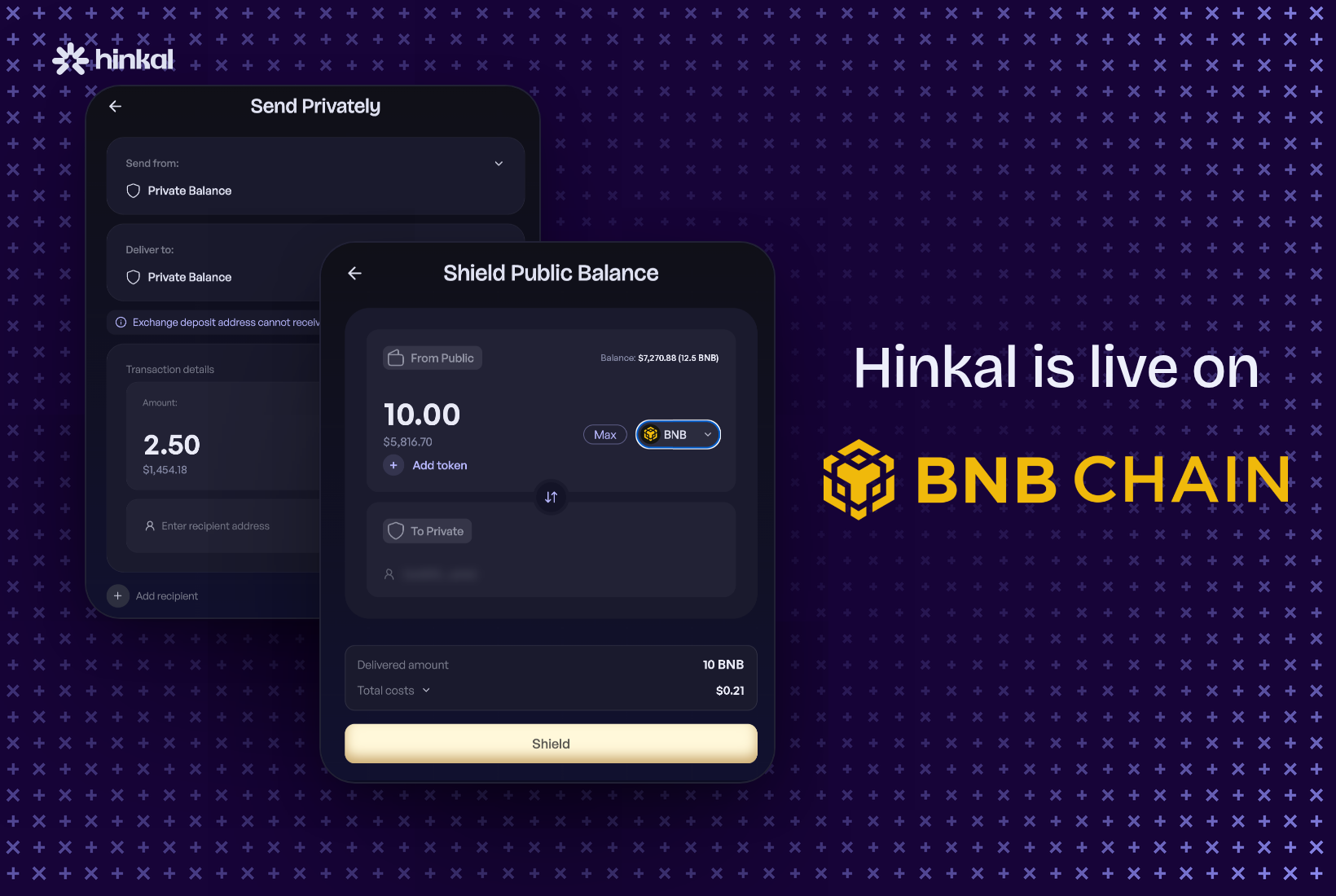
Hinkal provides a privacy-by-design solution that enables confidential settlements on public blockchains while maintaining verifiable settlement. Hinkal operates across Ethereum, Solana, Tron, Polygon, Base, Arbitrum, and Optimism, allowing enterprises to maintain existing custody and wallet arrangements while gaining transaction confidentiality.
Hinkal's core architecture delivers:
- Self-custodial design - Enterprises retain control via their private keys; Hinkal never holds or controls user assets
- Verifiable settlement - Settlement remains publicly verifiable on the blockchain while the privacy component obscures commercial details
- Multi-chain operations - Unified confidentiality across chains enterprises already use, with cross-chain privacy via Axelar integration
Hinkal has processed over $400M in private volume with 6 independent security audits. Backed by SALT, Draper Associates, Orange DAO, and SNZ, Hinkal is built specifically for institutional use cases requiring both confidentiality and auditability.
How Hinkal Achieves Verifiable Settlement
Hinkal uses zkSNARKs with stealth addresses to create confidential balances linked to recipients' existing wallets. When a sender routes funds through Hinkal's smart contract, the transaction shields sender identity, recipient identity, and transaction amount while settlement remains verifiable on-chain.
This architecture means:
- Recipients connect their existing wallet and see the confidential balance immediately
- No migration, new wallet creation, or recipient-side integration required
- Settlement verification remains public while commercial relationships stay confidential
The Power of Three: Shielding Sender, Recipient, and Transaction Amount
Most privacy approaches shield only one dimension of transaction data. Hinkal's architecture specifically protects all three critical data points that enterprises need shielded:
1. Sender Identity Protection
- Treasury wallets remain confidential, preventing competitors from mapping your capital positions
- Payment service providers can settle with merchants without revealing their operational wallet
2. Recipient Identity Protection
- Payees receive funds without their wallet addresses being linked to your organization
- Partner relationships and vendor networks stay confidential
3. Transaction Amount Protection
- Settlement volumes remain private, preventing counterparties from using your data in negotiations
- Salary costs, contractor payments, and affiliate commissions stay confidential
This comprehensive approach prevents the financial mapping that occurs when even one dimension remains exposed. A competitor who sees transaction amounts but not recipients can still estimate your payment infrastructure scale. A vendor who sees recipient addresses but not amounts can identify your business relationships.
Zero Setup for Recipients: Hinkal's Frictionless Integration for Enterprise Payments
A primary differentiator is Hinkal's zero setup requirement for recipients. When enterprises send funds through Hinkal, the recipient needs no special wallet, no prior Hinkal integration, and no technical setup.
How the frictionless flow works:
- Sender routes funds through Hinkal's smart contract into a confidential balance
- The confidential balance is linked to the recipient's existing wallet address
- Recipient connects their existing wallet to Hinkal
- Recipient sees and controls the confidential balance, ready to execute settlements
This "one button" approach applies across all institutional use cases:
- PSPs settling with merchants - Merchants connect their existing wallet and access funds without any integration work
- Companies paying employees - Staff receive confidential payroll to their current wallets
- OTC desks settling with counterparties - Trading partners access balances through their existing custody setup
- iGaming operators paying recipients - Payouts reach recipients with no public trace and no new wallet required
Hinkal Pay transforms any transfer into a confidential settlement. Users can send stablecoins without exposing balances, counterparties, or wallet history, all while recipients access funds through their existing wallet.
Comparing Compliance Frameworks: Selective Disclosure, KYT, and Zero-Knowledge Proofs
For enterprises operating under regulatory scrutiny, compliance capabilities separate institutional-ready solutions from general-purpose privacy tools.
Hinkal's Compliance Architecture
Hinkal provides three integrated compliance controls:
Selective Disclosure via Viewing Keys
- Reveal full or partial transaction history to auditors, regulators, or internal compliance teams on demand
- Control exactly what information each party sees
- Meet audit requirements without exposing all commercial data
KYT Enforcement via Chainalysis
- Blocks flagged wallets at the deposit level
- Prevents tainted funds from entering the system
- Real-time screening integrated at the protocol level
Custom Pool Deployments
- Heavily regulated entities can deploy dedicated pools with configurable compliance logic
- Optional master-key visibility for institutional oversight
- Tailored compliance frameworks for specific regulatory requirements
Integrity Check for Verification
For interactions over $10,000, Hinkal requires an Integrity Check using zero-knowledge proofs via Reclaim Protocol. Users can prove verification status without revealing identity data. Hinkal receives only a cryptographic proof confirming verification, never seeing names, IDs, or personal documents.
This compliance-ready architecture positions Hinkal for institutional adoption where regulatory requirements mandate both confidentiality and auditability.
How Railgun and Aleo Approach Compliance
Railgun offers view keys for selective disclosure but requires enterprises to implement additional compliance solutions separately.
Aleo's compliance approach is application-dependent. Developers building on Aleo can implement custom compliance logic based on their specific requirements.
Railgun
Railgun operates as a smart contract privacy system on EVM-compatible chains. The protocol uses zk-SNARKs with UTXO model to enable private transactions within its ecosystem.
Railgun's core characteristics:
- Established track record - Live since 2021 with $4B cumulative volume and $1.6B processed in 2024
- TVL position - $95M in total value locked
- Chain support - Four networks: Ethereum, Polygon, Arbitrum, and BSC
- DeFi integration - Native support for DEX swaps, lending, liquidity provision, and NFT transactions
- Gasless transactions - Broadcaster system enables meta-transactions without direct gas payment
Railgun's permissionless access model appeals to users seeking privacy without verification requirements. The protocol has received recognition through inclusion in the Ethereum Foundation's Kohaku wallet toolkit.
Aleo
Aleo represents a different approach: a dedicated blockchain built from the ground up for zero-knowledge cryptography. Rather than adding privacy to existing chains, Aleo provides a programmable privacy platform where developers build applications with native ZK capabilities.
Aleo's core characteristics:
- Architecture - Dedicated blockchain with native snarkVM and snarkOS execution environment
- Development focus - Leo programming language designed specifically for ZK smart contracts
- Ecosystem growth - 10,000+ programs deployed with 44,000+ provers connected to the network
- Mainnet status - Launched September 2024
- Funding - Over $250M raised from investors
Aleo targets developers building new applications that require programmable privacy logic. The platform enables custom privacy-preserving smart contracts through its ZK-native architecture.
Key Differentiators: Hinkal's Edge in Enterprise Adoption
When enterprise decision-makers evaluate privacy solutions for settlement and payout workflows, several factors determine practical value.
Multi-Chain Compatibility Without Migration
Hinkal
- Chain Support: Ethereum, Solana, Tron, Polygon, Base, Arbitrum, Optimism, plus others
- Migration Required: No, uses existing wallets
Railgun
- Chain Support: Ethereum, Polygon, Arbitrum, BSC
- Migration Required: No, EVM compatible
Aleo
- Chain Support: Aleo blockchain only
- Migration Required: Yes, requires building on new blockchain
Hinkal's cross-chain privacy via Axelar enables unified confidential operations across the chains enterprises already use. Treasury teams can manage assets across multiple networks without separate privacy implementations for each chain.
Compliance Integration
Hinkal
- Built-in KYT: Yes, Chainalysis
- Selective Disclosure: Yes, Viewing Keys
- Verification Options: ZK-TLS + Traditional KYC
Railgun
- Built-in KYT: External required
- Selective Disclosure: Yes, View Keys
- Verification Options: None built-in
Aleo
- Built-in KYT: Application-dependent
- Selective Disclosure: Application-dependent
- Verification Options: Developer-implemented
For enterprises with regulatory obligations, Hinkal's integrated compliance controls eliminate the need to bolt on external solutions or build custom compliance frameworks.
Integration Model
Hinkal
- Integration Approach: SDK integration, no custody changes
- Time to Deployment: Days to weeks
Railgun
- Integration Approach: Direct protocol interaction
- Time to Deployment: Weeks
Aleo
- Integration Approach: Build new application on Aleo
- Time to Deployment: Months
The Confidential Payments SDK enables companies to integrate confidential settlement into existing products without changing custody arrangements, wallets, or payment rails.
Real-World Applications: Where Hinkal's Confidential Payments Drive Value
Hinkal's design addresses specific pain points across enterprise verticals that process on-chain settlements.
Payment Service Providers
PSPs settling merchant funds on public chains expose merchant economics, counterparty relationships, and operational patterns. With Hinkal's SDK integration:
- Send funds to a merchant's confidential balance
- Merchants connect their existing wallet to see and access the balance
- No merchant-side integration required
- Settlement volumes and routing patterns remain confidential
Payroll and HR Platforms
Companies running crypto payroll expose headcount, pay cycles, salary costs, and contractor relationships on-chain. Hinkal addresses this by:
- Routing salary through the smart contract with sender and amounts remaining confidential
- Employees receive funds on their existing wallet
- No recipient-side setup required
- Compensation data stays between employer and employee
OTC Desks
OTC desks settling large bilateral trades expose trade volume, wallet patterns, and counterparty relationships. With Hinkal:
- Route settlement funds to a counterparty's confidential balance
- Counterparties connect their existing wallet to access the balance
- Trading patterns and volumes remain confidential
- No counterparty-side integration needed
Wallet Providers
Hinkal is the only multi-chain solution that enables private send where the recipient also receives confidentially. Once one wallet integrates Hinkal:
- Users can send confidentially to recipients on any other wallet
- Recipients connect to Hinkal and see their confidential balance
- No shared infrastructure required between wallets
- Confidentiality becomes a competitive product feature
Hinkal Pay enables any of these workflows through a simple interface, converting transfers into confidential settlements without requiring technical integration.
A Look Ahead: The Future of Confidentiality in a Transparent Web3 World
The enterprise blockchain landscape is evolving toward solutions that balance transparency with commercial confidentiality. As more institutional capital flows on-chain, the demand for compliant, confidential settlement grows.
Key trends shaping enterprise adoption:
- Regulatory clarity - Increasing regulatory frameworks require solutions that can satisfy both privacy needs and audit requirements
- Institutional standards - Enterprises expect the same confidentiality they have in traditional finance
- Multi-chain operations - Treasury teams operate across multiple blockchains and need unified confidentiality
- Compliance integration - Built-in compliance controls reduce implementation complexity and regulatory risk
Hinkal's position at the intersection of confidential settlements and compliance-ready architecture aligns with where institutional blockchain adoption is heading. The combination of multi-chain support, zero recipient setup, and integrated KYT enforcement creates a solution designed for real financial workflows.
For enterprises evaluating privacy solutions for settlement and payout operations, Hinkal represents the institutional-grade approach to confidentiality. The Hinkal Wallet provides persistent confidentiality for ongoing operations, while Hinkal Pay enables immediate confidential transfers, all without requiring custody changes or recipient-side integration.
Why Hinkal is The Best Alternative for Railgun and Aleo
For enterprises evaluating privacy solutions, Hinkal offers distinct advantages over both Railgun and Aleo in three critical areas: compliance readiness, multi-chain flexibility, and recipient experience.
Compliance Built for Institutional Adoption
While Railgun provides selective disclosure through view keys, enterprises must separately implement KYT screening and compliance frameworks. Aleo requires developers to build custom compliance logic from scratch for each application. Hinkal integrates Chainalysis KYT at the protocol level, blocking flagged addresses before they enter the system. This native compliance architecture means enterprises can deploy confidential settlements without building or managing separate compliance infrastructure.
Multi-Chain Operations Without Migration
Railgun operates on four EVM chains (Ethereum, Polygon, Arbitrum, BSC). Aleo requires building entirely new applications on its dedicated blockchain. Hinkal provides unified privacy across Ethereum, Solana, Tron, Polygon, Base, Arbitrum, and Optimism using existing wallets and custody arrangements. Treasury teams managing assets across multiple networks gain consistent confidentiality without chain-specific implementations or wallet migrations.
Zero-Friction Recipient Experience
Both Railgun and Aleo require recipients to understand and interact with privacy-specific infrastructure. Hinkal eliminates recipient-side setup entirely. When you send confidential funds through Hinkal, recipients connect their existing wallet and immediately see their confidential balance. No special wallets, no protocol-specific knowledge, no technical integration. This frictionless experience is critical for PSPs settling with hundreds of merchants, companies processing payroll to employees, and OTC desks settling with diverse counterparties.
SDK Integration for Existing Products
Railgun requires direct protocol interaction. Aleo requires building new applications from the ground up. Hinkal's Confidential Payments SDK integrates into existing payment products, wallet providers, and treasury systems in days to weeks without changing custody arrangements or payment rails. This approach enables companies to add confidentiality as a product feature rather than rebuilding infrastructure.
For enterprises requiring immediate deployment, regulatory compliance, and multi-chain operations, Hinkal delivers institutional-grade confidentiality with the integration simplicity that business operations demand.
























































.png)
.png)





.webp)