Running stablecoin settlements on public blockchains exposes your entire financial operation to competitors, counterparties, and market observers. Every settlement volume, every payout pattern, every counterparty relationship becomes permanently visible on-chain. For PSPs, OTC desks, and treasury teams, this transparency creates competitive intelligence leakage that traditional financial rails would never tolerate. Confidential settlement protocols now enable enterprises to shield sender identity, recipient identity, and transaction amounts while maintaining public verifiability—reducing settlement times from three to seven days to seconds or minutes without sacrificing compliance or changing existing custody arrangements.
Key Takeaways
- Public blockchain settlements expose three critical data points—sender identity, recipient identity, and transaction amount—that competitors can use to map your entire payment infrastructure
- Protocol-level confidentiality works across Ethereum, Solana, Tron, and major EVM chains without requiring network migration or custody changes
- Zero-knowledge proofs and encryption protocols enable verification of transaction validity without revealing commercial details to public observers
- Recipients can access confidential balances using their existing wallets—no migration, no new infrastructure, no recipient-side integration required
- Viewing keys provide selective disclosure capabilities, allowing auditors and regulators to verify specific transactions without public broadcast
- Cross-chain bridge exploits have resulted in $2.8 billion in losses since 2021, making trust-minimized confidential protocols increasingly critical for enterprise operations
The Challenge of Public Blockchain Transparency for Enterprise Settlements
Every stablecoin settlement your organization executes on a public blockchain creates a permanent, queryable record accessible to anyone with an internet connection. For payment service providers settling merchant funds, OTC desks executing bilateral trades, or treasury teams rebalancing liquidity across entities, this transparency represents a fundamental operational risk that traditional financial infrastructure never imposed.
What Gets Exposed in Public Settlements
Public blockchain settlements reveal far more than transaction confirmations:
- Settlement volumes that competitors can aggregate to estimate your market share and growth trajectory
- Routing patterns that expose which counterparties you work with and how frequently
- Wallet balances that signal your liquidity position and financial health to anyone watching
- Timing patterns that reveal your operational cadence, payroll cycles, and strategic moves
- Counterparty relationships that map your entire business network for competitor analysis
A PSP settling $10 million monthly with 50 merchants creates a complete map of merchant economics, payment frequencies, and commercial relationships. An OTC desk executing large bilateral trades broadcasts trade volumes and counterparty identities to every market participant watching the chain.
The Competitive Intelligence Problem
The transparency problem compounds because blockchain data doesn't disappear. Historical analysis allows observers to reconstruct your entire operational history, identify growth trends, and anticipate strategic moves based on treasury flows.
For enterprises accustomed to the confidentiality of traditional banking rails, this exposure creates uncomfortable vulnerabilities:
- Negotiating leverage shifts when counterparties know your volumes before discussions begin
- Market impact increases when large settlements signal intent to competitors
- Compliance risks emerge when regulators question why confidential financial data is publicly accessible
- Operational security degrades when treasury positions become visible to potential bad actors
The question facing enterprise payment operations isn't whether blockchain settlement makes sense—the speed, cost, and 24/7 availability advantages are clear. The question is how to capture those benefits without broadcasting your financial playbook to the world.
Introducing Protocol-Level Confidentiality for Multi-Chain Settlement
Protocol-level confidentiality addresses the transparency problem by encrypting sensitive transaction details before they reach the blockchain. Unlike approaches requiring migration to specialized networks, confidential settlement protocols become a feature of the public chains enterprises already use—Ethereum, Solana, Tron, Polygon, Base, Arbitrum, and Optimism.
How Confidential Settlement Works
Confidential settlement protocols use cryptographic techniques to separate transaction validity from transaction details:
- Encryption at origin ensures sensitive data never appears in plaintext on-chain
- Zero-knowledge proofs verify transaction validity without revealing amounts or identities
- Commitment schemes allow cryptographic verification that assets exist without exposing quantities
- Selective disclosure mechanisms enable authorized parties to decrypt specific transactions on demand
The settlement itself remains publicly verifiable—you can confirm that a valid transaction occurred and that the protocol rules were followed. But the commercial details embedded in that settlement—who paid whom, how much, and for what—remain encrypted and accessible only to authorized parties.
Maintaining Existing Wallets and Custody Arrangements
Critical for enterprise adoption: confidential settlement protocols don't require changing your custody infrastructure. Your treasury wallets, your custodian relationships, your key management practices remain intact. The confidentiality becomes a feature of your existing settlement flows, not a replacement.
This architecture matters because enterprise treasury operations involve:
- Existing custody relationships with established security controls and insurance coverage
- Audit trails that compliance teams have built reporting around
- Operational workflows that staff have been trained on
- Risk management frameworks that assume specific custody arrangements
Forcing migration to new wallets or custody solutions introduces operational risk, compliance complexity, and staff retraining requirements that make adoption impractical. Protocol-level confidentiality avoids these barriers by working with—not replacing—existing infrastructure.
Multi-Chain Compatibility
Enterprise payment operations rarely operate on a single blockchain. PSPs may settle on Ethereum for some merchants and Tron for others. OTC desks execute across whichever chains their counterparties prefer. Treasury teams move assets across multiple networks based on liquidity and cost considerations.
Confidential settlement protocols that span multiple chains eliminate the need to implement separate confidentiality solutions for each network. A single integration provides confidential settlement capability across your entire multi-chain operation.
Shielding Sender Identity, Recipient Identity, and Transaction Amounts
Effective confidential settlement requires shielding all three critical data points simultaneously: sender identity, recipient identity, and transaction amount. Solutions that protect only one dimension leave exploitable gaps that determined observers can use to reconstruct commercial relationships.
Why Partial Confidentiality Fails
Consider a settlement where the amount is encrypted but sender and recipient addresses are visible. An observer can:
- Track the sender wallet to identify the organization
- Track the recipient wallet to identify the counterparty
- Aggregate transaction frequency to estimate volumes even without exact amounts
- Correlate timing with known business events to infer commercial relationships
Conversely, concealing the sender but revealing amounts and recipients still exposes your payout structure, merchant economics, and commercial terms.
The Three Pillars of Transaction Confidentiality
Complete confidential settlement requires protecting:
Sender Identity: The wallet initiating the settlement remains unlinkable to your organization. Observers cannot trace settlements back to your treasury wallets, eliminating balance exposure and historical analysis risks.
Recipient Identity: The wallet receiving funds remains private. Your counterparty relationships, merchant network, and payout recipients stay confidential even though settlement occurs on a public chain.
Transaction Amount: The specific value transferred remains encrypted. Competitors cannot aggregate your settlement volumes, estimate your market share, or map your commercial terms from on-chain data.
When all three elements are protected, on-chain observers see that a valid transaction occurred without learning any commercially sensitive information. The settlement is publicly verifiable, but the business intelligence embedded in it remains private.
Beyond Single-Dimension Solutions
Most existing approaches to blockchain confidentiality protect only one or two dimensions. Common limitations include:
- Amount-only encryption that still exposes counterparty relationships
- Sender shielding that reveals recipients and amounts
- Network-specific solutions that don't span multi-chain operations
- Per-transaction tools that don't maintain continuous confidentiality for ongoing operations
For enterprise settlement workflows involving recurring payments, multiple counterparties, and multi-chain operations, partial solutions create false confidence while leaving significant exposure.
Seamless Integration: Confidential Settlements for PSPs and Enterprises
Implementing confidential settlement doesn't require rebuilding your payment infrastructure. Modern SDK integrations enable enterprises to add confidentiality to existing settlement flows with minimal development overhead.
Integrating Confidentiality into Existing Financial Workflows
The integration model for confidential settlement follows standard enterprise patterns:
- API-based settlement initiation that mirrors existing payment workflows
- Webhook notifications for settlement confirmation and status updates
- Batch processing support for high-volume payout operations
- Existing wallet compatibility requiring no custody changes
For PSPs already settling stablecoin payments, the integration typically involves:
- Routing settlement calls through the confidential protocol instead of direct chain transfers
- Receiving encrypted confirmation data that your systems store for audit purposes
- Providing recipients with access instructions (or automatic notification) for claiming funds
- Maintaining viewing keys that enable selective disclosure for compliance reporting
Use Cases for Confidential Payments SDK
The Confidential Payments SDK addresses specific enterprise settlement scenarios:
PSP Merchant Settlement: Settle funds with merchants without exposing merchant economics, settlement volumes, or the breadth of your merchant network to competitors analyzing on-chain activity.
OTC Desk Counterparty Settlement: Execute bilateral trade settlements where neither party's identity nor the trade size becomes public information. Counterparties maintain commercial confidentiality even while settling on public rails.
Treasury Operations: Rebalance liquidity across entities, fund operational wallets, and execute inter-company transfers without broadcasting your treasury structure and capital allocation strategy.
Vendor and Partner Payouts: Pay affiliates, contractors, and partners at scale without revealing payout graphs that expose your commercial relationships and commission structures.
Payroll and Recurring Payments: Execute salary payments and recurring vendor settlements where neither your treasury wallet identity nor individual payment amounts become public record.
Implementation Timeline
Enterprise implementations typically follow this progression:
- Weeks 1-2: Architecture planning and compliance framework definition
- Weeks 2-4: Infrastructure setup and testnet integration
- Weeks 4-6: Protocol integration and encryption configuration
- Weeks 6-8: Compliance controls and selective disclosure setup
- Weeks 8-10: Security validation and third-party audit (if required)
- Weeks 10-12: Production deployment with staged rollout
Enterprise implementations typically follow an 8-12 week timeline from pilot to production, based on Hinkal's institutional deployment experience.
Zero Setup for Recipients: Frictionless Private Fund Reception
A critical differentiator for enterprise adoption: recipients don't need special software, new wallets, or protocol-specific setup to receive confidential settlements. The sender routes funds through the confidential protocol, and recipients access their balance using their existing wallet.
Empowering Recipients with Immediate Access to Private Funds
The zero-setup model works because:
- Confidential balances link to existing wallet addresses rather than requiring protocol-specific wallets
- Recipients connect their existing wallet to see available confidential balances
- No migration means recipients continue using their preferred custody arrangements
- No integration required on the recipient side—the complexity lives entirely with the sender
For a PSP settling with 500 merchants, this architecture eliminates the impossible task of convincing every merchant to adopt new wallet infrastructure. Merchants receive a notification, connect their existing wallet, and access funds. The merchant's operational workflow remains unchanged.
Why 'No Setup Needed' Drives Adoption
Enterprise payment networks involve counterparties with varying technical sophistication, different custody preferences, and limited appetite for operational changes. Solutions requiring recipient-side setup face adoption barriers at every counterparty relationship:
- Technical barriers for counterparties without blockchain development resources
- Compliance concerns about new custody arrangements
- Operational resistance to workflow changes
- Training requirements for staff unfamiliar with new systems
The frictionless recipient experience eliminates these barriers. Recipients who have never heard of your confidential settlement protocol receive funds seamlessly. Their experience is simply: connect wallet, see balance, transact.
This "one button flow" applies across all institutional use cases: PSPs settling with merchants, companies paying employees, OTC desks settling with counterparties, and gaming operators executing payouts to recipients.
Ensuring Regulatory Compliance with Selective Disclosure and KYT
Confidential settlement for enterprises must balance confidentiality with regulatory obligations. Solutions designed for institutional adoption build compliance capabilities into the architecture rather than treating them as afterthoughts.
Balancing Confidentiality with Auditability
The compliance framework for confidential settlement includes several mechanisms:
Selective Disclosure via Viewing Keys: Generate cryptographic keys that allow authorized parties—auditors, regulators, compliance teams, or exchange partners—to decrypt specific transactions or transaction ranges. You control which transactions become visible and to whom.
Know Your Transaction (KYT) Enforcement: Integration with blockchain analytics providers blocks flagged wallets at the deposit layer. Funds from wallets associated with sanctioned entities or illicit activity cannot enter the confidential settlement flow.
Audit Trail Preservation: Even with commercial details encrypted, the cryptographic proofs of transaction validity create audit trails demonstrating compliance with protocol rules and regulatory requirements.
Programmable Compliance Policies: Enterprise deployments can implement custom compliance logic—transaction limits, geographic restrictions, counterparty verification requirements—enforced at the protocol level.
Integrity Check for High-Value Transactions
For transactions exceeding regulatory thresholds, compliance frameworks typically require additional verification. Modern confidential settlement protocols implement verification using zero-knowledge proofs that confirm user verification status without revealing identity data.
The verification flow:
- User generates a cryptographic proof confirming prior verification on a compliant platform
- The proof confirms verification status without revealing names, IDs, or personal documents
- The protocol receives only the cryptographic proof—never identity data
- Verified users can execute confidential settlements above verification thresholds
This approach satisfies regulatory requirements while maintaining the confidentiality that makes the settlement protocol valuable. The protocol never holds identity information, reducing data liability while enabling compliant operation.
Private Pay and Private Wallet: Options for Every Confidentiality Need
Enterprise confidentiality requirements vary based on use case, volume, and operational preferences. Different product configurations address different needs.
Choosing the Right Confidentiality Solution for Your Business
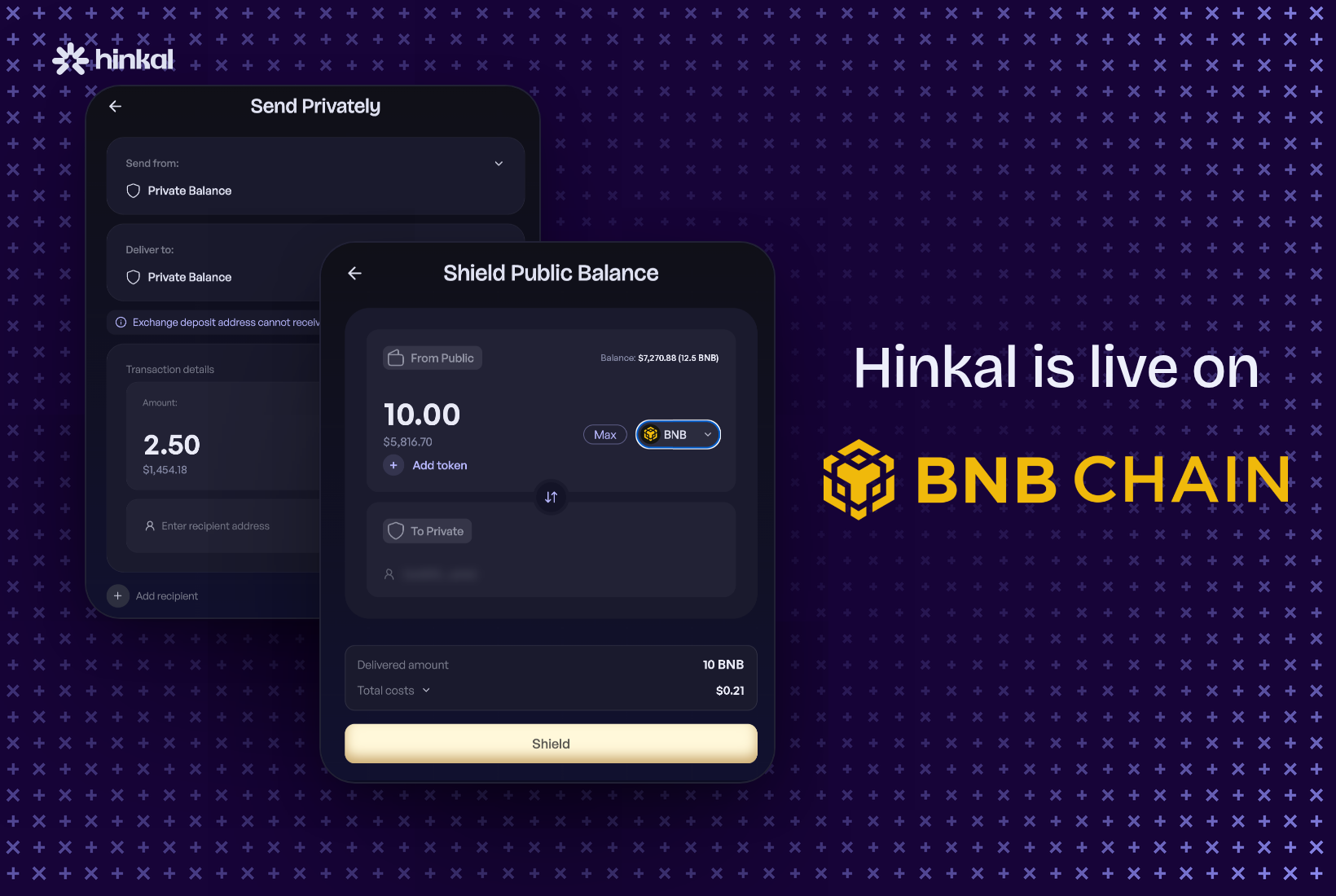
Hinkal Pay transforms individual transfers into confidential transactions. Designed for organizations needing per-transaction confidentiality without committing to continuous private operations, Private Send:
- Works with any existing wallet—no special software required
- Shields sender, recipient, and amount for individual transfers
- Requires no custody changes or ongoing commitments
- Suits one-off settlements, periodic payouts, or testing confidential workflows
Private Wallet provides continuous confidentiality for all account activity. Organizations with ongoing settlement flows, recurring payout requirements, or treasury operations benefiting from persistent confidentiality use Private Wallet to:
- Shield balances from public view on an ongoing basis
- Execute swaps, transfers, and settlements from a consistently confidential account
- Manage multi-chain assets privately across supported networks
- Maintain operational continuity for staff accustomed to consistent interfaces
Continuous vs. Per-Transaction Confidentiality
The choice between per-transaction and continuous confidentiality depends on operational patterns:
Per-Transaction (Private Send) suits:
- Periodic large settlements where confidentiality matters most
- Testing confidential settlement before broader adoption
- Organizations with variable settlement patterns
- Operations where only specific transactions require confidentiality
Continuous (Private Wallet) suits:
- Treasury operations with ongoing confidentiality requirements
- High-frequency settlement operations
- Organizations where all on-chain activity should remain confidential
- Teams preferring consistent operational workflows
Most enterprises begin with per-transaction confidentiality to validate workflows, then migrate high-volume operations to continuous confidentiality as adoption matures.
Bridging Institutional Requirements with Public Blockchain Transparency
The institutional adoption question isn't whether to use public blockchains for settlement—the efficiency gains are too significant to ignore. Settlement time reductions from days to minutes, 24/7 operation without banking hours limitations, and elimination of correspondent banking fees create compelling economics.
The Strategic Imperative of Confidentiality in Web3 Finance
The question is whether public blockchain settlement can meet institutional requirements for:
- Commercial confidentiality that traditional banking provides by default
- Regulatory compliance through auditable but not public transaction records
- Operational security that doesn't expose treasury positions to market observers
- Competitive positioning that doesn't hand intelligence to rivals
Protocol-level confidentiality resolves this tension. Enterprises capture the speed, cost, and availability benefits of blockchain settlement while maintaining the confidentiality expectations of traditional finance.
Future-Proofing Enterprise Operations On-Chain
The confidentiality gap between blockchain transparency and institutional requirements represents a temporary market condition, not a permanent limitation. As confidential settlement protocols mature:
- First-mover advantages accrue to enterprises implementing confidential settlement before competitors
- Regulatory clarity will increasingly distinguish between compliant confidential protocols and non-compliant alternatives
- Operational sophistication develops as teams gain experience with confidential workflows
- Counterparty expectations shift as confidential settlement becomes standard practice
Organizations implementing confidential settlement now build operational experience, develop compliance frameworks, and establish counterparty relationships before these capabilities become table stakes.
Why Hinkal Delivers Confidential Settlement for Enterprise Payment Operations
While multiple approaches to blockchain confidentiality exist, Hinkal is the only platforms that provides the specific capabilities enterprise payment operations require: multi-chain confidential settlement that works with existing wallets and custody arrangements, built-in compliance controls, and zero setup for recipients.
What Makes Hinkal Different
Hinkal addresses the complete enterprise confidential settlement requirement:
Multi-Chain Coverage Without Migration: Hinkal operates across Ethereum, Solana, Tron, Polygon, Base, Arbitrum, Optimism, Arc, and Tempo. Your settlement flows work across all major chains without implementing separate confidentiality solutions for each network.
Three-Dimensional Confidentiality: Hinkal shields sender identity, recipient identity, and transaction amount simultaneously. Partial confidentiality that exposes any dimension allows observers to reconstruct commercial relationships—Hinkal eliminates this gap.
Existing Wallet Compatibility: Neither senders nor recipients need new wallets. Your custody arrangements remain intact. Recipients connect their existing wallet and see their confidential balance immediately.
Built-In Compliance Architecture: Viewing keys enable selective disclosure to auditors and regulators. Chainalysis KYT integration blocks flagged wallets at the deposit layer. The compliance posture supports institutional adoption, not avoidance.
SDK Integration: The Confidential Payments SDK enables developers to build confidential settlement flows directly into existing products. Available via npm, the SDK allows integration without changing custody, wallets, or payment rails.
Practical Applications for Your Operations
For PSPs, Hinkal enables confidential merchant settlement without exposing merchant economics or counterparty relationships. Merchants connect their existing wallet to access funds—no merchant-side integration required.
For OTC desks, Hinkal enables confidential bilateral settlement. Trade volumes, wallet patterns, and counterparty relationships stay private even while settling on public chains. Counterparties access confidential balances using their existing infrastructure.
For treasury teams, Hinkal enables confidential capital movement and liquidity rebalancing. Strategy and counterparty information stay private. No broadcast of treasury structure or allocation decisions.
Organizations ready to evaluate confidential settlement for their operations can schedule a technical discussion to explore implementation requirements for their specific use case.
Frequently Asked Questions
What information does confidential settlement keep private?
Confidential settlement protocols shield three critical data points: sender identity, recipient identity, and transaction amount. All three must be protected simultaneously—partial confidentiality that exposes any dimension allows determined observers to reconstruct commercial relationships. The settlement itself remains publicly verifiable on the blockchain, confirming that a valid transaction occurred and protocol rules were followed. But the commercial details embedded in that settlement—who paid whom and how much—remain encrypted and accessible only to authorized parties holding viewing keys.
Do I need to change my existing wallet or custody solution?
No. Protocol-level confidential settlement works with your existing wallets and custody arrangements. Your treasury wallets, custodian relationships, key management practices, and operational workflows remain intact. Recipients also use their existing wallets—they connect their wallet to see their confidential balance without any migration or new infrastructure. This architecture eliminates the operational risk, compliance complexity, and staff retraining that would make adoption impractical if new custody solutions were required.
How does confidential settlement maintain regulatory compliance?
Confidential settlement protocols designed for institutional use include built-in compliance mechanisms. Selective disclosure via viewing keys allows authorized parties—auditors, regulators, compliance teams, or exchange partners—to decrypt specific transactions on demand. KYT (Know Your Transaction) enforcement through integration with blockchain analytics providers blocks flagged wallets at the deposit layer, preventing funds from sanctioned entities or illicit activity from entering the confidential flow. For high-value transactions, zero-knowledge proofs can confirm user verification status without revealing identity data. This compliance architecture distinguishes institutional protocols from tools designed to avoid oversight.
Which blockchain networks support confidential settlement?
Institutional-grade confidential settlement protocols support multiple chains including Ethereum, Solana, Tron, and major EVM-compatible networks like Polygon, Base, Arbitrum, and Optimism. Multi-chain compatibility matters because enterprise payment operations rarely operate on a single blockchain—PSPs may settle on different chains for different merchants, OTC desks execute across whichever chains counterparties prefer, and treasury teams move assets across multiple networks. A single confidential settlement integration spans your entire multi-chain operation without implementing separate solutions for each network.
What is the difference between per-transaction and continuous confidentiality?
Per-transaction confidentiality (like Private Send) transforms individual transfers into confidential transactions—useful for periodic large settlements, testing workflows, or operations where only specific transactions require confidentiality. Continuous confidentiality (like Private Wallet) shields all account activity on an ongoing basis—better for treasury operations with persistent confidentiality requirements, high-frequency settlement, or organizations where all on-chain activity should remain private. Most enterprises begin with per-transaction confidentiality to validate workflows, then migrate high-volume operations to continuous confidentiality as adoption matures.
How long does it take to implement confidential settlement?
Enterprise implementations typically require 8-12 weeks from pilot to production, including architecture planning, infrastructure setup, protocol integration, compliance configuration, security validation, and staged production deployment. This timeline reflects enterprise requirements for security validation and compliance review, not technical complexity. Organizations with existing blockchain infrastructure, clear compliance frameworks, and experienced development teams often complete integration faster. The SDK integration path provides documentation and support resources that reduce implementation overhead for technical teams.

























































.png)
.png)











.webp)