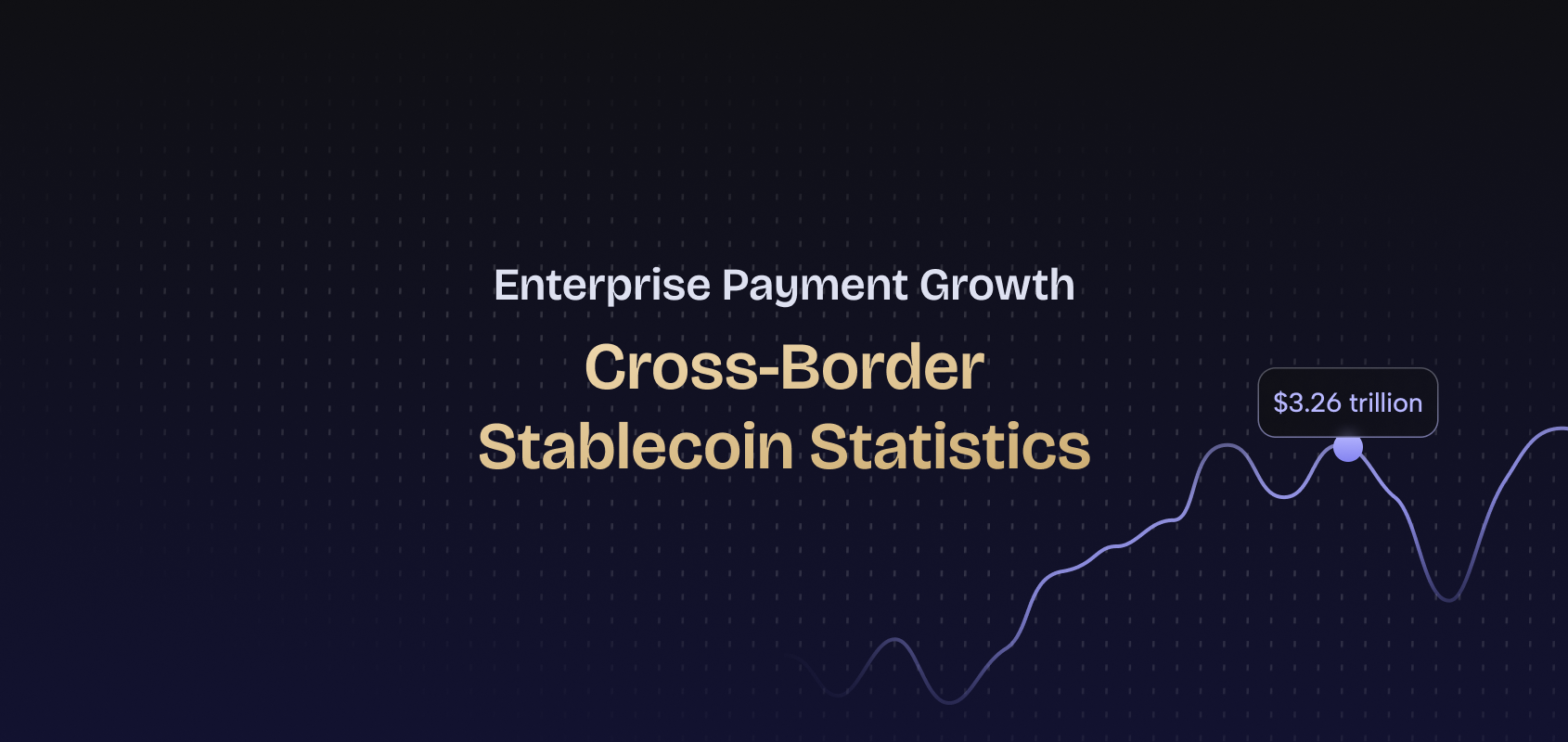
Data-driven analysis of cross-border stablecoin settlement growth, enterprise adoption trends, and the emerging need for confidential payment workflows
Cross-border stablecoin payments have moved from experimental to operational. Total stablecoin transaction volume reached $33 trillion in 2025, up 72% year-over-year—yet every settlement broadcasts sender identity, recipient identity, and transaction amount to anyone watching the blockchain. For PSPs settling with merchants, OTC desks executing bilateral trades, and treasury teams moving capital between entities, this transparency creates competitive exposure. Hinkal enables confidential stablecoin settlements on Ethereum, Solana, Tron, and Polygon without requiring recipients to change wallets, custody arrangements, or payment rails.
Key Takeaways
- Cross-border stablecoin TAM reaches $17.9 trillion — The addressable market for non-G20 countries alone represents a $17.9 trillion opportunity, with upside TAM hitting $23.5 trillion for non-G10 markets
- Stablecoins settle 500x faster than traditional rails — Specific corridors now see near-instant finality compared to 3-5 day traditional settlement windows
- Less than 1% current market penetration — Despite $33 trillion in volume, stablecoins represent under 1% of global cross-border payments—creating massive growth runway
- All settlements occur on transparent public blockchains — Every transaction exposes sender identity, recipient identity, and transaction amount to competitors, counterparties, and market observers
The Explosive Growth of Cross-Border Stablecoin Payments: 2026 Projections
1. $17.9 trillion total addressable market for non-G20 countries
The cross-border stablecoin market represents a $17.9 trillion TAM for non-G20 countries according to FXC Intelligence. This figure captures the scale of international payment flows currently served by correspondent banking and legacy payment networks that stablecoins can address with faster settlement and lower costs.
2. $23.5 trillion upside TAM for non-G10 markets
When expanding the analysis to non-G10 markets, the upside TAM reaches $23.5 trillion. This expanded figure accounts for emerging market corridors where traditional banking infrastructure creates the greatest friction and cost burden for cross-border settlements.
3. $33 trillion total stablecoin transaction volume in 2025
Total stablecoin transactions reached $33 trillion in 2025, marking 72% year-over-year growth according to Bloomberg. This volume milestone demonstrates that stablecoins have achieved the transaction throughput necessary to support enterprise payment operations at scale.
4. $312 billion stablecoin market capitalization
Stablecoin market capitalization hit $312 billion in October 2025, providing the liquidity depth required for large institutional settlements. This capitalization growth from $5.3 billion at the start of 2020 to over $300 billion represents a 57x increase in available settlement liquidity.
The Challenge of Public Blockchain Settlement for Businesses
5. Less than 1% current market penetration despite massive volume
Despite processing $33 trillion in transactions, stablecoins currently represent less than 1% of global cross-border payment volume. This gap between transaction activity and market penetration highlights both the growth opportunity and a key barrier: enterprises hesitate to expose settlement data on transparent public blockchains.
Every stablecoin settlement broadcasts three critical data points to anyone watching the blockchain:
- Sender identity — Your wallet address reveals your entire transaction history
- Recipient identity — Counterparty relationships become publicly visible
- Transaction amount — Settlement volumes expose commercial economics
For PSPs settling merchant funds, this transparency reveals merchant economics and counterparty relationships. For OTC desks, it exposes trade volumes and operational patterns. For treasury teams, it broadcasts capital movements and rebalancing strategies.
Hinkal's Confidential Payments SDK addresses this challenge by shielding all three data points while settlement remains publicly verifiable on-chain. Recipients connect their existing wallet to access a confidential balance—no migration, no new wallet, no integration required on the recipient side.
6. 500 million unique stablecoin wallet addresses by Q3 2025
Unique stablecoin wallet addresses increased from 350 million in 2023 to over 500 million as of Q3 2025. Each wallet creates a permanent, searchable record of transaction history that competitors and counterparties can analyze to map business relationships and payment patterns.
Settlement Speed and Cost Efficiency
7. 500x faster settlement than traditional systems
Stablecoins enable settlements 500x faster than traditional systems in specific corridors according to FXC Intelligence. Euro settlements in Brazil, for example, achieve near-instant finality compared to multi-day correspondent banking processes.
8. Only 35% of traditional payments settle within one hour
Only 35% of retail cross-border payments reach beneficiaries within one hour using traditional methods, far below the G20 target of 75%. Stablecoin settlements achieve finality in minutes or seconds, creating a clear operational advantage for payment companies willing to accept blockchain transparency trade-offs.
Multi-Chain Stablecoin Activity
9. $6 billion monthly B2B stablecoin payments by mid-2025
Stablecoin-based B2B payments surged from under $100 million monthly in early 2023 to over $6 billion by mid-2025. This 60x growth in monthly B2B volume demonstrates that enterprise adoption has moved past experimentation into operational deployment.
10. $19 billion annualized remittance and P2P stablecoin payments
Stablecoin remittances and P2P payments hit a $19 billion annualized run rate by August 2025 according to Artemis Analytics. The average stablecoin P2P transfer size was $47 compared to $250 for traditional remittances, indicating high transaction frequency that creates detailed payment pattern data.
11. $300 billion crypto volume in South Asia driven by stablecoins
South Asia saw stablecoin-driven crypto volumes rise 80% to $300 billion between January and July 2025. This regional concentration demonstrates how specific corridors are adopting stablecoin settlements at scale—and creating regionally-concentrated transaction data that reveals market positioning.
Institutional Adoption and the Regulatory Landscape
12. 131% growth in consumer-to-business stablecoin payments
Consumer-to-business stablecoin payments grew 131% in 2025, making it one of the fastest-growing stablecoin payment categories. This C2B growth expands the surface area of on-chain payment data, creating detailed customer payment profiles that become visible to anyone analyzing blockchain activity.
13. $3.5 billion Visa stablecoin-linked card spend with 460% growth
Visa's stablecoin-linked card spend reached a $3.5 billion annualized run rate in Q4 FY2025, marking 460% year-over-year growth. This card program growth demonstrates institutional commitment to stablecoin settlement infrastructure.
14. $4.5 billion Visa stablecoin settlement volume
Visa stablecoin settlement volumes hit $4.5 billion in annualized run rate as of January 2026. Card programs settling through stablecoins create predictable, traceable payment patterns that reveal program economics to on-chain observers.
15. $177.6 billion in Treasury exposure for Tether and Circle at end Q2 2025
Tether and Circle have $177.6 billion in total U.S. Treasury exposure at the end of Q2 2025, underscoring how large dollar-backed stablecoins have become as holders of short-dated government-linked reserve assets.
For enterprises operating in regulated environments, Hinkal's compliance framework provides selective disclosure via Viewing Keys, KYT enforcement via Chainalysis integration, and optional custom pool deployments for institutions requiring enhanced oversight capabilities.
Future Projections and Market Trajectory
Stablecoins are projected to handle 5-10% of all cross-border payments by 2030 according to EY, equivalent to $2.1-4.2 trillion annually. Stablecoin supply is forecast to reach $1.9 trillion (base case) to $4 trillion (aggressive scenario) by 2030. Crypto card spending, often backed by stablecoins, exceeded $18 billion on an annualized basis in early 2026.
Why Confidential Settlement Matters Now
The statistics above paint a clear picture: stablecoin cross-border payments are scaling rapidly toward enterprise adoption. The efficiency advantages—500x faster settlement, 24/7 finality—make stablecoins compelling for PSPs, OTC desks, and treasury operations.
But every efficiency gain comes with transparency exposure. When settlement volumes scale to billions, public blockchain data becomes a competitive intelligence goldmine:
- PSPs expose merchant economics and counterparty relationships
- OTC desks reveal trade volumes and wallet patterns
- Treasury teams broadcast rebalancing strategies and inter-entity flows
- Payroll operations disclose headcount, pay cycles, and contractor relationships
Hinkal addresses this gap by providing confidential stablecoin settlements that shield sender identity, recipient identity, and transaction amount while maintaining verifiable settlement on public blockchains. The Institutional Use Cases span PSP settlement, OTC desk operations, treasury management, and payroll—each benefiting from zero recipient-side setup requirements.
With $400M+ processed, Hinkal demonstrates that confidential settlement works at enterprise scale without requiring new wallets, custody changes, or network migrations.
Frequently Asked Questions
Why is confidentiality important for cross-border stablecoin payments in 2026?
Cross-border stablecoin payments now process $33 trillion annually on public blockchains where every settlement exposes sender identity, recipient identity, and transaction amount. For enterprises, this transparency reveals merchant economics, counterparty relationships, and operational patterns to competitors and market observers.
How does Hinkal ensure compliance while maintaining transaction confidentiality?
Hinkal provides three compliance controls: selective disclosure via Viewing Keys that allow revealing full or partial transaction history to auditors or regulators on demand, KYT enforcement via Chainalysis integration that blocks flagged wallets at the deposit level, and an Integrity Check for transactions over $1,000 using zero-knowledge proofs. Hinkal receives only a cryptographic proof confirming verification status—never names, IDs, or personal documents.
Can businesses use their existing wallets for confidential stablecoin settlements with Hinkal?
Yes. Hinkal's primary differentiator is zero setup for recipients. The sender routes funds through Hinkal's smart contract into a confidential balance linked to the recipient's existing wallet. The recipient connects their existing wallet and sees the confidential balance—no migration, no new wallet, no integration required on the recipient side. This frictionless flow works across PSPs settling with merchants, OTC desks settling with counterparties, and companies paying employees or vendors.
What specific data points does Hinkal shield during a stablecoin settlement?
Hinkal shields three critical data points: sender identity, recipient identity, and transaction amount. Most alternatives shield only one dimension—hiding the sender but not the amount still exposes enough data for a competitor to map volumes and counterparty relationships. Settlement remains publicly verifiable on the blockchain, but the commercial relationships and financial details stay confidential.
Is Hinkal non-custodial, and how does this protect enterprise funds?
Hinkal is non-custodial. Hinkal does not store, send, or receive funds or cryptoassets. Enterprises retain control via their private keys, which Hinkal does not access. This architecture means that confidential settlements operate through smart contracts on Ethereum, Solana, Tron, and other public chains without introducing custody risk or counterparty dependency.

























































.png)
.png)








.webp)