Data-driven analysis of enterprise stablecoin settlement confidentiality: why payment companies, PSPs, and treasury teams need protocol-level privacy for on-chain payouts
Stablecoins processed $46 trillion in transaction volume over the past year, yet nearly every dollar moved on public blockchains exposes sender identity, recipient identity, and transaction amount to competitors, counterparties, and market observers. For PSPs settling merchant funds, OTC desks executing bilateral trades, and treasury teams moving capital between entities, this transparency creates material business risk. Hinkal addresses this gap by enabling confidential settlements on Ethereum, Solana, Tron, and Polygon—shielding all three data points while maintaining verifiable settlement and compliance controls.
Key Takeaways
- Stablecoin settlement volumes are massive—and fully transparent — $9 trillion in adjusted volume flowed on-chain in the past year, exposing commercial relationships and operational patterns to anyone with a block explorer
- Only 11.4% of crypto transactions were confidential — The vast majority of on-chain activity remains visible, creating a confidentiality gap for enterprises adopting stablecoins
- Enterprise adoption is accelerating without privacy controls — 54% of enterprises not yet using stablecoins plan to adopt within 6-12 months
- B2B stablecoin payments surged 30x — Monthly volumes grew from under $100 million to over $3 billion in two years
- 97 countries now have digital asset frameworks — Regulatory infrastructure is expanding rapidly, making compliance-ready confidentiality essential
- Cross-border supplier payments lead use cases — 77% of corporates cite this as their top stablecoin application
The Stablecoin Settlement Explosion: Volume Statistics That Demand Confidentiality
1. Stablecoins processed $46 trillion in transaction volume over the past year
This staggering figure of $46 trillion represents more than just trading activity—it includes settlement flows, treasury movements, payroll, and vendor payouts. Every transaction broadcasts commercial intelligence to anyone monitoring the blockchain.
2. Adjusted stablecoin transaction volume reached $9 trillion, up 87% year-over-year
When filtering for genuine economic activity (excluding wash trading and arbitrage), stablecoins still processed $9 trillion in adjusted volume. This 87% growth rate signals that enterprises are moving real money on-chain—without corresponding growth in confidentiality tools.
3. Stablecoins now comprise 30% of all on-chain crypto transaction volume
Nearly one-third of all blockchain transactions involve stablecoins. For payment companies and PSPs, this concentration means their settlement activity is increasingly visible within the most-watched segment of on-chain finance.
4. B2B stablecoin payments surged from under $100 million to over $3 billion monthly
This 30x increase in two years demonstrates that business-to-business settlement on stablecoins has moved from experimental to operational. Yet this growth occurred without corresponding enterprise-grade confidentiality solutions—until now. The Confidential Payments SDK enables companies to integrate confidentiality into existing settlement workflows without changing custody arrangements.
The Confidentiality Gap: Why 88.6% of Transactions Remain Exposed
5. Only 11.4% of crypto transactions were confidential in Q1 2025
This 11.4% figure reveals the scale of enterprise exposure. When a PSP settles merchant funds or an OTC desk completes a bilateral trade, the transaction details—sender identity, recipient identity, and amount—are visible to: competitors mapping settlement patterns, counterparties gaining negotiation leverage, market observers tracking treasury movements, and analysts reverse-engineering commercial relationships
6. Stablecoin transaction volume increased 83% between January-July 2025
Stablecoin transaction volume increased 83% during the first seven months of 2025, showing sustained acceleration. Enterprise adoption is outpacing the development of confidentiality controls, creating an expanding gap between transaction volume and protected settlement flows.
7. Active stablecoin wallets grew 53% year-over-year, from 19.6 million to over 30 million
Active stablecoin wallets grew 53% year-over-year, from 19.6 million to over 30 million. More wallets mean more observable on-chain relationships—and more opportunities for competitors to map payment networks, identify vendor relationships, and track treasury activity.
Enterprise Adoption: The Rush to Stablecoins Without Privacy Controls
8. 54% of enterprises not yet using stablecoins plan to adopt within 6-12 months
54% of enterprises not yet using stablecoins plan to adopt within 6-12 months, signaling imminent enterprise adoption at scale. The question for payment companies and treasury teams: will they adopt with or without confidentiality controls for their settlement flows?
9. 77% of corporates cite cross-border supplier payments as their top stablecoin use case
77% of corporates cite cross-border supplier payments as their top stablecoin use case. This use case exposes sensitive supplier relationships, payment terms, and procurement volumes to anyone monitoring public blockchains.
10. 48% of stablecoin users cite real-time settlement as the top advantage over traditional rails
48% of stablecoin users cite real-time settlement as the top advantage over traditional rails—speed drives adoption. But real-time settlement on public blockchains means real-time exposure of commercial intelligence. Hinkal Pay delivers the speed advantage while shielding sender identity, recipient identity, and transaction amount.
11. More than 1% of all U.S. dollars now exist as tokenized stablecoins on public blockchains
More than 1% of all U.S. dollars now exist as tokenized stablecoins on public blockchains, quantifying the scale of dollar-denominated value flowing through transparent networks. For enterprises, this means a growing share of their treasury and settlement activity occurs on rails where competitors can observe every movement.
Regional Growth: Where Confidential Settlement Demand Is Emerging
12. US crypto transaction volume rose approximately 50% between January-July 2025
US crypto transaction volume rose approximately 50% between January-July 2025, with US transaction volume exceeding $1 trillion in the first seven months of 2025. This growth occurs in a regulatory environment where enterprises need both compliance controls and commercial confidentiality.
13. South Asia emerged as the fastest-growing region with 80% increase in crypto adoption
South Asia emerged as the fastest-growing region with an 80% increase in crypto adoption. Payment companies serving cross-border corridors involving this region face increasing exposure as volumes grow.
14. APAC saw 69% year-over-year increase in on-chain activity
APAC saw a 69% year-over-year increase in on-chain activity, confirming Asia-Pacific as a major growth driver. Enterprises operating across APAC markets need confidential settlement capabilities to protect commercial relationships spanning multiple jurisdictions.
Compliance and Regulatory Landscape: Why Selective Disclosure Matters
15. 97 countries now have dedicated regulatory frameworks addressing digital asset privacy
Up from 79 countries in 2023, 97 countries now have dedicated regulatory frameworks addressing digital asset privacy. Enterprises need confidentiality solutions that work within—not against—regulatory requirements.
Hinkal's compliance framework addresses this through:
- Selective disclosure via Viewing Keys — Reveal full or partial transaction history to auditors, regulators, or internal compliance teams on demand
- KYT enforcement via Chainalysis — Block flagged wallets at the deposit level to prevent tainted funds
- Custom pool deployments — Configurable compliance logic for heavily regulated entities
16. Illicit volume as a proportion of overall crypto volume fell to 1.2% in 2025
Illicit volume as a proportion of overall crypto volume fell to 1.2% in 2025, down from 1.3% in 2024. This trend supports the case for compliance-ready confidentiality—legitimate enterprise use cases dominate the market.
17. Stablecoins are now the #17 holder of U.S. Treasuries, holding over $150 billion
Stablecoins are now the #17 holder of U.S. Treasuries, holding over $150 billion, positioning stablecoins as a significant institutional asset class. The institutional adoption driving this Treasury holding demands institutional-grade confidentiality controls for settlement workflows.
Infrastructure and Technology: The Foundation for Confidential Settlement
18. Blockchains now process 3,400 transactions per second
Blockchains now process 3,400 transactions per second—throughput has increased 100x in the past five years. This capacity expansion supports enterprise-scale settlement volumes—but also means enterprise-scale exposure without confidentiality solutions.
19. Over $175 billion sits in Bitcoin and Ethereum exchange-traded products
Over $175 billion sits in Bitcoin and Ethereum exchange-traded products, documenting institutional capital flowing into digital assets. Treasury teams managing these positions need confidential on-chain operations to prevent market observers from front-running or reverse-engineering their strategies.
20. Digital asset treasury companies collectively hold about 4% of total Bitcoin and Ethereum
Digital asset treasury companies collectively hold about 4% of total Bitcoin and Ethereum, quantifying corporate treasury exposure. For these companies, every treasury movement on public chains broadcasts their holdings, rebalancing activity, and operational patterns.
21. There are roughly 40-70 million active crypto users
There are roughly 40-70 million active crypto users—active monthly users have grown by approximately 10 million over the past year. As the user base expands, so does the audience capable of monitoring and analyzing public settlement activity.
Risk and Security: What Transparency Costs Enterprises
22. 45% of financial institutions experience fraud and cybercrime annually
45% of financial institutions experience fraud and cybercrime annually, highlighting the security environment in which enterprises operate. Public transaction data provides intelligence that bad actors can exploit—from identifying high-value targets to timing attacks around settlement activity.
23. Retail transactions rose by more than 125% between January-September 2024 and 2025
Retail transactions rose by more than 125% between January-September 2024 and 2025, documenting retail growth. For PSPs and payment companies, growing retail transaction volumes mean growing exposure of customer payment patterns and merchant settlement flows.
24. 716 million people own crypto globally, representing 16% growth from the prior year
716 million people own crypto globally, representing 16% growth from the prior year—this figure includes both active and passive holders. As ownership expands, so does the pool of observers capable of analyzing on-chain data—and the commercial value of the intelligence exposed through transparent settlement.
The Zero-Setup Advantage: Confidential Settlement Without Migration
What distinguishes Hinkal from alternative approaches is the zero-setup requirement for recipients. When a PSP settles merchant funds through Hinkal:
- The sender routes funds through Hinkal's smart contract into a confidential balance linked to the recipient's existing wallet
- The recipient connects their existing wallet and sees the confidential balance
- No migration, no new wallet, no recipient-side integration required
This "one button, frictionless flow" applies across all enterprise verticals:
- PSPs settling with merchants — Merchant economics and counterparty relationships remain confidential
- Companies paying employees — Headcount, pay cycles, and salary costs stay private
- OTC desks settling with counterparties — Trade volumes and wallet patterns are shielded
- iGaming operators paying recipients — Operator economics and customer payouts remain confidential
The recipient controls the confidential balance via their existing wallet on any supported chain—Ethereum, Solana, Tron, Polygon, Base, Arbitrum, or Optimism.
Implementation Considerations for Enterprise Teams
For payment companies and treasury teams evaluating confidential settlement solutions, several factors determine success:
Integration complexity — Hinkal's SDK is available via npm (@hinkal/common), enabling developers to build confidential payment flows directly into existing applications without changing custody arrangements or payment rails.
Compliance readiness — Hinkal enforces Know Your Transaction (KYT) via Chainalysis integration, blocking flagged wallets at the deposit level. Viewing Keys enable selective disclosure to auditors and regulators on demand.
Multi-chain coverage — Enterprises operating across multiple blockchains need a solution that works consistently across Ethereum, Solana, Tron, and Polygon without fragmenting workflows or requiring chain-specific implementations.
Non-custodial architecture — Hinkal never holds or controls user assets. Users retain control via their private keys, maintaining the self-custody model that enterprises require for treasury operations.
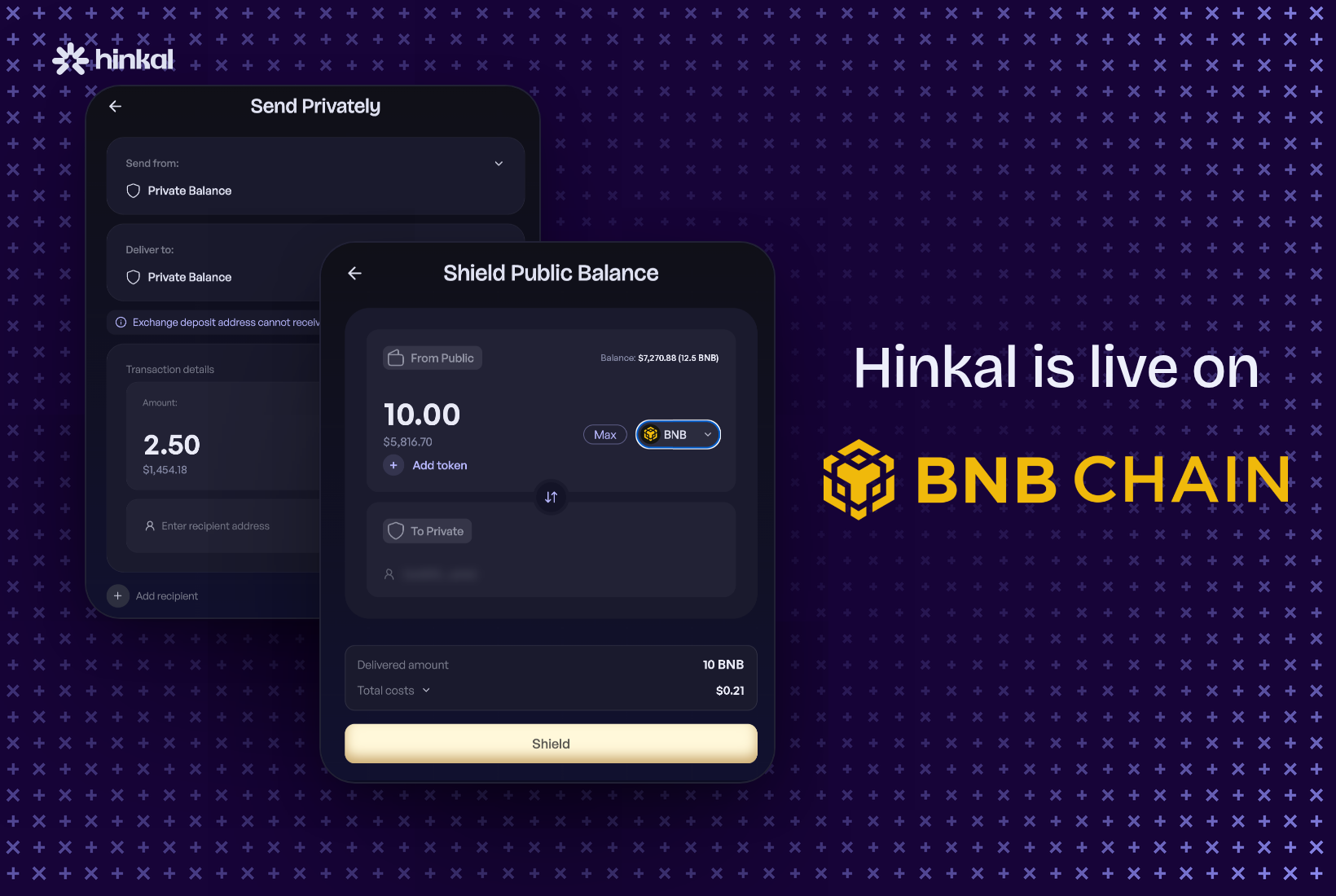
Hinkal has processed over $400M in private on-chain volume, with 6 independent security audits validating the architecture.
Frequently Asked Questions
What data is shielded in a confidential settlement on Hinkal?
Hinkal shields three critical data points: sender identity, recipient identity, and transaction amount. Settlement remains publicly verifiable on the blockchain, but the commercial relationships and financial details are protected from competitors, market observers, and counterparties. Most alternatives shield only one dimension—protecting the sender but not the amount still allows competitors to map volumes and operational patterns.
How does Hinkal differ from privacy-focused blockchains?
Hinkal operates on public chains that enterprises already use—Ethereum, Solana, Tron, and Polygon—rather than requiring migration to a separate network. This approach lets companies maintain existing custody arrangements, wallets, and settlement workflows while adding confidentiality. There's no new chain to integrate, no new custody to arrange, and no recipient-side setup required.
Can regulators and auditors access transaction details when needed?
Yes. Hinkal provides selective disclosure via Viewing Keys, allowing enterprises to reveal full or partial transaction history to auditors, regulators, exchanges, or internal compliance teams on demand. This capability distinguishes Hinkal from purely anonymous systems and enables enterprises to meet regulatory requirements while maintaining operational confidentiality.
Does the recipient need to be a Hinkal user before receiving funds?
No. The sender routes funds through Hinkal's smart contract into a confidential balance linked to the recipient's existing wallet address. The recipient simply connects their existing wallet to see and control the confidential balance—no advance setup, no new wallet, no migration required. This zero-setup model removes friction for PSPs settling with merchants, companies paying vendors, and OTC desks settling with counterparties.
What compliance controls does Hinkal provide for enterprise users?
Hinkal offers three compliance mechanisms: Selective Disclosure via Viewing Keys for revealing transaction history to authorized parties; KYT Enforcement via Chainalysis integration that blocks flagged wallets at the deposit level; and Custom Pool Deployments with configurable compliance logic for heavily regulated entities. For transactions over $1,000, Hinkal requires an Integrity Check to comply with US/EU AML/CFT regulations and block sanctioned entities.























































.png)
.png)




.webp)