Data-driven analysis revealing why enterprises are prioritizing confidential settlements and what the numbers mean for payment companies, PSPs, and treasury teams
Every stablecoin settlement your company executes on a public blockchain broadcasts sensitive financial data to competitors, market observers, and anyone with a block explorer. With over 820 million active cryptocurrency wallets now operating globally and institutional adoption accelerating, the confidentiality gap in enterprise payment workflows has become impossible to ignore. Companies leveraging Hinkal for confidential settlements report the ability to shield sender identity, recipient identity, and transaction amount — the three critical data points that expose commercial relationships and operational strategy when left visible on-chain.
Key Takeaways
- Institutional wallet ownership surged 51% in 2025 — now accounting for over 31 million crypto wallets, signaling enterprise-scale adoption of on-chain payments
- Self-custody dominates enterprise preference — 59% of users globally prefer non-custodial solutions, demanding confidentiality without sacrificing asset control
- Security vulnerabilities remain pervasive — approximately 90% of browser-based wallets have at least one exploitable security flaw
- $2.7 billion in crypto stolen in 2025 — with 23.35% from personal wallets, making wallet-level confidentiality essential for protection
- Zero-knowledge proof adoption projected to reach 25% — privacy-preserving verification is becoming standard for enterprise compliance workflows
- 68% of transactions now flow through self-custodial wallets — enterprises increasingly demand control over settlements
Public blockchain transparency creates an existential problem for enterprise payment operations. Every settlement, every payout, every treasury movement becomes permanently visible intelligence for competitors, counterparties, and market observers. When your PSP settles merchant funds on Ethereum or Solana, anyone can trace settlement volumes, counterparty relationships, and operational patterns in real-time.
The scale of this exposure is substantial. With institutional wallet ownership growing 51% in 2025 alone, enterprise-scale on-chain activity has reached a tipping point where confidentiality is no longer optional — it's a competitive necessity.
1. Over 820 million active cryptocurrency wallets exist globally in 2025
The sheer volume of active wallets worldwide means more counterparties, more observers, and more potential exposure for every settlement. This proliferation of wallet activity creates a dense network where transaction patterns become easier to analyze and commercial relationships become simpler to map.
2. 59% of crypto wallet users globally prefer non-custodial solutions
The preference for self-custody wallets reflects enterprise demand for control — but control without confidentiality leaves companies vulnerable to competitive intelligence gathering. Organizations want to own their keys while keeping their financial operations private.
3. Institutional wallet ownership grew 51%, now exceeding 31 million wallets
This dramatic growth in institutional adoption means more enterprise capital flowing through transparent public chains. Treasury teams, payment processors, and OTC desks face mounting pressure to protect settlement data that's visible to everyone by default.
Shielding Identities and Amounts: The Core of Wallet Privacy
4. 78% of all crypto wallets are hot wallets (online, connected)
The dominance of hot wallet usage means most enterprise wallets maintain persistent network connections, making transaction patterns continuously observable. This always-on visibility creates a constant stream of competitive intelligence for anyone monitoring the chain.
5. 68% of crypto transactions processed via self-custodial wallets by Q3 2025
The shift toward self-custodial transaction processing reflects institutional preference for direct control — but without confidentiality solutions, this control comes with permanent transparency. Every self-custodial settlement publishes irrevocable data about your business operations.
6. Hardware wallet sales increased 31% in 2025
The surge in hardware wallet adoption signals rising security consciousness among institutional users. However, hardware wallets alone don't address the on-chain transparency problem — they secure keys while transactions remain publicly visible.
Frictionless Confidentiality: When 'No Setup Needed' Becomes a Business Imperative
7. 35.09% of wallet downloads went to Trust Wallet in March 2025
The fragmented wallet market landscape — with Trust Wallet commanding just over a third of downloads — means enterprises cannot assume counterparties use compatible infrastructure. Any confidentiality solution requiring specific wallet adoption faces immediate scalability constraints.
8. MetaMask captured 13.74% of total wallet downloads
The second-place position of MetaMask in downloads reinforces the fragmentation challenge. With no single wallet dominating the market, enterprises need confidentiality solutions that work across all wallet types without requiring counterparty migration.
9. 71% of crypto users reported increased awareness of self-custody in 2025
Growing self-custody awareness means more users — and more enterprise counterparties — want to control their own keys. Solutions requiring custody changes or specialized wallet deployments face resistance from this increasingly sophisticated user base.
The Rise of Compliance-Ready Privacy Protocols for Institutions
10. 25% projected adoption of zero-knowledge proof features by 2025
The rising adoption of ZK-based verification reflects institutional demand for privacy that satisfies compliance requirements. Zero-knowledge proofs enable enterprises to demonstrate verification status without revealing underlying identity data — a critical capability for regulated settlement operations.
11. 9 million institutional multi-signature wallet deployments reached in 2025
The scale of multi-sig adoption demonstrates institutional commitment to security governance. However, multi-signature controls address authorization, not visibility — transactions from multi-sig wallets remain as publicly observable as any other.
12. 84% of mobile wallets adopted biometric authentication in 2025
The near-universal biometric authentication adoption shows security investment priorities for wallet providers. Yet authentication controls who can initiate transactions — they don't address who can observe those transactions after execution.
Multi-Chain Confidentiality: Expanding Enterprise Reach and Flexibility
13. North America accounts for 134 million wallet users — approximately 16% of global users
The substantial North American wallet base operates across Ethereum, Solana, Tron, and multiple EVM chains. Enterprises serving this market need confidentiality solutions that match their multi-chain settlement infrastructure.
14. Asia-Pacific region wallet adoption reached 350 million users — 43% of global share
The dominant Asia-Pacific base transacts heavily on Tron and alternative EVM chains. Payment companies with cross-border operations require confidentiality that spans the chains their counterparties actually use.
15. Crypto wallet market projected to reach $100.77 billion by 2033
The massive projected market growth — at a 26.3% CAGR — signals continued multi-chain proliferation. Enterprises investing in confidentiality infrastructure today need solutions that scale across emerging chains, not just current leaders.
Non-Custodial Privacy: Retaining Control in a Confidential Environment
16. 59% of users prefer non-custodial wallets over custodial alternatives
The strong preference for self-custody among the majority of crypto wallet users reflects institutional demand for direct asset control. Enterprises won't adopt confidentiality solutions that require entrusting funds to third parties.
17. Self-custodial wallets processed 68% of transactions by Q3 2025
The dominant transaction share through self-custody demonstrates that enterprises have already voted with their wallets — they want control. Confidentiality solutions must preserve this control, not compromise it.
Security Threats Driving Enterprise Confidentiality Demand
18. $2.7 billion in crypto stolen in 2025 — the highest year on record
The staggering theft volume demonstrates that on-chain visibility creates targeting opportunities for sophisticated attackers. Enterprises with visible high-value wallets become primary targets.
19. 23.35% of stolen funds came from personal wallet compromises
Nearly a quarter of theft activity targeted personal wallets directly — not just exchanges. This statistic underscores why wallet-level confidentiality matters for enterprise treasury and settlement operations.
20. In 2024, 70% of stolen funds stemmed from private-key or seed-phrase compromise
The dominant attack vector through key compromise often begins with reconnaissance — identifying high-value targets through on-chain observation. Confidential settlements remove the visibility that enables target selection. This 2024 trend highlights ongoing key security concerns.
21. 48% of exchange platform breaches caused by phishing attacks in H1 2025
The prevalence of phishing-based breaches demonstrates how attackers combine on-chain intelligence with social engineering. Visible wallet activity and settlement patterns provide the foundation for targeted phishing campaigns.
22. Physical "wrench attacks" on track to be 2x higher than any previous year
The alarming increase in physical coercion attacks against crypto holders correlates directly with on-chain wealth visibility. Confidential settlements reduce the observable signals that make individuals and companies targets for physical threats.
23. 90% of browser-based wallets have at least one exploitable vulnerability
The pervasive security vulnerabilities in widely-used browser-based wallets create attack surfaces that sophisticated actors exploit. Confidentiality adds a defensive dimension — even if a wallet is compromised, transaction history and balance information remain protected.
Practical Applications: Confidentiality for B2B Financial Workflows
24. Projected 26.3% CAGR for crypto wallet market through 2033
The sustained growth trajectory indicates that on-chain payment volumes will continue expanding across PSPs, payroll platforms, OTC desks, and treasury operations. Enterprises investing in confidential settlement infrastructure now position themselves for this growth without accumulating years of visible transaction history.
Leveraging ZKPs for Privacy-Preserving Identity Verification
Zero-knowledge proofs enable enterprises to satisfy verification requirements without exposing identity data. Hinkal's Integrity Check for transactions over $1,000 uses ZK proofs via Reclaim Protocol — users prove verification status while Hinkal receives only a cryptographic proof, never seeing names, IDs, or personal documents.
This architecture satisfies AML/CFT requirements while preserving the confidentiality that enterprises need for competitive protection.
The Path Forward for Enterprise Confidential Settlements
The statistics paint a clear picture: institutional on-chain activity is scaling rapidly, security threats are intensifying, and the transparency problem creates mounting competitive risk. With 51% growth in institutional wallet ownership and $2.7 billion in theft losses, enterprises face an inflection point.
Hinkal has processed over $400M in private on-chain volume — demonstrating that confidential settlement at enterprise scale is not a future possibility but a current reality.
Frequently Asked Questions
How does Hinkal ensure confidentiality without functioning as a mixer?
Hinkal enforces Know Your Transaction (KYT) via Chainalysis integration at the deposit level, blocking sanctioned wallets and tainted funds before they enter confidential settlement pools. Additionally, Viewing Keys enable selective disclosure to auditors, regulators, or compliance teams — the opposite of mixer architecture, which provides no disclosure mechanism. For transactions over $1,000, an Integrity Check using zero-knowledge proofs verifies user status without exposing identity data.
Can businesses use Hinkal with their existing blockchain wallets and infrastructure?
Yes. Hinkal requires no custody changes, no new wallets, and no infrastructure migration. Senders integrate confidential settlement through the SDK, and recipients simply connect their existing wallet to access confidential balances. This zero-setup approach works with MetaMask, Trust Wallet, and any other wallet across supported chains.
What specific data points does Hinkal's confidentiality shield in transactions?
Hinkal shields three critical data points: sender identity, recipient identity, and transaction amount. Most alternatives protect only one or two dimensions — shielding the sender while leaving amounts visible, for example. This comprehensive approach prevents observers from mapping volumes, tracing counterparty relationships, or reconstructing commercial patterns.
How does Hinkal accommodate regulatory requirements like AML/CFT?
Hinkal's compliance framework includes selective disclosure via Viewing Keys for revealing transaction history to regulators on demand, KYT enforcement via Chainalysis blocking flagged wallets at deposit, and Integrity Checks using zero-knowledge proofs for transactions over $1,000. For heavily regulated environments, custom pool deployments offer configurable compliance logic with optional master-key visibility.
Is Hinkal a custodial solution, or do users maintain control of their assets?
Hinkal is entirely non-custodial. It never stores, sends, or receives funds or cryptoassets. Users retain complete control via their private keys, which Hinkal never accesses. This architecture eliminates counterparty risk while providing confidentiality for settlement flows — functioning as infrastructure for confidential transactions, not a custodian.
Which blockchain networks does Hinkal support for confidential transactions?
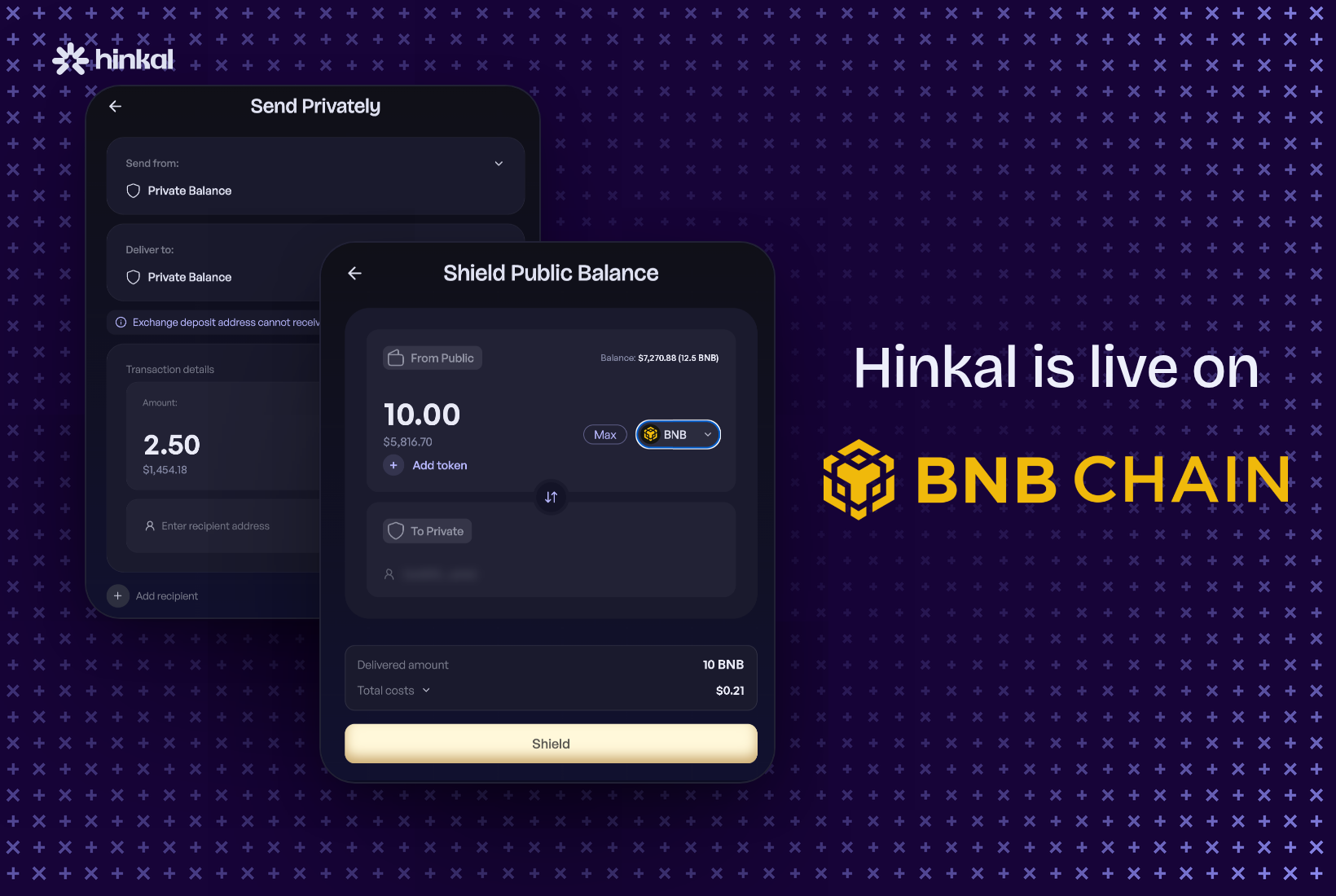
Hinkal operates across Ethereum, Solana, Tron, Polygon, Base, Arbitrum, Optimism, Arc, and Tempo. This multi-chain support enables enterprises to settle confidentially across the networks their counterparties actually use — without requiring migration to a specialized chain or compromising on settlement infrastructure flexibility.























































.png)
.png)



.webp)