Data-driven analysis of the regulatory landscape shaping enterprise stablecoin settlements and institutional blockchain adoption
The blockchain compliance market has reached a critical inflection point. With regulatory fines exceeding $2.1 billion in 2025 and enforcement agencies worldwide tightening their grip on digital asset operations, enterprises running stablecoin settlements face an unprecedented compliance challenge. Yet this same regulatory pressure creates a paradox: the demand for confidentiality in settlement flows has never been higher. Hinkal addresses this tension directly by shielding sender identity, recipient identity, and transaction amount while maintaining verifiable settlement and built-in compliance controls through selective disclosure via Viewing Keys and KYT enforcement via Chainalysis.
Key Takeaways
- Compliance spending is accelerating — The global crypto compliance market reached $3.8 billion in 2025 and is projected to hit $14.6 billion by 2034 at a 16.1% CAGR
- Enforcement has real consequences — Regulatory fines for AML failures surged 417% in H1 2025, totaling $1.23 billion across financial institutions
- User preference favors compliance with confidentiality — 31% of users prefer platforms offering zero-knowledge proof alternatives for verification
- KYC technology is maturing — 92% of centralized exchanges are now fully KYC compliant with average verification times of 3.5 minutes
The Imperative of Regulatory Compliance in Blockchain Adoption: 2026 Outlook
Regulatory compliance has shifted from a back-office function to a strategic imperative for any enterprise settling payments on public blockchains. The consequences of non-compliance now extend beyond fines to include operational shutdowns, license revocations, and reputational damage that can take years to repair.
1. $3.8 billion global crypto compliance market in 2025
The crypto compliance industry has matured into a $3.8 billion market as of 2025, reflecting the scale of enterprise investment in regulatory infrastructure. This market encompasses transaction monitoring, identity verification, risk management, and reporting tools that enterprises need to operate legally across jurisdictions. The growth signals that compliance is no longer optional for institutional participants.
2. 16.1% CAGR projects $14.6 billion market by 2034
The compliance market is expected to grow at a 16.1% CAGR through 2034, reaching $14.6 billion. This trajectory outpaces general blockchain adoption metrics, indicating that regulatory requirements are intensifying faster than overall industry growth. For PSPs and treasury teams, this means compliance costs will consume an increasing share of operational budgets without proper infrastructure.
3. $4.3 billion Binance penalty set the enforcement benchmark
The $4.3 billion penalty imposed on Binance in November 2023 for inadequate AML controls remains the largest U.S. Treasury settlement in history. This enforcement action demonstrated that regulators are willing to impose existential penalties on even the largest market participants. Enterprise settlement operations must now assume similar scrutiny applies to their activities.
4. OKX faced $500 million in AML fines
Beyond Binance, OKX received over $500 million in penalties in late 2025 for AML failures including weak KYC verification. This pattern of enforcement against major exchanges signals that regulators are systematically addressing compliance gaps across the industry. Enterprises using these platforms for settlement must verify the compliance posture of their partners.
5. Global regulatory fines surged 417% in H1 2025
Financial institution penalties totaled $1.23 billion in H1 2025, representing a 417% increase from the prior period. Much of this surge came from KYC and AML breaches at digital asset firms. This enforcement trend affects any enterprise conducting settlements on-chain, regardless of whether they consider themselves "crypto companies."
For enterprises managing stablecoin settlements, Hinkal's compliance architecture provides the selective disclosure capabilities needed to satisfy regulatory requirements while maintaining operational confidentiality.
The Evolution of Regulatory Compliance in Banking with Blockchain Technology
Traditional financial institutions are increasingly intersecting with blockchain-based payment rails. This convergence requires compliance frameworks that bridge both worlds — satisfying banking regulators while operating on public chain infrastructure.
6. 92% of centralized exchanges are fully KYC compliant
As of 2025, 92% of centralized exchanges globally have achieved full KYC compliance. This near-universal adoption creates a baseline expectation that institutional participants will meet similar standards. Treasury teams settling through exchanges can rely on this infrastructure, but direct on-chain settlements require additional compliance tooling.
7. Financial institutions represent 26.4% of compliance market revenue
Banks and traditional financial institutions account for 26.4% of revenue in the crypto compliance market. This substantial share indicates that institutional blockchain adoption is driving significant compliance investment. The integration of blockchain settlements into traditional banking workflows requires compliance solutions that satisfy both crypto-specific and traditional banking regulations.
8. Spending on AML/KYC technology reached $2.9 billion in 2025
Annual spending on AML and KYC technology hit $2.9 billion in 2025, representing a 12.3% year-over-year increase. This investment reflects the operational burden that compliance places on financial services operations. For enterprises, the question becomes whether to build these capabilities internally or integrate with compliant settlement infrastructure.
9. Manual KYC reviews cost $1,500 to $3,500 per client
Traditional manual KYC verification costs institutions between $1,500 and $3,500 per client, making automation essential for scalable operations. This cost structure creates significant friction for enterprises onboarding large numbers of settlement counterparties. Automated verification systems have become necessary for any volume settlement operation.
The Confidential Payments SDK enables enterprises to integrate confidential settlement flows without changing custody arrangements or adding compliance overhead for counterparties.
Elliptic Crypto and the Shifting Landscape of On-Chain Analytics for Compliance in 2026
Blockchain analytics has evolved from an investigative tool to a real-time compliance requirement. The integration of transaction monitoring into settlement workflows now determines which enterprises can operate and which face regulatory action.
10. Transaction monitoring holds 31.5% market share
Transaction monitoring solutions command 31.5% market share, the largest single segment. This dominance reflects regulatory expectations that all on-chain activity be monitored for suspicious patterns. Enterprises settling stablecoins must implement transaction monitoring or risk being deemed willfully blind to potential illicit activity.
11. Top 5 vendors control 48.5% of compliance market revenue
The leading compliance solution providers — including Chainalysis, Elliptic, TRM Labs, Merkle Science, and Sumsub — control approximately 48.5% of revenue. This concentration means enterprises have limited options for transaction monitoring infrastructure. Integration with these providers has become a de facto requirement for institutional operations.
12. AI reduced false-positive rates by 40-65%
Advanced analytics platforms have achieved 40-65% reductions in false-positive alert rates compared to first-generation rule-based systems. This improvement directly impacts operational efficiency by reducing the manual review burden. For settlement operations, fewer false positives means faster throughput without sacrificing compliance quality.
13. 90% of platforms implement real-time monitoring post-KYC
Beyond initial verification, 90% of centralized platforms now implement real-time transaction and wallet monitoring after KYC completion. This continuous surveillance approach has become the regulatory expectation for institutional participants. Settlement operations must maintain ongoing monitoring, not just point-in-time verification.
Hinkal enforces KYT via Chainalysis integration, blocking flagged wallets at the deposit level to prevent tainted funds from entering confidential balances — maintaining compliance without exposing settlement details to competitors.
Bridging Privacy and Compliance: Hinkal's Architecture for Institutional Blockchain
The central challenge for enterprise blockchain adoption is reconciling regulatory compliance requirements with legitimate business confidentiality needs. Public blockchain transparency exposes settlement volumes, counterparty relationships, and operational patterns to any observer.
14. 57% of users concerned about KYC data handling
A majority of crypto users — 57% — express concern about how platforms handle personal data collected during KYC processes. This concern extends to enterprise contexts where settlement data exposure creates competitive and regulatory risks. The demand exists for compliance solutions that minimize data collection while satisfying regulatory requirements.
15. 31% prefer zero-knowledge proof verification alternatives
Nearly a third of users prefer platforms offering zero-knowledge proof or privacy-preserving KYC alternatives. This preference reflects growing awareness that compliance and confidentiality need not be mutually exclusive. Enterprise decision-makers should evaluate whether their settlement infrastructure supports privacy-preserving verification.
16. 16% of systems now implement ZKP technology
Currently, 16% of systems implement zero-knowledge proof technology to verify identity without revealing underlying data. This adoption rate is growing rapidly as the technology matures. Enterprises implementing ZKP-based verification today position themselves ahead of regulatory trends favoring privacy-preserving compliance.
Hinkal Pay converts any stablecoin transfer into a confidential settlement without exposing sender identity, recipient identity, or transaction amount — while the Integrity Check uses ZK-proofs via Reclaim Protocol to verify user status without accessing personal documents.
The Role of Viewing Keys in Regulatory Reporting
Hinkal's selective disclosure architecture through Viewing Keys enables enterprises to reveal full or partial transaction history to auditors, regulators, or internal compliance teams on demand. This capability satisfies regulatory requirements for auditability while maintaining day-to-day operational confidentiality. The technology proves that confidential settlements can coexist with regulatory compliance.
Forecasting Compliance Challenges: Data Transparency vs. Commercial Confidentiality by 2026
Enterprise settlement operations face an inherent tension: public blockchains provide transparency that regulators appreciate, but this same transparency exposes commercially sensitive information to competitors, negotiation counterparties, and market observers.
17. 79% cite regulatory complexity as top challenge
Among global crypto firms, 79% cite regulatory complexity as a top-three challenge in 2025. This complexity compounds when enterprises must also protect commercial information from public exposure. The dual requirement for compliance and confidentiality creates operational challenges that standard blockchain infrastructure cannot address.
18. Average compliance costs reached $620,000 annually for mid-sized firms
Small-to-mid-sized crypto firms now spend an average of $620,000 annually on compliance, representing a 28% increase from prior periods. This cost burden falls disproportionately on firms that lack the scale to absorb compliance overhead. Settlement infrastructure that includes compliance capabilities reduces the total cost of regulatory adherence.
For PSPs settling merchant funds on public chains, the exposure of merchant economics, counterparty relationships, and operational patterns creates competitive risk. Hinkal's SDK integration lets PSPs send funds to a merchant's confidential balance — the merchant connects their existing wallet and executes payouts with no integration required on their side.
Automated Compliance: The Rise of Smart Contracts and ZK-Proofs in 2026
Automation has transformed compliance from a manual, labor-intensive function into a technology-driven capability. Smart contracts and zero-knowledge proofs enable compliance verification at the protocol level rather than through human review.
19. Over 90% of platforms use AI-based identity verification
The vast majority of crypto platforms — over 90% — now employ some form of AI or machine learning for identity verification. This automation has reduced verification times while improving accuracy. For settlement operations, AI-based verification enables rapid counterparty onboarding without sacrificing compliance quality.
20. 70% of onboarding processes expected to be fully automated
By 2025, more than 70% of platform onboarding processes are expected to achieve full automation, dramatically reducing manual review requirements. This automation trend enables enterprises to scale settlement operations without proportional increases in compliance headcount.
21. Average KYC verification time reduced to 3.5 minutes
The average KYC completion time has dropped to 3.5 minutes, with 23% of verifications completing instantly through AI-based systems. This speed improvement removes friction from counterparty onboarding and enables real-time settlement initiation. Enterprise workflows can now include verification as a seamless step rather than a multi-day process.
How ZK-TLS Verification Enhances Enterprise Confidentiality and Compliance
Hinkal's Integrity Check for transactions over $1,000 uses the ZK-TLS method via Reclaim Protocol. This generates a zero-knowledge proof on the user's device confirming prior verification on major exchanges — Hinkal receives only the cryptographic proof, never seeing names, IDs, or personal documents. The approach satisfies AML/CFT requirements while preserving user confidentiality.
Global Reach, Local Rules: The Evolution of Jurisdictional Compliance in Blockchain (2026)
International settlement operations must satisfy multiple, sometimes conflicting, regulatory regimes. The patchwork of global regulations creates compliance complexity that favors enterprises with flexible, jurisdiction-aware infrastructure.
22. North America commands 38.7% of compliance market
The North American market accounts for 38.7% of revenue, approximately $1.47 billion in 2025. This dominance reflects both the concentration of institutional activity in North America and the stringent regulatory environment under U.S. law. Enterprises targeting North American markets face the highest compliance standards globally.
23. Only 40 of 138 jurisdictions are "largely compliant" with FATF standards
Despite regulatory momentum, only 40 of 138 jurisdictions evaluated by FATF have achieved "largely compliant" status with crypto standards as of April 2025. This compliance gap creates risk for enterprises operating across jurisdictions. Settlement infrastructure must accommodate varying compliance requirements across markets.
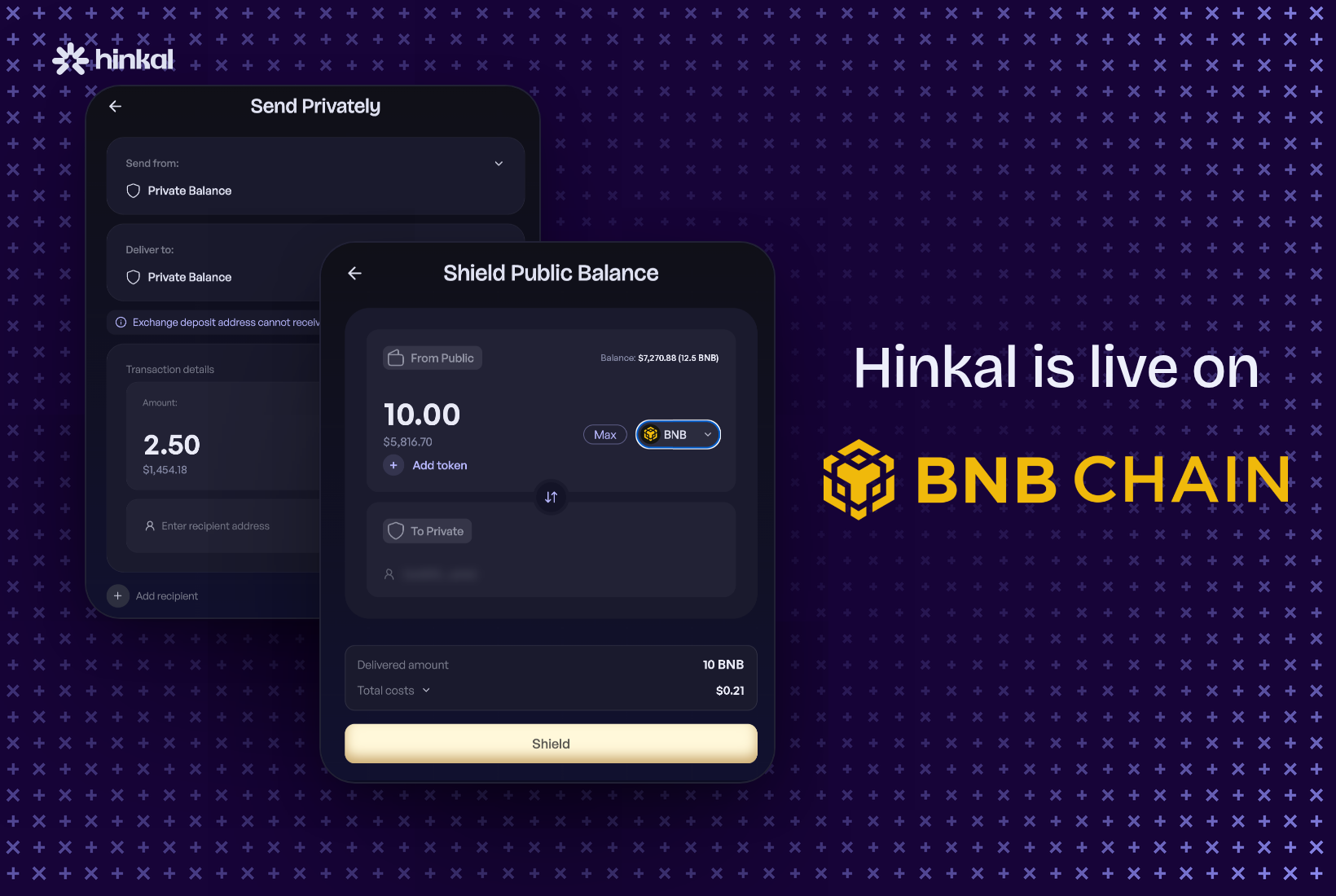
Hinkal operates across Ethereum, Solana, Tron, Polygon, Base, Arbitrum, Optimism, Arc, and Tempo — enabling enterprises to maintain compliance across jurisdictions without migrating between networks.
Hinkal SDK: Integrating Confidential Settlements into Existing Operations
The Confidential Payments SDK enables enterprises to integrate confidential settlement flows directly into existing products. Available via npm (@hinkal/common), the SDK allows developers to build confidential payment capabilities without changing custody arrangements or rails. Integration partners including MPCVault, Utila, and Aquanow have already implemented Hinkal's confidential settlement capabilities.
With over $400M volume processed and 6 independent security audits, Hinkal provides the proven scale that enterprise operations require.
Frequently Asked Questions
How does blockchain confidentiality avoid being classified as non-compliant from a regulatory perspective?
The distinction lies in selective disclosure capabilities and transaction monitoring. Hinkal integrates KYT enforcement via Chainalysis, blocking flagged wallets at the deposit level. The Viewing Keys feature enables revealing full or partial transaction history to auditors, regulators, or compliance teams on demand. The Integrity Check uses zero-knowledge proofs to verify user status without Hinkal accessing personal documents. This architecture provides confidentiality for day-to-day operations while maintaining auditability for regulatory purposes.
What are the major compliance risks for enterprises using public blockchains for financial operations?
The primary risks include exposure of settlement volumes enabling counterparty negotiation leverage, competitors mapping treasury and payment infrastructure through on-chain analysis, regulators demanding disclosure enterprises cannot selectively control, and potential sanctions violations from transacting with flagged addresses. Platforms with robust KYC and AML policies saw 44% fewer attacks compared to non-compliant peers, demonstrating that compliance also reduces operational security risks.
Can enterprises achieve full regulatory compliance while maintaining transaction confidentiality on-chain?
Yes, through architectures that separate transaction confidentiality from regulatory auditability. 31% of users already prefer platforms offering zero-knowledge proof alternatives, and 16% of systems implement ZKP technology. Hinkal demonstrates this capability by shielding sender identity, recipient identity, and transaction amount while maintaining Chainalysis KYT integration and selective disclosure via Viewing Keys. The settlement remains verifiable on the blockchain while commercial relationships stay confidential.
How does Hinkal ensure compliance for both sender and recipient in a confidential settlement?
Hinkal's compliance architecture operates at multiple levels. At the deposit level, Chainalysis KYT blocks flagged wallets before funds enter the confidential balance. The Integrity Check verifies users through ZK-proofs for transactions over $1,000. Viewing Keys enable selective disclosure of transaction history to authorized parties. For heavily regulated entities, Hinkal offers custom pool deployments with configurable compliance logic. Critically, the recipient controls their confidential balance via their existing wallet — no migration required — while both parties benefit from compliance infrastructure built into the settlement flow.
























































.png)
.png)


.webp)