While Zama dominates fully homomorphic encryption (FHE) infrastructure, enterprise treasury teams, PSPs, and OTC desks need more than developer libraries, they need production-ready confidential settlement solutions that work across existing chains without network migration. From multi-chain confidential payments to compliance-ready payroll, these six alternatives address specific gaps in Zama's infrastructure-only approach for enterprises requiring operational privacy today. This analysis examines each solution's strengths, supported chains, and use cases to help finance teams and compliance officers make informed decisions for confidential settlement workflows.
Key Takeaways
- Multi-chain support determines operational flexibility: Hinkal operates natively across Ethereum, Solana, Tron, and Polygon without requiring network migration, while Zama-based solutions focus primarily on EVM chains. Choose based on where your treasury and counterparties already operate
- Compliance architecture separates enterprise-ready solutions: Hinkal integrates Chainalysis KYT at the contract level plus selective disclosure via viewing keys, enabling regulated institutions to adopt confidential settlement without sacrificing audit capabilities
- Zero recipient setup eliminates adoption friction: Only Hinkal allows senders to route funds to a counterparty's confidential balance where recipients connect their existing wallet to access funds, no integration required on the recipient side
- Three data points define complete confidentiality: Hinkal shields sender identity, recipient identity, and transaction amount simultaneously. Most alternatives protect only one dimension, leaving enough exposed for competitors to map volumes and relationships
- Production readiness versus research stage matters: Hinkal has processed over $400M in private volume with 6 independent security audits, while many FHE-based alternatives remain in testnet or early mainnet phases
The blockchain confidentiality market has matured significantly as enterprises recognize that public transaction data creates competitive vulnerabilities. While Zama provides core FHE infrastructure used by approximately 90% of FHE projects, six alternatives now offer capabilities specifically designed for enterprise treasury operations, settlement workflows, and compliant payout flows.
Industry analysis indicates that FHE computation currently operates at 20 TPS with 1,000+ targets in 2026, creating performance constraints that zkSNARK-based solutions have already solved. This technical reality means enterprises requiring confidential settlement today often find Zama's infrastructure-first approach misaligned with immediate operational needs.
Understanding the Need for Confidential Transactions in 2026
Public blockchains create a transparency problem that traditional finance never faced. Every stablecoin settlement, payroll disbursement, and partner payout broadcasts sensitive commercial data to competitors, counterparties, and market observers.
The On-Chain Transparency Problem
When a PSP settles with merchants on public chains, observers can map:
- Settlement volumes revealing merchant economics and transaction patterns
- Wallet relationships exposing counterparty networks and commercial partnerships
- Payment timing broadcasting operational cadence and business cycles
- Treasury positions signaling negotiation leverage and financial health
For OTC desks, this exposure means counterparties can see trade volumes before negotiations. For payroll platforms, it means competitors can estimate headcount and salary costs. For iGaming operators, it means payout patterns become visible to regulators and competitors alike.
1. Hinkal: Production-Ready Confidential Settlement Across Ethereum, Solana, and Tron
Hinkal stands as the only confidential settlement solution designed for enterprise treasury operations with native multi-chain support, built-in compliance controls, and zero recipient-side setup requirements.
Key Features:
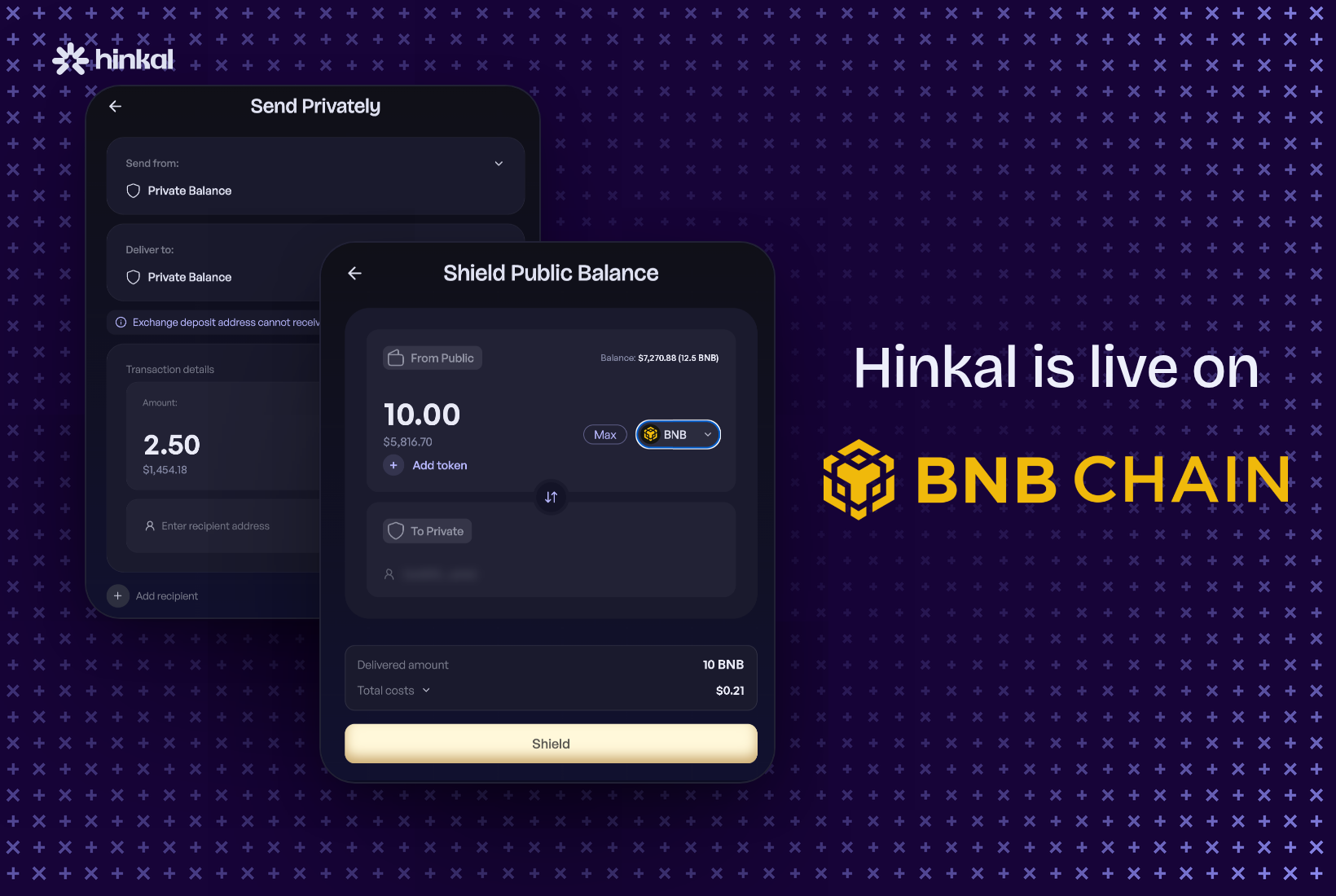
- Native confidential settlement across Ethereum, Solana, Tron, Polygon, Arbitrum, Base, and Optimism
- Shields all three critical data points: sender identity, recipient identity, and transaction amount
- Privacy-preserving KYC via ZK-TLS through Reclaim Protocol, proves verification without revealing identity
- Chainalysis KYT integration blocking flagged wallets at the deposit level
- Selective disclosure via viewing keys for auditor and regulatory access
- Zero recipient setup, counterparties connect existing wallets to access confidential balances
- $400M+ private volume processed with 6 independent security audits
Product Suite:
- Confidential Payments SDK: Enterprise integration for private settlement, payouts, and treasury flows
- Hinkal Pay: Transforms any transfer into a confidential transaction for stablecoin payments
- Hinkal Wallet: Multichain wallet shielding balances and transaction history
Compliance Architecture:
Hinkal differentiates from purely confidential systems through three compliance features:
- Viewing Keys: Enable revealing full or partial transaction history to auditors, regulators, exchanges, or internal compliance teams
- KYT Enforcement: Chainalysis integration prevents tainted funds from entering
- Custom Pool Deployments: Heavily regulated entities can deploy dedicated pools with configurable compliance logic and optional master-key visibility
Enterprise Use Cases:
Hinkal serves specific institutional workflows:
- PSP Settlement: Route merchant funds to confidential balances without exposing volumes or counterparty relationships
- OTC Desk Operations: Settle bilateral trades without broadcasting trade volume or wallet patterns
- Payroll Platforms: Pay employees and contractors without revealing sender treasury wallet or amounts
- iGaming Payouts: Execute confidential payouts where recipients access funds with no public trace
- Treasury Operations: Move capital and rebalance liquidity without signaling strategy
Why Hinkal Leads for Enterprise Confidential Settlement:
The combination of multi-chain native support, production-ready products, and compliance architecture positions Hinkal as the complete solution for enterprises requiring operational confidentiality today, not infrastructure for future custom development.
Integration partners include MPCVault, Utila, Psalion, Request, omypayments, and Aquanow, demonstrating enterprise adoption across custody, payments, and trading verticals.
For treasury teams evaluating confidential settlement, schedule a demo to see Hinkal's SDK and product capabilities.
2. Fhenix
Fhenix brings fully homomorphic encryption to Ethereum rollups, enabling confidential smart contract execution on Arbitrum and Base through its CoFHE (Collaborative FHE) architecture.
Key Features:
- FHE-based confidential computation built on Zama's TFHE-rs library
- Optimized for Arbitrum and Base rollup environments
- $22M in funding for development
- CoFHE system enabling encrypted computation across contracts
- Developer-focused tooling for building confidential applications
Technical Approach:
Fhenix extends Zama's FHE primitives specifically for rollup architectures:
- Encrypted data remains encrypted during computation
- Smart contracts operate on ciphertext without decryption
- Results decrypt only for authorized parties
- Optimized for L2 gas economics
Use Cases:
- Confidential DeFi applications on Arbitrum or Base
- Encrypted smart contract development requiring FHE capabilities
- Projects building on Zama's technology stack with rollup-specific needs
3. Inco Network
Inco Network positions as a confidentiality-as-a-service solution, combining FHE, trusted execution environments (TEE), and multi-party computation (MPC) in a modular architecture.
Key Features:
- Hybrid encrypted computation using FHE, TEE, and MPC
- Modular architecture deployable across Cosmos and EVM chains
- $4.5M in funding for development
- Cross-chain functionality via IBC protocol
- Focus on gaming applications
Technical Approach:
Inco's modular design enables:
- Confidential randomness for gaming applications
- Hidden game state preventing front-running and manipulation
- Cross-chain confidential data transmission
- Flexible deployment across supported networks
Use Cases:
- On-chain gaming requiring confidential randomness
- Applications needing hidden state mechanics
- Projects requiring modular confidentiality across Cosmos ecosystem
4. Railgun
Railgun operates as a privacy solution enabling confidential DeFi interactions through shielded balances and zero-knowledge proofs.
Key Features:
- Shielded token balances for confidential holdings
- Zero-knowledge proof verification for transactions
- DeFi compatibility for swaps and interactions
- Multi-chain deployment across select EVM networks
Technical Approach:
Railgun uses zero-knowledge cryptography to:
- Shield token balances from public observation
- Enable confidential transfers between shielded addresses
- Support interactions with external DeFi applications
- Verify transactions without revealing details
Use Cases:
- Individual users seeking confidential DeFi participation
- Projects requiring shielded token functionality
- DeFi interactions where balance privacy matters
5. Mind Network
Mind Network applies fully homomorphic encryption to AI and decentralized application infrastructure, enabling computation on encrypted data without exposure.
Key Features:
- FHE-based encrypted computation for AI workloads
- $2.5M from Binance Labs for development
- Focus on AI agent and decentralized compute scenarios
- Testnet phase with mainnet development ongoing
Technical Approach:
Mind Network targets the intersection of FHE and AI:
- Encrypted inference preserving data privacy
- Secure computation for AI model interactions
- Decentralized infrastructure for FHE workloads
Use Cases:
- AI applications requiring encrypted inference
- Decentralized compute with privacy requirements
- Projects at the FHE and AI convergence
6. Privasea
Privasea combines AI and FHE technology to enable privacy-preserving machine learning and decentralized AI network operations.
Key Features:
- FHE-based privacy for AI model execution
- $5M from Binance Labs for development
- Genesis NFT program for network participants
- Focus on privacy-preserving AI infrastructure
Technical Approach:
Privasea targets AI-specific privacy scenarios:
- Encrypted machine learning model execution
- Privacy-preserving inference for AI applications
- Decentralized AI network with FHE integration
Use Cases:
- AI applications requiring model privacy
- Privacy-preserving machine learning deployments
- Projects building at the AI and FHE intersection
The Zama Reality: Why Enterprises Seek Application-Ready Alternatives
Zama provides foundational FHE infrastructure that powers much of the blockchain confidentiality ecosystem. Understanding Zama's role clarifies why enterprises often need application-ready alternatives.
Zama's Infrastructure Strengths:
- Core FHE libraries: TFHE-rs and fhEVM enable encrypted computation
- Research leadership: Strong cryptographic credentials and industry recognition
- Ecosystem adoption: Approximately 90% of FHE projects use Zama infrastructure
- Strong capitalization: Substantial funding supporting development
Why Zama Alone Doesn't Serve Enterprise Treasury Needs:
Infrastructure versus Products: Zama offers developer libraries, not treasury tools. Enterprises need settlement products, not encryption primitives to build from.
Chain Ecosystem: Zama's focus on EVM chains while significant stablecoin settlement volume occurs across multiple ecosystems including Solana and Tron.
Performance Reality: Current FHE computation operates at 20 TPS with targets of 1,000+ in 2026. For enterprises needing confidential settlement today, zkSNARK-based solutions like Hinkal operate at standard blockchain speeds.
Compliance Architecture: Zama provides encryption primitives but not the viewing keys, KYT integration, or selective disclosure that regulated enterprises require.
Development Timeline: Building enterprise-grade confidential settlement on Zama infrastructure requires significant engineering investment and time, resources better allocated to core business operations.
Why Hinkal is The Best Alternative for Zama
For enterprises evaluating Zama infrastructure and seeking production-ready confidential settlement, Hinkal delivers immediate operational value through several key differentiators:
Production-Ready Products vs. Infrastructure Libraries
While Zama provides FHE primitives requiring custom development, Hinkal offers production-ready products: Hinkal Pay for instant confidential transfers, the Confidential Payments SDK for enterprise integration, and Hinkal Wallet for multichain confidential operations. Treasury teams can deploy confidential settlement workflows immediately without engineering overhead.
Multi-Chain Native Support
Zama's EVM focus creates gaps for enterprises operating across Solana, Tron, and other high-volume stablecoin ecosystems. Hinkal operates natively on Ethereum, Solana, Tron, and Polygon plus EVM chains like Arbitrum, Base, and Optimism, supporting settlement wherever counterparties transact without network migration.
Compliance Architecture for Regulated Institutions
Enterprises cannot adopt solutions that conflict with AML/CFT obligations. Hinkal integrates Chainalysis KYT at the contract level, provides selective disclosure via viewing keys for auditors and regulators, and enables privacy-preserving verification through ZK-TLS. This compliance foundation makes confidential settlement viable for regulated institutions.
Zero Recipient Setup Eliminates Adoption Friction
Traditional confidential payment solutions require recipients to complete onboarding, create new wallets, or integrate custom infrastructure. Hinkal enables senders to route funds to recipients' confidential balances where counterparties simply connect their existing wallet to access funds. No migration, no setup, no integration required. This frictionless experience drives adoption across PSPs, payroll platforms, and OTC desks.
Proven Scale and Security
Hinkal has processed $400M+ in volume with 6 independent security audits, demonstrating production reliability. Where FHE-based alternatives remain in testnet or early mainnet phases with performance constraints, Hinkal operates at standard blockchain speeds today.
Enterprise Integration Partners
MPCVault, Utila, Psalion, Request, omypayments, and Aquanow have integrated Hinkal for confidential settlement across custody, payments, and trading verticals, validation from enterprises with actual treasury operations.
For treasury teams requiring confidential settlement across existing chains with compliance controls and zero recipient friction, Hinkal provides the complete solution that Zama's infrastructure alone cannot deliver. Schedule a demo to see production-ready confidential settlement in action.
Frequently Asked Questions
What makes Hinkal a suitable alternative to Zama for enterprise confidentiality?
Zama provides FHE infrastructure, developer libraries and encryption primitives for building confidential applications. Hinkal provides production-ready confidential settlement products that enterprises can deploy today. Where Zama requires significant custom development to build treasury workflows, Hinkal offers Hinkal Pay, the Confidential Payments SDK, and Hinkal Wallet for immediate integration. Additionally, Hinkal operates natively across Ethereum, Solana, Tron, and Polygon; chains where Zama's EVM-focused infrastructure cannot reach.
How does Hinkal ensure compliance without sacrificing transaction confidentiality?
Hinkal integrates three compliance features: selective disclosure via viewing keys enables revealing full or partial transaction history to auditors, regulators, or internal compliance teams on demand; KYT enforcement via Chainalysis blocks flagged wallets at the deposit level before tainted funds can enter; and Integrity Check verification uses zero-knowledge proofs through Reclaim Protocol, enabling users to prove verification status without revealing identity data. This architecture satisfies AML/CFT requirements while preserving operational confidentiality.
Can existing wallets and payment infrastructure integrate with Hinkal?
Yes. This represents one of Hinkal's primary differentiators. Enterprises maintain their existing custody arrangements and wallet infrastructure. Recipients connect their existing wallet to access confidential balances without any setup, migration, or new wallet creation. The SDK integrates with existing products, and Hinkal Pay works with any wallet. This zero-setup approach eliminates the adoption friction that typically prevents confidential payment adoption.
What specific financial data points does Hinkal shield?
Hinkal shields all three critical data points that define complete transaction confidentiality: sender identity (which wallet initiated the settlement), recipient identity (which counterparty received funds), and transaction amount (the value transferred). Most alternatives protect only one dimension, obscuring the sender but exposing the amount, for example, which leaves enough data visible for competitors to map volumes and relationships.
Is Hinkal custodial, or do users retain control of their assets?
Hinkal is non-custodial. Hinkal never stores, sends, or receives funds or cryptoassets. Users retain control via their private keys at all times, which Hinkal never accesses. Hinkal operates as confidentiality for settlement flows, not as an intermediary, custodian, or broker-dealer. This architecture limits liability while ensuring enterprises maintain full asset control throughout confidential settlement workflows.
How does Hinkal accommodate recipients who are not already Hinkal users?
When a sender routes funds through Hinkal, it creates a confidential balance linked to the recipient's existing wallet address. The recipient simply connects their existing wallet, no prior Hinkal account, no new wallet, no integration required. This "one button, frictionless flow" applies across all verticals: PSPs settling with merchants, companies paying employees, OTC desks settling with counterparties, and iGaming operators paying recipients. The recipient sees their confidential balance and can execute payouts from it using their existing wallet.





























































.png)
.png)











.webp)