Inco Network has positioned itself as a confidentiality solution for public blockchains from investors including a16z Crypto Startup Accelerator, Coinbase Ventures, and Circle Ventures. However, with Inco still operating in testnet on Base, enterprise decision-makers evaluating confidential settlement solutions need proven, production-ready alternatives. This guide examines six platforms that address the core challenge of protecting sensitive financial data on public blockchains, with Hinkal emerging as the clear choice for institutions requiring immediate deployment, compliance-ready architecture, and multi-chain support without operational disruption.
Key Takeaways
- Production readiness separates enterprise solutions from experimental projects: Hinkal has processed over $400M in volume with proven audited uptime, while Inco remains in testnet. Choose based on whether you need proven infrastructure or can wait for emerging technology to mature.
- True confidentiality requires shielding three data points: Hinkal protects sender identity, recipient identity, and transaction amount simultaneously. Solutions that shield only one dimension still expose enough data for competitors to map volumes and counterparty relationships.
- Compliance architecture determines institutional viability: Hinkal integrates selective disclosure via Viewing Keys and KYT enforcement through Chainalysis, enabling regulatory compliance without sacrificing confidentiality. Critical for PSPs, OTC desks, and treasury teams operating under AML/CFT requirements.
- Zero recipient-side setup eliminates adoption friction: With Hinkal, recipients connect their existing wallet and see their confidential balance immediately. No migration, no new wallet installation, no integration required on the recipient side.
- Multi-chain compatibility preserves existing infrastructure: Hinkal operates across Ethereum, Solana, Tron, Polygon, Base, Arbitrum, and Optimism without requiring network migration or custody changes.
1. Hinkal: Enterprise-Grade Confidential Settlement for Production Environments
Hinkal stands as the only confidential settlement solution designed specifically for institutional workflows, combining proven scale with compliance-ready architecture that enables immediate deployment across existing blockchain infrastructure.
Key Features:
- Complete confidentiality: Shields all three critical data points (sender identity, recipient identity, and transaction amount) while maintaining verifiable settlement on-chain
- Multi-chain deployment: Operates across Ethereum, Solana, Tron, Polygon, Base, Arbitrum, and Optimism without requiring network migration
- Zero recipient setup: Recipients connect their existing wallet to access their confidential balance. No new wallet, no migration, no recipient-side integration required
- Compliance controls: Selective disclosure via Viewing Keys, KYT enforcement through Chainalysis integration, and custom pool deployments for regulated entities
- Integrity Check verification: ZK-TLS method via Reclaim Protocol enables users to prove verification status without revealing identity data
- Proven track record: $400M+ in volume processed with 6 independent security audits
Product Suite:
- Confidential Payments SDK: Enterprise integration enabling private settlement, payouts, and treasury flows without changing custody arrangements
- Hinkal Pay: Transforms any transfer into a confidential transaction for stablecoin settlements without exposing balances or wallet history
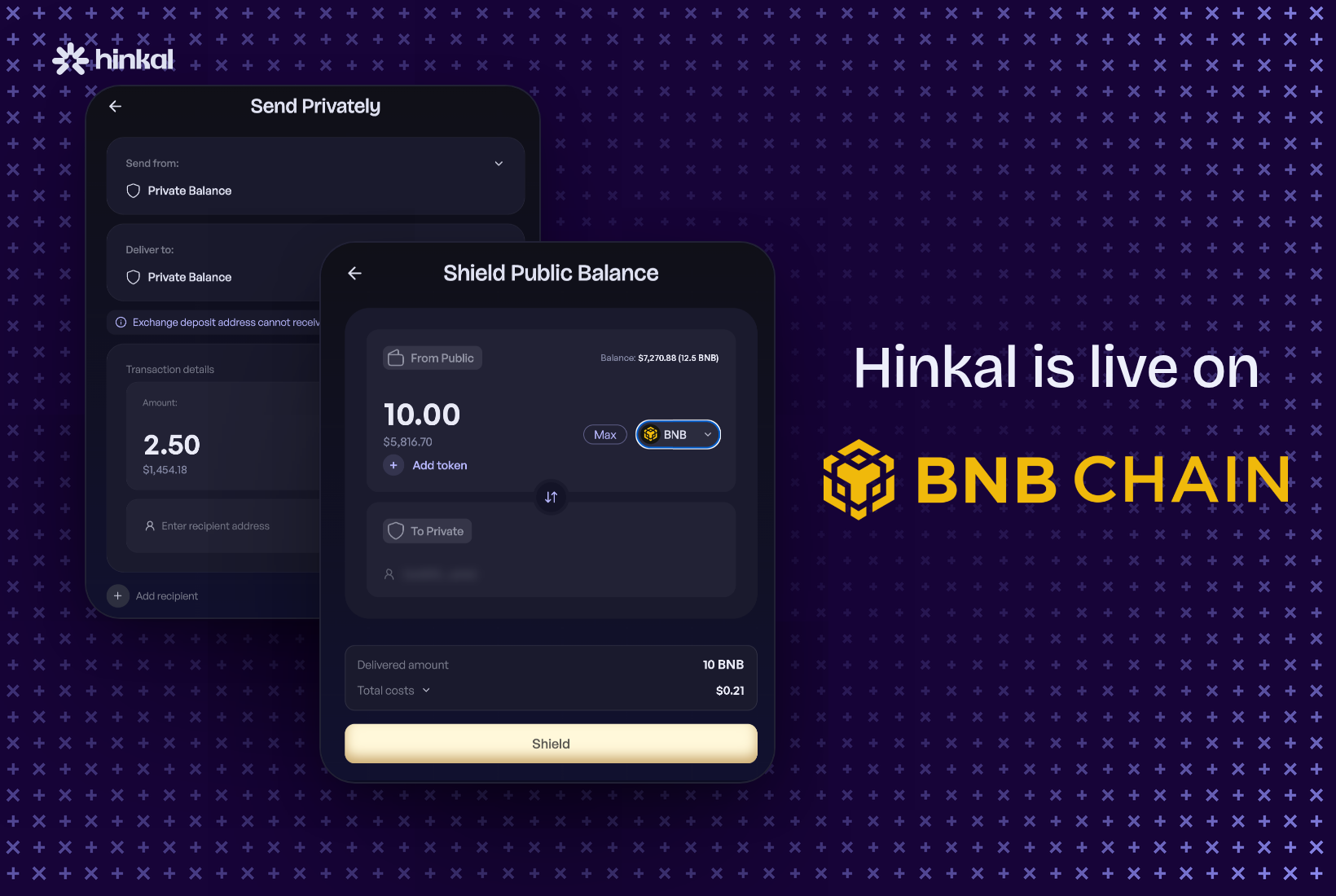
- Hinkal Wallet: Multichain wallet shielding balances and transaction history while enabling swaps and transfers
Ideal Use Cases:
- Payment Service Providers: Settle merchant funds without exposing merchant economics, counterparty relationships, or operational playbooks
- OTC Desks: Route settlement funds to counterparty confidential balances without revealing trade volumes or wallet patterns
- Payroll and Treasury: Execute recurring payments without broadcasting sender treasury wallet, amounts, or commercial relationships
- iGaming Operators: Process payouts where recipients access funds with no public trace and no new wallet required
For enterprise teams evaluating institutional use cases, Hinkal's architecture is self-custodial. The protocol never holds or controls user assets. Users retain full control via their private keys, which Hinkal does not access.
2. Aztec Network
Aztec Network has established itself within the Ethereum ecosystem, raising $171.6M in funding. Its Alpha mainnet launched in April 2026. The platform focuses on bringing confidentiality to Ethereum through zero-knowledge proof technology.
Key Features:
- ZK-SNARK/ZK-PLONK technology: Advanced zero-knowledge proof implementations for transaction privacy
- Ethereum L2 integration: Native integration with Ethereum's security model
- Hybrid public/private states: Flexibility for mixed data in the same contract
- Noir programming language: Custom DSL for writing confidential smart contracts
- Active community: 17,000+ nodes connected to the testnet with 556 million AZTEC tokens staked shortly after launch
3. Secret Network
Secret Network represents one of the longest-operating confidential blockchain environments, with its mainnet live since 2020. The platform uses Trusted Execution Environments (TEE) with Intel SGX to enable confidential computation.
Key Features:
- 5+ years mainnet operation: Security track record since 2020
- TEE-based architecture: Intel SGX for confidential smart contract execution
- Cosmos IBC integration: Native interoperability within the Cosmos ecosystem
- Confidential AI focus: Partnerships with private AI projects and AMD SEV-SNP integration
- Active ecosystem: Established dApps including SecretSwap and partnerships with DataHaven, Unbound Science, and Wunder
4. Aleo
Aleo launched its mainnet in September 2024 with over $200M in funding and a distinctive approach combining zero transaction fees with regulatory compliance tools.
Key Features:
- Zero transaction fees: Off-chain execution model eliminates gas costs
- Predicate Platform: Built-in OFAC screening and programmable compliance policies
- ZK-SNARK (ZEXE) technology: Advanced zero-knowledge proof implementation
- Leo programming language: Custom language for writing private applications
- Strong institutional backing: Funding from a16z, SoftBank, and partnerships with Circle, Paxos, and Binance Alpha
5. Manta Network
Manta Network provides privacy capabilities within the Polkadot ecosystem, with a market capitalization ranging from $30-94M.
Key Features:
- ZK-SNARK technology: Zero-knowledge proof implementation for transaction privacy
- Polkadot substrate: Native integration with Polkadot's cross-chain architecture
- EVM compatibility: Supports Solidity smart contracts
- Active mainnet: Operational with established user base
6. Railgun
Railgun focuses on enabling private transactions within decentralized finance applications, with reported TVL of $800M.
Key Features:
- DeFi integration: Designed for private swaps, lending, and yield farming
- Zero-knowledge proofs: Cryptographic privacy for transaction details
- Multi-chain presence: Operates across several EVM-compatible networks
- Smart contract architecture: Privacy-preserving interactions with DeFi protocols
Why Enterprise Teams Evaluate Inco Alternatives
Inco Network's approach using TEE with planned FHE/MPC addresses real confidentiality needs on public blockchains. However, several factors drive enterprise buyers to evaluate proven alternatives:
Production Readiness: Inco operates in testnet on Base with beta on Solana Devnet. Enterprise treasury operations, PSP settlements, and OTC desk workflows require production-ready infrastructure with proven track records.
Compliance Architecture: Organizations operating under AML/CFT regulations need selective disclosure capabilities for auditors and regulators. Hinkal's compliance framework with Viewing Keys and Chainalysis KYT integration addresses these requirements today.
Multi-Chain Requirements: While Inco plans multi-chain expansion, enterprises already operating across Ethereum, Solana, Tron, and Polygon need solutions that work across their existing infrastructure immediately.
Recipient Experience: Hinkal's zero-setup recipient model, where counterparties connect their existing wallet to access confidential balances, eliminates adoption friction that enterprise settlement workflows cannot tolerate.
Why Hinkal is The Best Alternative for Inco
While Inco Network pursues an ambitious vision combining TEE with planned FHE/MPC capabilities, Hinkal delivers production-ready confidential settlement today with proven institutional adoption.
Immediate Production Deployment: Hinkal has processed over $400M in private on-chain volume with 6 independent security audits and years of operational uptime. Enterprises cannot wait for testnet projects to mature when settlement confidentiality is required now.
Compliance-Ready Architecture: Hinkal integrates selective disclosure via Viewing Keys and KYT enforcement through Chainalysis from day one. Organizations operating under AML/CFT requirements need this compliance framework operational, not planned for future releases.
Multi-Chain Operation Today: Hinkal operates across Ethereum, Solana, Tron, Polygon, Base, Arbitrum, and Optimism without requiring network migration or custody changes. Enterprises already operating across multiple chains need solutions that work with their existing infrastructure immediately.
Zero-Friction Recipient Experience: Recipients connect their existing wallet and access confidential balances with no migration, no new wallet installation, and no integration. This eliminates the adoption barriers that prevent enterprise settlement workflows from scaling.
Self-Custodial Security: Hinkal never holds or controls user assets. Users maintain full control via their private keys, which Hinkal does not access. This self-custodial model aligns with institutional security requirements while adding confidentiality to settlement.
For teams ready to implement confidential settlements across production workloads, schedule a demo with Hinkal to explore how the Confidential Payments SDK integrates with your existing custody arrangements and payment rails.
Frequently Asked Questions
How does Hinkal's approach to transaction confidentiality differ from traditional privacy solutions?
Hinkal is architected for enterprise settlement workflows, not general-purpose privacy. The protocol shields all three critical data points (sender identity, recipient identity, and transaction amount) while maintaining verifiable settlement on public blockchains. Unlike purely cryptographic approaches, Hinkal integrates compliance controls including selective disclosure via Viewing Keys and KYT enforcement through Chainalysis, blocking flagged wallets at the deposit level. This compliance-ready architecture positions Hinkal for institutional adoption where regulatory requirements mandate both confidentiality and auditability.
Can enterprises use Hinkal without migrating to a new blockchain or changing their existing wallets?
Yes. Hinkal operates as confidential settlement technology across chains enterprises already use: Ethereum, Solana, Tron, Polygon, Base, Arbitrum, and Optimism. Users maintain existing wallets and custody arrangements. The sender routes funds through Hinkal's smart contract into a confidential balance linked to the recipient's existing wallet. The recipient connects their existing wallet and sees the confidential balance. No migration, no new wallet, no integration required on the recipient side.
What specific data points does Hinkal shield from public view, and why are all three important?
Hinkal shields sender identity, recipient identity, and transaction amount. Most alternatives shield only one or two dimensions, but partial confidentiality still exposes critical business intelligence. If competitors can see transaction amounts, they can map volumes. If they can see recipient addresses, they can identify counterparty relationships. Shielding all three data points simultaneously prevents observers from reconstructing commercial relationships, settlement patterns, or treasury strategy from on-chain data.
How does Hinkal ensure compliance with regulations like AML/CFT while maintaining user confidentiality?
Hinkal provides three compliance mechanisms. First, selective disclosure via Viewing Keys enables revealing full or partial transaction history to auditors, regulators, exchanges, or internal compliance teams on demand. Second, KYT enforcement via Chainalysis blocks flagged wallets at the deposit level, preventing sanctioned funds from entering. Third, for interactions over $1,000, the Integrity Check uses zero-knowledge proofs via Reclaim Protocol. Users prove verification status without revealing identity data. Hinkal receives only a cryptographic proof confirming verification, never seeing names, IDs, or personal documents.
Is Hinkal a custodial service, or do users maintain full control of their funds?
Hinkal is fully self-custodial. The protocol never stores, sends, or receives funds or cryptoassets. Users retain control via their private keys, which Hinkal does not access. The company explicitly states it is not a broker-dealer, KYC provider, intermediary, agent, advisor, or custodian. This self-custodial architecture means users maintain the same control they have with any direct blockchain interaction. Hinkal adds confidentiality to the settlement process without taking custody.
What's the difference between Hinkal Pay and Hinkal Wallet?
Hinkal Pay transforms any individual transfer into a confidential transaction, ideal for one-off settlements or continuous operations from a confidential balance. Hinkal Wallet provides continuous confidentiality for all account activity, maintaining a persistent confidential account that shields balances and transaction history while enabling swaps and transfers across multiple chains. Choose Hinkal Pay for transaction-level confidentiality; choose Hinkal Wallet for comprehensive, ongoing confidentiality across your entire portfolio.























































.png)
.png)




.webp)